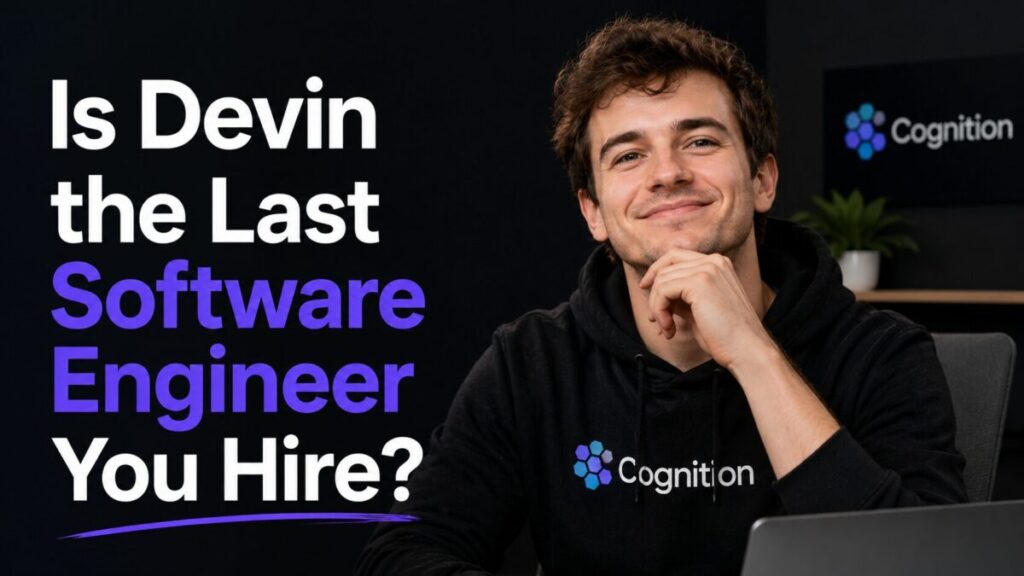
Most people still think of AI as a fancy autocomplete tool. You type, it suggests, and you accept or reject. That’s the version of AI that most developers have gotten used to. But Cognition AI is doing something that feels genuinely different. It is not suggesting the next line. It is writing the whole thing, shipping it, and then fixing the bugs. That is a very different conversation.
What Is Cognition AI?
Cognition AI is an applied AI company building software agents that can plan, reason, and execute full engineering tasks on their own. Founded in August 2023 by Scott Wu, Steven Hao, and Walden Yan, all three founders are gold medalists from the International Olympiad in Informatics. That is not a small detail. That pedigree is baked into how the company thinks about hard problems.
Based in San Francisco, Cognition AI started with one clear thesis: AI should not just help humans work. It should be capable of owning work entirely. The company has raised $806 million in total and hit a $9.8 billion valuation in 2025. And their revenue growth? We will get to that. But spoiler: it is the kind of number that makes other founders quietly uncomfortable.
So why does this matter to you? Because the gap between “AI helps me code” and “AI codes for me” is not just a technical gap. It is a business model gap. A hiring gap. A competitive gap. Cognition AI is betting everything on that gap being very, very wide.
What Is Devin AI – The World’s First AI Software Engineer?
Devin. Just the name caused chaos when it dropped in March 2024. Here is the kicker. Unlike every AI coding tool before it, Devin does not suggest lines or snippets. It plans, executes, and validates multi-step software tasks entirely on its own. It builds apps. It fixes bugs. It writes tests. It browses documentation. And it does all of this without someone holding its hand through every single step.
On the SWE-bench benchmark, the industry’s standard test for real-world coding performance, Devin resolved 13.86% of real GitHub issues end-to-end. That is a 7x improvement over previous AI models, which sat around 1.96%. Now, 13.86% sounds low. And honestly, on its own, it is. But stop and think about what it means for a machine to independently fix a real GitHub issue from start to finish, without a human in the loop. That was science fiction two years ago.
Cognition AI also released Devin 1.2 in early 2025, adding in-context reasoning improvements and voice command integration, allowing Devin to better analyze code repositories and reuse existing code where relevant. Then came Devin 2.0. A much bigger deal.
How Does Devin AI Actually Work?
Okay, let’s get practical. Because “autonomous AI engineer” sounds impressive at a conference. But what does it actually do when you give it a task?. The reality is, Devin does not just generate code and send it back to you like a fancy text editor. It works inside a sandboxed environment. A secure, isolated workspace where it can write code, run terminal commands, use a browser, and talk to external tools. All at once. All on its own.
Devin 2.0 introduced a cloud-based interactive IDE that lets you spin up multiple Devins working in parallel, each handling separate tasks at the same time. Think about what that actually means for a small team.
There is also a feature called Interactive Planning. It lets developers start with a rough, incomplete idea and collaborate with Devin to scope out a detailed task plan before any code is written. So you do not need to have everything figured out before you hand the work over. That is a thoughtful product decision. And the efficiency gains are real. According to Cognition AI’s own benchmarks, Devin 2.0 completes 83% more junior-level development tasks per Agent Compute Unit compared to the previous version. Not slightly better. Eighty-three percent better. Per unit of compute.
Short version: Devin thinks, plans, builds, tests, and iterates. You supervise. Or you do not. That choice is increasingly yours.
Cognition AI vs Other AI Coding Tools (Copilot, Cursor & More)
The honest comparison nobody wants to have is this: Devin and Cursor are not really competing for the same job. Cursor is excellent. At $20 per month for its Pro plan, most independent reviewers consider it the better daily coding partner for individual developers because of how naturally it fits into an existing workflow. Fast. Responsive. Feels like an extension of your brain.
But it is still assisting you. You are still the engineer. You are still making the calls. Cognition AI is going after something different entirely: autonomous end-to-end software development, where the agent owns execution across full workflows, not just individual lines.
As of 2025, 84% of developers are using or planning to use AI in their work. And $8.2 billion was invested in 2024 specifically in companies building autonomous software development solutions. The market has already made its bet. The question is just which layer of that market you sit in. So here is how to think about it simply. You use Cursor to go faster. You use Devin to go bigger. One helps you write the code. The other writes it for you while you focus on something else.
Is Devin AI Worth the Price? Plans and Pricing Explained
This is where things get real. Because for a long time, Cognition AI priced Devin in a way that basically said “this is for enterprises only, do not bother if you are a solo developer.” The original Devin cost $500 per month. Devin 2.0 dropped that entry price to $20 per month for the Core plan. That is a 96% reduction. Overnight, the tool went from something most developers could never justify to something anyone can try.
Here is how the plans currently break down:
The Core Plan is $20 per month. Pay-as-you-go Agent Compute Units, or ACUs. Good for individuals, freelancers, or small teams wanting to test things on lighter projects.
The Team Plan is $500 per month and includes 250 ACUs each month. Engineering managers get predictable costs and consistent workflows, and the plan includes API access for teams with more complex automation needs.
Enterprise pricing is custom. Built for larger organizations that need private, secure deployments.
ACUs measure the complexity and duration of what Devin is actually doing, including planning, debugging, context gathering, running code, and browser actions. Cognition AI says a typical frontend task runs about 1 to 2 ACUs.
Is it worth it? For enterprise teams buried in repetitive work, probably yes. For a solo developer just curious? The $20 plan is now a reasonable experiment. That is the point.
Can Devin AI Really Replace Software Developers?
Short answer: no. Not now. But also, let’s not pretend that is the whole story.
Goldman Sachs has been piloting Devin alongside their 12,000 human developers. Goldman Sachs. One of the most conservative, risk-averse institutions on the planet. That tells you something. But the reality is that independent tests paint a more grounded picture. In one real-world evaluation across 20 tasks, Devin failed 14 times, succeeded 3 times, and returned unclear results for 3 others. That is a long way from replacing anyone.
And here is what I think people miss in this conversation. The goal was never to fire your engineers. The goal is to change what engineers spend their time on. The tedious, well-defined, repetitive work? Devin takes that. The architecture decisions, the creative thinking, the judgment calls? Those still belong to humans.
Think less “replacement” and more “the best junior developer you have ever had, who never sleeps, never complains, and never asks for a raise.” That framing is far more accurate. And far less scary.
Cognition AI Funding, Growth and What is Next in 2025
The numbers here are just genuinely hard to ignore. Cognition AI’s recurring revenue went from $1 million in September 2024 to $73 million by June 2025. That is not a typo. That is 73x growth in under nine months.
They raised $400 million in a funding round led by Founders Fund, with Lux Capital, 8VC, and Elad Gil also participating. The round pushed the valuation to $10.2 billion.
Then came the Windsurf acquisition. In July 2025, Cognition AI signed a definitive agreement to acquire Windsurf, a popular AI-native IDE with agentic workflows built in. Smart move. It gives Cognition AI a direct line into daily developer workflows, not just the autonomous agent side of the market. Since buying Windsurf, Cognition AI’s annual recurring revenue has more than doubled. And the company is now reportedly in conversations about a funding round that could put its valuation at $25 billion.
The trajectory is steep. The product is still maturing. But Cognition AI has done something most AI companies only talk about: it built a thing people actually pay for, at scale, fast. That is the whole game. And right now, they are winning it.
Read about – Startup business models
Read in – Startup Directory
Read about Solo businesses

Hi Friends, This is Swapnil; I love reading and sharing knowledge. Currently working as a content writer at startupsunion.com. You all can hang out with me here.