What Is Catalyst Fund?
Catalyst Fund is a pan-African climate venture fund and venture builder. It backs early-stage startups fighting Africa’s toughest climate problems. The fund grew out of BFA Global’s impact accelerator program. The mission was simple: close the equity gap for climate adaptation ideas that everyone else was ignoring.
It’s based in Nairobi, Kenya. Four partners run the show: Maelis Carraro (founder and General Partner), Maxime Bayen, Olúwatóyìn Emmanuel-Olubake, and Amolo Ng’weno.
Here’s the thing most funds get wrong. They write a check and disappear. Catalyst Fund doesn’t do that. It pairs capital with real, hands-on support, working with founders from day one, not after things go sideways. The fund invests from pre-seed through Series A. Initial checks land between $200,000 and $300,000, aimed squarely at the sub-$500,000 range where founders are usually left scrambling on their own.
Catalyst Fund Raises $30 Million in Second Close
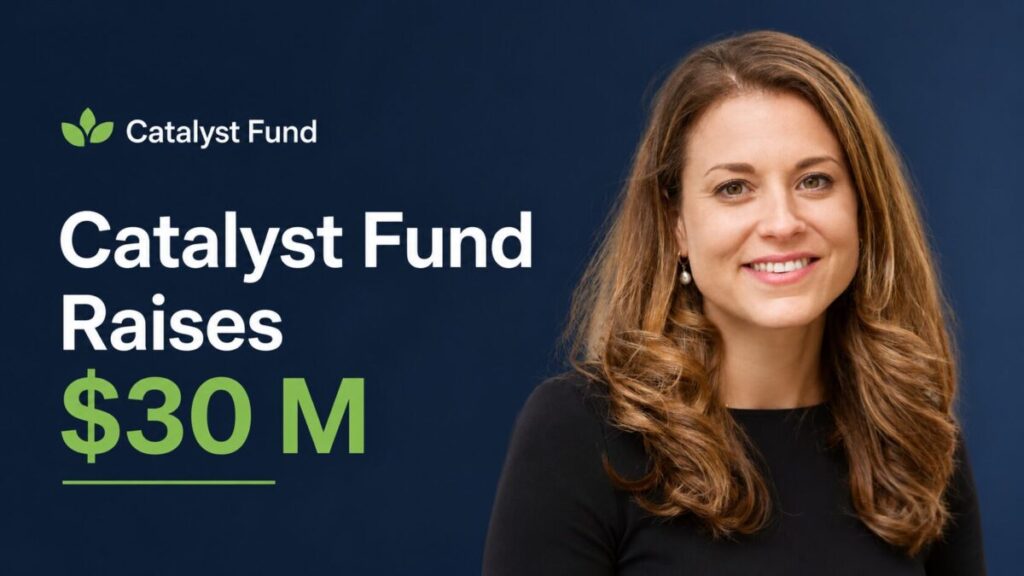
So here’s the update. Catalyst Fund just closed the second round of its debut fund, Catalyst Climate Resilience Fund I. Total commitments now sit at $30 million.
That’s real growth. The first close, back in Q3 2023, brought in $9 million. Now Catalyst Fund has secured $30 million total, and it’s within striking distance of a $40 million target.
The timing isn’t an accident. Climate tech funding across Africa took a hit in 2024, dropping to $754 million according to TechCabal Insights. Then it clawed back to $1.1 billion by November 2025. Carraro said climate tech made up 40% of all disclosed startup funding in 2025. That’s the highest share in five years. Let that sink in for a second.
Catalyst Fund expects to wrap its final close before year-end. And when that happens, the plan doesn’t change. More capital, same playbook: funding paired with the kind of operational support founders actually need.
Who Are the Investors Behind This Round?
The list of backers here is genuinely broad. New names include the International Finance Corporation (IFC), FASA (Financing for Agri-SMEs in Africa), Shell Foundation, Trafigura Foundation, Speedinvest, Blink Impact, and a group of private, high-net-worth individuals. The Women Entrepreneurs Finance Initiative (We-Fi) also came on board, specifically to grow the fund’s pipeline of women-led startups. FSD Africa and Cisco Foundation, both early believers from the first close, came back for round two.
FASA’s move is worth pulling apart. It put in $5 million in junior equity, structured as a first-loss position built to de-risk the fund for everyone else coming in behind it. FASA’s Investment Director, Mamadou Ndao, said the group picked Catalyst Fund because its venture-building model hits the exact gaps early-stage climate founders run into. On top of the capital, FASA also committed to giving technical support to the fund’s strongest agriculture-focused startups.
For Trafigura Foundation, this was its first impact investment, period. Director Dario Soto-Abril said the goal was to be catalytic, to help unlock capital for a space that’s still badly underfunded despite how urgent it is. Shell Foundation’s CEO, Jonathan Berman, said something similar. Climate shocks are already hitting millions of people across Africa. Founders building adaptation solutions need real support early, not later.
IFC’s Farid Fezoua, global director for disruptive technologies, services, and funds, put it plainly. The goal is to mobilize capital and expertise so these early-stage ventures can scale on their own terms and eventually attract private investors without leaning on development finance forever.
How Catalyst Fund Supports African Startups
Let’s be honest. Money alone doesn’t fix an early-stage startup’s problems. A lot of African founders get funded and then hit a wall. They have the capital but not the infrastructure to actually use it. That’s the exact gap Catalyst Fund built itself around.
Working with BFA Global, the fund pairs its checks with support that touches nearly every part of a company’s early life. Strategy. Hiring. Commercial traction. Partnerships. Getting ready for the next fundraise. It’s not passive. Catalyst Fund positions itself as a co-builder in the trenches with founders from the start.
It goes beyond equity too. The fund also helps its companies line up debt and grants, especially for research and development costs. Carraro has pointed out that equity alone rarely cuts it for climate companies, particularly the ones working in capital-heavy sectors like infrastructure or agriculture. These businesses often need a mix: venture capital, concessional finance, and non-dilutive funding, stitched together.
General Partner Maxime Bayen summed up where things are headed. Climate isn’t a side theme anymore. It’s touching agriculture, logistics, healthcare, financial services, and all of it. And investors are starting to see that businesses helping people adapt aren’t just doing good. They’re chasing large, growing markets with real commercial upside.
Catalyst Fund’s Portfolio Companies
Numbers are nice. But here’s what it looks like on the ground. Catalyst Fund has backed 28 startups across 10 African markets so far, spanning agriculture, food systems, energy, water, mobility, and climate fintech. It’s also made nine follow-on investments into its best performers.
A few names stand out. Keep It Cool, out of Kenya, builds solar-powered cold-chain infrastructure that helps fishers and poultry farmers cut down on post-harvest losses. It won the 2024 Earthshot Prize. That’s not a small thing. MazaoHub, based in Tanzania, uses AI and agronomy services to help smallholder farmers grow more with what they’ve got. Bekia, in Egypt, runs a recycling platform that connects households and businesses with waste collectors, keeping materials in the loop instead of the landfill.
Then there’s Octavia Carbon, a direct air capture startup out of Nairobi. It was recently named one of 16 winners in Tencent’s CarbonX program, earning a grant for pilot projects in Kenya. Carraro called it one of the strongest signals yet that Kenya is becoming a real hub for direct air capture technology.
Geographically, the fund’s activity is concentrated in Nigeria, Kenya, Egypt, and Tanzania. Kenya alone pulls in more than 70% of climate-focused startup funding on the continent, according to Carraro.
Why Climate Adaptation Startups Need More Funding
Here’s a number that should stop you for a second. Africa produces less than 4% of global carbon emissions. And yet it faces some of the harshest climate consequences anywhere on earth. Disrupted rainfall. Flooding. Droughts. Food insecurity is threatening hundreds of millions of people.
The funding gap backs this up too. Adaptation finance comes in at just $64 billion a year, out of roughly $2 trillion in total global climate finance. Most of that money still goes toward renewable energy and emissions reduction. Startups focused on resilience and adaptation are left fighting over scraps, even as the need for what they’re building keeps growing.
This imbalance is basically Catalyst Fund’s whole thesis. The startups tackling Africa’s climate resilience problems aren’t just doing impact work. They’re sitting on a real commercial opportunity too. Carraro has said climate adaptation is shaping up to be one of Africa’s defining investment themes for the next decade. The need is immediate. And the entrepreneurial talent building solutions for it is not in short supply.
What’s next for Catalyst Fund?
Right now, Catalyst Fund is focused on one thing: finishing its final raise before the year is out. Once it hits that $40 million target, the plan is to back around 40 ventures across Africa total, sticking with the pre-seed to Series A approach while keeping capital in reserve for its strongest performers.
The timing matters here. Venture funding across Africa has stayed fairly cautious since the highs of 2021 and 2022. But climate tech has held up better than most sectors. Investors are starting to treat adaptation as a long-term, structural opportunity, not a trend that fades once the news cycle moves on. That gives Catalyst Fund a solid runway heading into its final close.
For founders across the continent building practical solutions to real climate problems, this second close is a good sign. Serious capital, paired with actual operational support, is getting easier to find. And given how long adaptation-focused startups have been overlooked, that shift is worth paying attention to.
Sources used in this article:
- Catalyst Fund secures $30mn commitments for Africa climate resilience – CNBC Africa
- Catalyst Fund Secures $30 Million as It Nears $40 Million Target – Amplify Africa
- African Climate Tech Keeps Drawing Capital As Catalyst Fund Nears Target With $30M Close – TechBuild Africa
- Catalyst Fund nears $40 million target with second close – TechCabal
Read about – Startup business models
Read in – Startup Directory
Read about Solo businesses

Hi Friends, This is Swapnil; I love reading and sharing knowledge. Currently working as a content writer at startupsunion.com. You all can hang out with me here.
Obrigado! Nano Banana 2: / para arte com IA. Nano Banana 2
Solid write-up — learned a lot. Worth trying Pixwit — for all-in-one AI video.. Pixwit
This answered my questions. Also recommend WanVideoGen: for 480P–1080P Wan 3.0 generation.. WanVideoGen