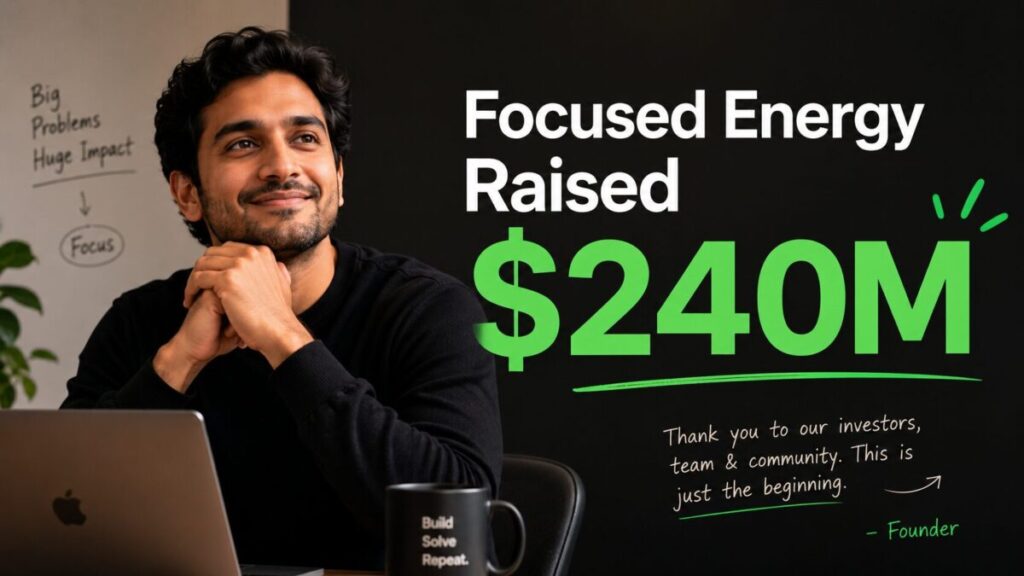
Let’s be honest. When most people hear “fusion energy,” they picture a whiteboard covered in equations and a scientist saying “give us 20 more years.” That story is old. When Focused Energy raised $240M in a Series A round, something shifted. This wasn’t a research grant. It wasn’t a government charity. It was real capital, from real investors, betting that laser fusion is ready to leave the lab and go industrial.
And that changes things.
What Is Focused Energy and What Does It Do?
Focused Energy is a German-American laser fusion company. It was founded in 2021 as a spin-off of the Technical University of Darmstadt, Germany. The CEO is Thomas Forner. Offices sit in Darmstadt, Berlin, Austin, and San Francisco. Here is the simple version of what they do. They fire powerful lasers at a tiny fuel pellet. That compression triggers nuclear fusion, the same process that powers the sun, releasing enormous amounts of clean energy.
Their specific technology is called the LightHouse architecture. It uses high-repetition-rate lasers alongside specially engineered fuel targets they call Pearl DT. The method is called direct-drive laser inertial fusion, and it is built directly on the physics proven at the National Ignition Facility in the United States.
So they are not starting from a theory. They are starting from a proven result and engineering it into something that can actually power a city.
Why Did Focused Energy Raise $240 Million?
The reality is, a lot of fusion startups raise money to keep doing research. Focused Energy raised $240M to stop being a research company. Forner said it clearly: “We are no longer just a research startup. We are an industrial energy company scaling the technology that will power the next century.”
That one sentence tells you everything about what this raise is for. It is about moving from a scientific proof-of-concept to an actual power plant. It is about hiring engineers who build things, not just scientists who publish papers. It is about regulatory approvals, site development, and commercial deployment.
And the timing matters. Europe has been through years of energy volatility. Energy security is now a political priority, not just an environmental one. Germany and the EU are actively looking for home-grown, carbon-free energy sources. Focused Energy walked into that moment with a technology that works and a plan to scale it.
That is why $240M made sense to the people writing the checks.
Who Invested in Focused Energy’s $240M Series A Round?
Look at this investor list and you’ll understand why this round is different from most. RWE, one of Europe’s largest energy utilities, led with $60 million and will play a direct role in developing the Biblis plant site. Then you have SPRIND, Germany’s Federal Agency for Breakthrough Innovation. The European Innovation Council Fund, which is the EU’s flagship deep-tech investment arm. And Prime Movers Lab, the previous lead investor, coming back in.
That is corporate capital, federal government money, European Union money, and venture capital. All in the same round. All behind the same company. That does not happen by accident. Each of those investors has their own process, their own due diligence, their own reasons for saying yes. For all of them to land in the same place means the science held up every time someone looked closely at it.
On top of the round itself, the state of Hesse added a 18.4 million euro grant through Minister Kaweh Mansoori specifically to fund the basic infrastructure of the Biblis hub. So when Focused Energy raised $240M, the number undersells the story. The real story is who stood behind it.
What Is Laser Fusion Energy and How Does It Work?
Okay, here is the part where most articles lose people. Bear with me, because this actually makes sense once you see it. Nuclear fusion joins two light atoms together. When they fuse, they release a huge amount of energy. No long-lived radioactive waste. No carbon. The fuel comes from hydrogen isotopes, and the raw material is effectively abundant in seawater.
In laser fusion, you fire incredibly powerful lasers at a small fuel pellet. The lasers compress and heat that pellet to conditions that exist at the core of the sun. That triggers the fusion reaction. The critical proof that this works came from the National Ignition Facility in the US, where scientists achieved net energy gain from laser fusion for the first time in history. That means the fusion reaction produced more energy than the lasers put in.
Here is the kicker. Laser fusion is currently the only fusion approach where that net energy gain has been scientifically verified. Every other method is still chasing that milestone. Focused Energy’s entire technology stack is built on top of those NIF results, using ex-NIF scientists who were in the room when it happened.
That is not a small thing.
Where Will the $240 Million Be Spent?
The former RWE nuclear power plant site in Biblis, Hesse, Germany. That is the answer. And the thinking behind that choice is actually smart. Building a new fusion facility from scratch means starting with zero infrastructure. Biblis already has grid connections, existing nuclear infrastructure, and decades of regulatory history. RWE brings expertise in handling exactly the kind of approvals that a fusion plant needs.
So instead of spending years and hundreds of millions just to get a site ready, Focused Energy walks into a site that already works. They are repurposing it. Rebuilding it for a different kind of nuclear reaction, but using everything that is already there. The plan for the capital includes building and testing the LightHouse modular fusion power plant, developing the high-repetition-rate laser systems, and setting up Biblis as what the company calls a global deep tech node for fusion industrialization.
The 18.4 million euro state grant from Hesse covers the basic infrastructure setup specifically, which means the $240M can go toward the technology itself. Focused Energy wants Biblis to be a blueprint. Build it once, prove it works, then replicate that model at decommissioned nuclear sites around the world.
Why Is This the Biggest Fusion Series A in History?
Short answer: no one has done this before at this scale with this level of commitment. When Focused Energy raised $240M, it became the largest fully secured Series A financing in the history of the global fusion industry. Not just in Germany. Not just in Europe. In the world.
It also makes Focused Energy the most valuable fusion company in Europe. To put that in context, most fusion Series A rounds have landed in the $50M to $100M range. Getting to $240M fully committed means every investor in the round had to independently decide the risk was worth it. There is no “we’ll figure it out later” in this round.
The broader market gives you a sense of the stakes. The global fusion energy market was valued at $347.48 billion in 2025 and is projected to reach $419.84 billion by 2030. Other companies are moving fast. Inertia Enterprises raised $450M in February 2026 for their laser fusion pilot. Marvel Fusion has secured 112.8 million euros in total.
But Focused Energy’s $240M fully committed Series A, backed by government, EU, corporate, and venture money together, stands as its own category. It is not just a record. It is a different kind of signal.
What Does This Mean for the Future of Clean Energy?
Here is what I think gets missed in most coverage of deals like this. The money matters less than what the money represents. For decades, fusion was the punchline. Always promising, never delivering. The joke was that commercial fusion is always 30 years away. And honestly? For a long time, that was fair.
But the reality is, that era is closing. NIF proved net energy gain. Focused Energy raised $240M to build the first industrial laser fusion site. Governments in Germany and across the EU are treating fusion as a strategic energy priority, not a research curiosity. RWE CEO Dr. Markus Krebber said Germany is well-positioned to take a leading global role in nuclear fusion thanks to its research ecosystem and companies like Focused Energy.
And if Biblis works? The model gets copied. Decommissioned nuclear sites exist across Europe and beyond. Every one of them is a potential future fusion site with infrastructure already in place. So the short version of this story is Focused Energy raised $240M. But the real version is longer. It is about a world that is finally taking fusion seriously, putting serious money behind it, and building the actual thing.
It is happening. And it is no longer 30 years away.
Read about – Startup business models
Read in – Startup Directory
Read about Solo businesses

Hi Friends, This is Swapnil; I love reading and sharing knowledge. Currently working as a content writer at startupsunion.com. You all can hang out with me here.