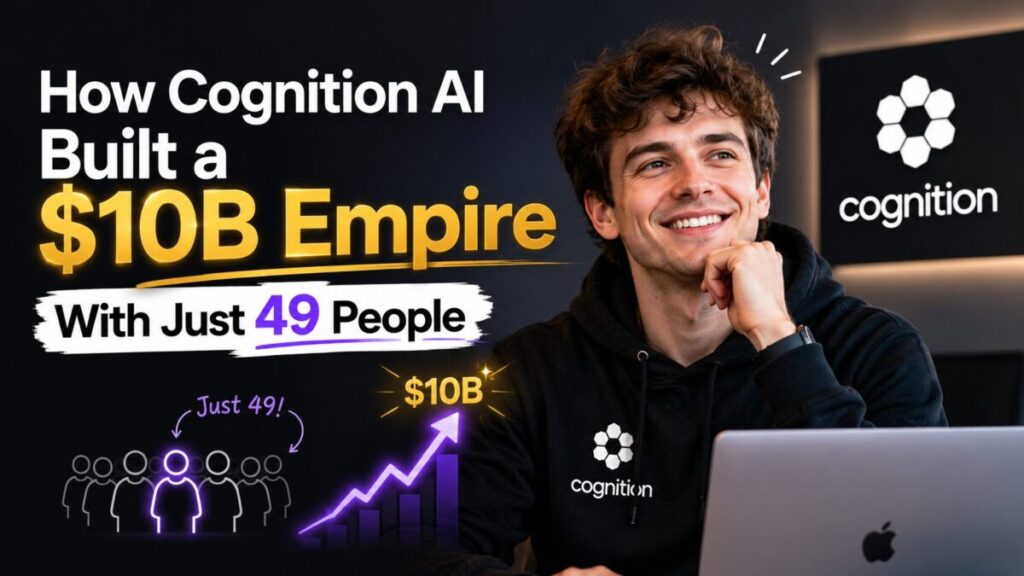
Every decade or so, something comes along that makes experienced engineers go quiet for a moment. Not out of fear exactly. More like recognition. Cognition AI is that kind of company. Founded with a simple but genuinely radical idea, it has raised nearly $700 million, landed enterprise clients most startups spend years dreaming about, and built one of the fastest-growing revenue curves in recent B2B software history. So what actually happened here?
How Cognition AI Started: Problem, Solution, and Target Audience
Here is the thing about software development that nobody likes to say out loud: it is brutally expensive and permanently understaffed. Companies hire engineers, engineers write code, and somewhere in the middle, deadlines slip, bugs pile up, and entire sprints get consumed by maintenance work that nobody wanted to do in the first place.
Traditional AI coding tools tried to fix this. They offered suggestions. Better autocomplete. Smarter tab-completion. Useful, sure. But you still needed a skilled engineer in the chair, reviewing every line, making every call. The bottleneck did not actually move.
The core thesis at Cognition was that software development is a reasoning-intensive task, and that building agents capable of long-horizon planning and tool use would unlock step-change improvements in how software is built. Not a better autocomplete. An agent that could own the whole job.
Founded in 2023 and based in San Francisco, the company stayed quiet until it was ready. Cognition emerged from stealth in March 2024 with its flagship product, Devin, positioning itself as a leader in applied AI for coding automation. Devin was not pitched as a helper. It was pitched as an engineer.
The target audience is not hobbyists. It is organisations that run on software. Startups trying to scale without tripling headcount. Mid-market tech companies buried under legacy code. Large enterprises wanting to automate the repetitive work that consumes junior developer hours. And it worked. Cognition’s growing user base now consists of names such as Goldman Sachs, Cisco, Palantir, and Mercado Libre.
Competitive Advantage
Let’s be honest, every AI startup claims it is different. Most are not. Cognition has earned the right to make that claim. Unlike copilots that assist human programmers, Devin executes entire software projects and resolves 13.9% of real-world GitHub issues end-to-end on SWE-bench, far outperforming GPT-4’s 1.7% and Claude 2’s 4.8% as of March 2024. Numbers like that are hard to argue with.
But the smarter move was the acquisition. In July 2025, the company acquired Windsurf, an AI-powered IDE and coding platform with tens of millions of dollars of ARR and hundreds of enterprise customers, bringing combined ARR into the approximately $150 million range. By owning both the agent and the development environment, Cognition stopped being a single product and started being a platform. That is a very different business.
And here is the kicker. While most AI companies are burning cash at frightening speed, Cognition kept it tight. Devin’s ARR grew from roughly $1 million in September 2024 to about $73 million by June 2025, while the company kept cumulative net burn under $20 million since founding. That kind of capital efficiency tells you a lot about how the founders think.
The company also offers secure workspaces and execution contexts that can be deployed via SaaS or in a customer VPC, enabling teams to integrate Devin into real engineering systems. For enterprise buyers, that flexibility is not a nice-to-have. It is a requirement.
Marketing Techniques
Cognition did not build its reputation by running ads. It built it by doing something genuinely impressive and letting people watch. The viral launch was no accident. A demo video showing Devin autonomously fixing a bug in an open-source library gained over 30 million views on X as of January 2026. Thirty million views. No ad budget required. The company also claimed Devin had passed real-world engineering interviews. That story spread itself.
Then there was the benchmark strategy. Rather than vague claims, Cognition published actual performance scores tied to SWE-bench, a real-world dataset of GitHub issues. Developers could verify, debate, and share those numbers. That drove organic conversation in exactly the communities that matter most.
And instead of chasing mainstream press first, Cognition built developer credibility from the ground up. API access, Slack integrations, early adopter communities. Developers who tested Devin became its most effective salespeople, sharing results on forums and social channels without being asked. The enterprise side benefited from warm capital relationships. Backed by Founders Fund, 8VC, and Khosla Ventures, introductions into large procurement cycles came with the territory.
How Cognition AI Makes Money
The model is usage-based SaaS, anchored around Agent Compute Units. The reality is, pricing tells you a lot about who a company is actually targeting at any given moment. When Devin launched, it cost $500 per month. That was a deliberate enterprise signal. Then Devin 2.0 changed the math. The self-serve lineup now reads: Free, Pro at $20/month, Max at $200/month, Teams at $80/month, and Enterprise at custom pricing. That price drop was not desperation. It was a deliberate push for broader developer adoption.
Enterprise customers pay custom amounts tied to dedicated infrastructure, VPC deployment, and proper SLAs. That is where the real revenue density lives.
And the Windsurf acquisition added a whole second leg. IDE seat licensing from individual developers and enterprise teams now runs alongside the Devin agent business. So when Cognition reports numbers, it is drawing from two distinct, complementary revenue streams. In 2025, Cognition AI’s revenue reached $80 million, up from $5.4 million in 2024. That is not a slow build. That is a sprint.
Market Share of Cognition AI
Here is some context worth sitting with. Cognition operates within the emerging generative AI coding assistants market, which was valued at $25.9 million in 2024 and is expected to grow to $97.9 million by 2030, reflecting a CAGR of 25.5%. Still early. Still forming. But the direction is clear.
Cognition ranks first amongst 157 active competitors in its segment, and stands first in terms of total funding among its competitors. Its challengers include GitHub Copilot (Microsoft), Amazon Q Developer, and Cursor. None have matched the combination of autonomous execution depth, enterprise traction, and capital position that Cognition currently holds.
As of April 2026, Cognition is in early financing talks targeting a $25 billion valuation, more than double its prior valuation of approximately $10.2 billion. Whether or not that round closes at that number, the direction of travel is obvious.
Business Model Canvas of Cognition AI
Key Partners: Founders Fund, 8VC, Khosla Ventures as capital backers. Enterprise anchor clients including Goldman Sachs, Cisco, and Palantir. OpenAI powering underlying model infrastructure.
Key Activities: Improving Devin’s autonomous reasoning. Maintaining the Windsurf IDE platform. Enterprise sales. Benchmark research to sustain technical credibility.
Key Resources: A team of 49 employees. Proprietary agent architecture. The Windsurf IDE acquired in July 2025. Significant cash reserves from total funding.
Value Propositions: Replacing or augmenting junior engineering roles. Faster software delivery. Continuous code execution without human fatigue. A secure, enterprise-grade agentic environment.
Customer Relationships: Self-serve onboarding for small teams. Dedicated account management and custom SLAs for enterprise. API integrations that let Devin operate inside existing workflows.
Channels: Direct SaaS via cognition.ai. Enterprise sales teams. Developer community and social media. Third-party integrations through Slack, GitHub, and the Windsurf ecosystem.
Customer Segments: Enterprise engineering teams, funded startups scaling development capacity, and individual developers.
Cost Structure: AI compute costs, engineering talent, cloud infrastructure, and post-acquisition Windsurf integration.
Revenue Streams: Tiered SaaS subscriptions (ACU-based), enterprise custom contracts, and Windsurf IDE seat licensing.
Conclusion: Is Cognition AI a Viable Business?
Short answer? Yes. But not without risk.
Cognition recorded continuous revenue increases since launch, including a jump from $1 million in recurring revenue in September 2024 to $73 million in June 2025. That pace of growth is rare in enterprise software. The Windsurf acquisition shows the founders are thinking beyond a single product. The enterprise clients prove real-world utility, not just demo magic.
But the competition is closing in fast. With GitHub Copilot, Windsurf, and Amazon Q Developer among others all offering free versions of their AI coding assistants, Devin 2.0 faces an increasingly tough set of competitors in a white-hot market. And the big model providers are not standing still. They are building agentic capabilities that could squeeze independent players over time.
The reality is, Cognition’s best asset is not Devin alone. It is the integrated stack it is building. The combination of agent plus IDE plus enterprise infrastructure is harder to copy than a single product. The company is not pitching a narrow coding assistant. Devin is marketed as a fully autonomous software engineer, a system that can take on end-to-end tasks rather than simply autocomplete lines or suggest snippets. That claim has made the company one of the most closely watched names in AI.
So is it viable? Yes. Is it guaranteed? Nothing ever is. But if autonomous agents do genuinely take over meaningful portions of software development, Cognition has positioned itself to be the platform that captures that shift. And right now, that bet looks pretty good.
Read about – Startup business models
Read in – Startup Directory
Read about Solo businesses

Hi Friends, This is Swapnil; I love reading and sharing knowledge. Currently working as a content writer at startupsunion.com. You all can hang out with me here.