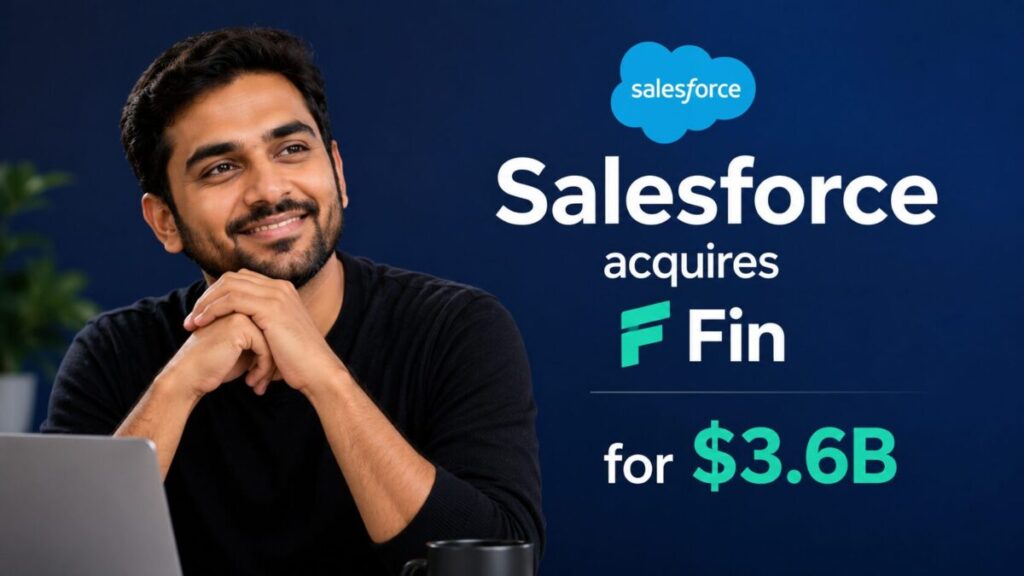
The customer service industry just got flipped upside down. Salesforce has announced it will acquire Fin, the AI-powered customer support agent built by Intercom, in a deal valued at $3.6 billion. One of the largest acquisitions in Salesforce’s history. And honestly, if you have been paying attention to where enterprise AI was heading, this should not surprise you. The Salesforce Fin acquisition is not a bet on the future. It is a confirmation that the future is already here.
What Is Fin and Why Did Salesforce Buy It?
Fin is an AI-powered customer support agent built by Intercom. Not a chatbot in the old-school sense. Not a scripted flow that sends users in circles. Fin uses large language models to actually understand what a customer is asking, pull from the company’s knowledge base, and respond with something useful.
The reality is, most companies have been burning money on support teams handling the same repetitive questions every single day. Fin was built to absorb that load. According to Intercom, Fin has been hitting resolution rates above 50% across thousands of businesses, meaning more than half of customer queries get resolved with zero human involvement.
So why did Salesforce buy it? Because building something like this from scratch takes years. Acquiring Fin means Salesforce gets a product that already works, a customer base that already trusts it, and a team that already knows how to scale it. The Salesforce Fin acquisition is not about vision. It is about speed.
Salesforce Pays $3.6 Billion for Fin: Deal Details Explained
Three point six billion dollars. Let that sit for a moment.
This puts the Salesforce Fin acquisition among the biggest deals Salesforce has made since buying Slack for $27.7 billion in 2021. But here is the kicker: Salesforce is not buying all of Intercom. The deal covers Fin as a standalone product, including the intellectual property, infrastructure, and the team behind it. Intercom itself continues to operate independently.
That distinction matters. Intercom keeps its broader customer messaging platform. Salesforce gets the AI agent that has been generating real, measurable business results.
The $3.6 billion price reflects what enterprise software buyers already know: production-ready AI that actually performs is rare. Anyone can demo a chatbot. Very few companies have shipped an AI support agent that resolves tickets at scale, in real business environments, day after day.
The deal is expected to close in Salesforce’s fiscal year 2026, pending regulatory approvals.
How Fin’s AI Customer Support Fits Into Salesforce’s Plans
Salesforce has been building something called Agentforce. Launched in late 2024, it is Salesforce’s platform for deploying autonomous AI agents across sales, service, marketing, and commerce. The goal is straightforward: let AI handle complex, multi-step business tasks with minimal human supervision.
Fin was the missing piece.
By bringing Fin into Agentforce and Service Cloud, Salesforce gets a customer service agent that enterprise customers can actually deploy from day one. Not a prototype. Not a pilot program. A working product. And for Salesforce customers, especially those running Service Cloud, this is genuinely significant. Instead of stitching together third-party tools, they can run Fin inside the environment they already use, connected directly to CRM data, case histories, and workflows.
The Salesforce Fin acquisition also sharpens the competitive picture. Microsoft has been pushing Copilot deep into Dynamics 365. ServiceNow has been aggressive with AI-driven automation. Salesforce needed a flagship AI service product. Now it has one.
What This Means for Intercom and the AI Support Industry
For Intercom, this is a defining moment. The company built something so good that a $200 billion company paid $3.6 billion to take it off their hands. That is not a failure. That is a very specific kind of success.
Intercom CEO Eoghan McCabe has called the deal a validation of what the team built. And to be fair, it is hard to argue with that framing. Fin now gets access to Salesforce’s global enterprise customer base, a distribution channel Intercom could not have replicated on its own in the same timeframe.
But let’s be honest about what it signals for the rest of the industry. If Salesforce is writing a $3.6 billion check for a single AI product, every serious enterprise software company is now under pressure to either build or buy their own AI service agent. Zendesk, Freshdesk, Zoho, they are all watching this deal very closely.
And for AI support startups? The ones with real resolution rates, real enterprise clients, and real performance data? Their valuations just went up. The Salesforce Fin acquisition set a new reference point for what capable AI agents are worth.
Will Fin Replace Human Customer Service Agents?
Here is the honest answer. Yes and no.
Fin is built for the high-volume, repetitive end of the support queue. Order status. Password resets. Product FAQs. Basic troubleshooting. The kind of tickets that eat four hours of an agent’s day and require almost no judgment to resolve. In those categories, Fin already performs at a level that rivals, and in some cases exceeds, human teams in terms of speed and consistency.
But that is not the whole picture of what support teams do.
Emotionally charged complaints, complex escalations, enterprise relationship management, situations where someone needs to feel genuinely heard, those are not Fin’s territory. At least not yet. The realistic outcome for most companies that deploy Fin at scale is a meaningful reduction in tier-one headcount, with existing agents shifting toward higher-complexity work.
Salesforce has been careful with its public messaging around the Salesforce Fin acquisition. The company frames it as augmentation, not replacement. Human agents become more effective because Fin handles the volume that was previously drowning them.
Whether that actually plays out that way inside real companies depends entirely on how leadership chooses to deploy it. Technology does not make that decision. People do.
How the Acquisition Affects Salesforce Customers and Businesses
If you are running on Service Cloud today, the Salesforce Fin acquisition is straightforwardly good news. You are getting access to an AI support agent that is already proven in production, integrated natively into the platform you are already paying for. No new vendor relationship. No separate contract negotiation. It just becomes part of the stack.
For businesses currently evaluating Fin as a standalone Intercom product, the calculus has shifted. Depending on where you are in that evaluation, you may want to understand how the roadmap and pricing will change once the deal closes.
Existing Intercom customers who use Fin should expect transition communication from both companies. The product is not going away. But its pricing, roadmap, and support structure will evolve as Salesforce absorption progresses.
Pricing details for Fin inside Salesforce have not been announced officially. Enterprise customers should expect it to be packaged within Agentforce or offered as a Service Cloud add-on.
Salesforce’s Big Bet on AI: What Comes Next After Fin
The Salesforce Fin acquisition is not the finish line. It is the starting gun for the next phase.
Salesforce is building toward something specific: a complete AI-powered operating layer for enterprise customer operations. Agentforce is the platform. Fin is the customer service anchor. What comes next is deeper integration across Salesforce Data Cloud, MuleSoft, and Tableau, AI agents that do not just answer questions but identify patterns, trigger workflows, and surface decisions before a human even knows there is a problem to solve.
The $3.6 billion makes sense if it drives Agentforce adoption, locks in Service Cloud renewals, and wins competitive deals against Microsoft and ServiceNow.
So here is where we land. Salesforce is not testing AI anymore. The Salesforce Fin acquisition is a statement of intent. The company is positioning itself to be the default infrastructure for how enterprises run customer operations in an AI-first world.
And they are willing to spend three and a half billion dollars to make sure they get there first.
Read about – Startup business models
Read in – Startup Directory
Read about Solo businesses

Hi Friends, This is Swapnil; I love reading and sharing knowledge. Currently working as a content writer at startupsunion.com. You all can hang out with me here.