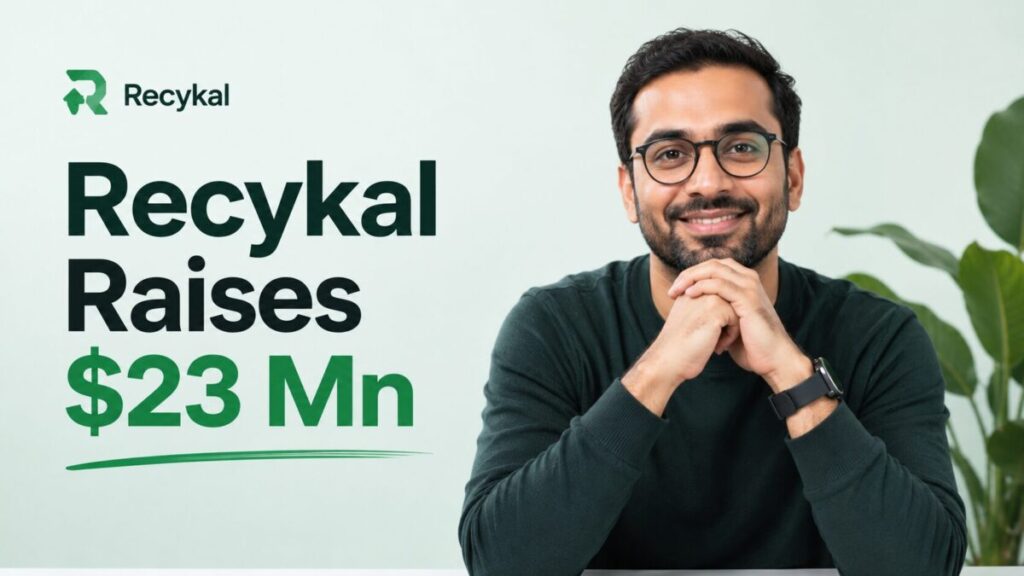
India’s waste problem is not a future crisis. It is happening right now. The country generates over 26,000 tonnes of plastic every single day, with barely 60% of it getting collected. E-waste is piling on another 1.2 million tonnes annually. And the infrastructure to process all of this at scale? Barely there.
That is the gap Recykal has been filling since 2016. And now, with a fresh $23 Mn bridge funding round closed, the Hyderabad-based cleantech startup is moving faster than ever. Not just to fix India’s waste problem. But to take the solution global.
What Is Recykal and What Does It Do?
Most people hear “waste management” and think trucks, landfills, and the smell of rotting garbage. Recykal thinks of it as a data problem.
The company has built tech-led platforms to boost the circular economy through a managed marketplace for secondary raw materials, an Extended Producer Responsibility (EPR) compliance platform, and a digital deposit refund system designed to drive behavioral change.
Founded in 2016 by Abhay Deshpande, Abhishek Deshpande, Ekta Narain, Vikram Prabakar, and Anirudha Jalan, Recykal is a cleantech platform that aims to digitize waste management. Its B2B marketplace connects buyers and sellers of recyclable materials, while its software solutions enable brands to track and trace plastic and e-waste recycling to meet compliance mandates.
The reality is, this is not a kabadiwala operation with a tech veneer. With a network of more than 400 brands, 500 recyclers and co-processors, 10,000 enterprises, and 600 urban local authorities, Recykal has processed 700,000 metric tons of waste so far. These are not marketing numbers. They represent a real, functioning supply chain for recyclable materials that simply did not exist in a traceable, formal form before Recykal built it.
Recykal Raises $23 Mn in Bridge Funding Round
Waste management startup Recykal has raised $23 Mn (nearly ₹217 Cr) as part of a bridge funding round, in a mix of primary and secondary deals, from existing backers and a clutch of family offices.
Here is how it breaks down. $17.6 Mn (over ₹166 Cr) was raised via primary transactions, while the remaining $5.4 Mn (nearly ₹51 Cr) comprised secondary deals.
So yes, this is a bridge round. But do not let that framing fool you. RoC filings revealed that the startup raised ₹166.5 Cr across two tranches since the start of this year. ₹128 Cr in February and ₹38.4 Cr in June. In total, it allocated 35,971 Series D compulsory convertible preference shares (CCPS) at an issue price of ₹46,275 apiece.
And the cumulative picture is even stronger. The Morgan Stanley-backed platform has raised more than $35 Mn in funding to date. This is a company that has been building quietly and consistently, and now it is accelerating.
Who Invested in Recykal’s Latest Round?
While Recykal did not disclose the investors that participated in the round, RoC filings revealed the round was led by Pidilite Industries Vice Chairman Ajay Parekh, who infused ₹30 Cr. The fundraise also saw participation from Biological E Ltd. (₹25 Cr), 360 ONE (₹20 Cr), Trinity Combine (₹15 Cr), and Strat Ventures (₹15 Cr), among others.
Let’s be honest. When the Vice Chairman of Pidilite personally writes a ₹30 Cr cheque into a waste management startup, that is not a casual bet. Pidilite is a legacy Indian industrial house. This kind of backing signals where India Inc. sees serious infrastructure opportunities in the next decade.
But the most interesting part of the investor story is not who came in. It is who left. Early backer Circulate Capital exited the startup during the round, with nearly 5X returns on its original investment. A 5X exit from an impact-focused fund is not common. And it tells you something real about Recykal’s business health that no press release ever could.
Where Will Recykal Use the $23 Mn?
The use of funds is always where you see whether a startup has real conviction or is just collecting capital.
Recykal plans to utilise the fresh funds to strengthen its tech stack, support global expansion, support strategic investments in the circular economy space, and accelerate the deployment of its DRS solutions.
CEO Abhay Deshpande put it plainly. “This bridge round gives us the flexibility to deepen our technology investments, scale DRS deployments, and expand into international markets where circularity infrastructure is rapidly becoming a priority. We remain committed to building the digital backbone for a globally connected circular economy.“
Four clear priorities. Tech. Global. Strategic bets. DRS. No fluff. That is the kind of capital allocation story that tells you a founder actually knows where the business is going, not just where they want it to go.
Recykal’s Revenue Hits ₹1,498 Cr in FY ’26 — Up 53%
Here is the number that changes the entire conversation.
On the financial front, Recykal said that it closed FY26 with gross revenue of ₹1,498 Cr, up 53.2% from ₹978 Cr in the year ago fiscal.
Think about that for a second. 53% year-on-year growth. At nearly ₹1,500 Cr in the topline. In waste management. This is not a scrappy early-stage startup chasing GMV. This is a platform business with real revenue, real growth, and a sector tailwind that is only getting stronger.
The funding comes amid growing investor interest in cleantech startups on the back of the country’s ambitious net-zero targets, regulatory support, and brands prioritizing environmental, social, and governance (ESG) mandates. And right at the center of all of it sits Recykal. India’s waste recycling services market is projected to become a $1.5 Bn opportunity by 2031.
Recykal is not waiting for that market to arrive. It is already operating at a scale that most competitors cannot touch.
Is Recykal Planning to Expand Outside India?
Yes. And this is where the story gets genuinely interesting.
The Hyderabad-based startup said it is actively pursuing opportunities in Europe and the United Kingdom through organic expansion, strategic partnerships, and potential acquisitions. It also plans to expand its marketplace to enable domestic and global sourcing of recyclable materials and circular commodities.
Europe is a smart target. The EU has some of the world’s strictest packaging and recycling regulations. Compliance infrastructure there is expensive, fragmented, and desperately in need of what Recykal already built for India. So the product-market fit question almost answers itself.
But it is not just Europe. In March 2025, Aramco Digital and Recykal joined forces to drive an AI-powered circular economy in Saudi Arabia. So the global play is already underway. This is not a company talking about going international. It is a company that already is.
What Is Recykal’s Deposit Return System (DRS)?
Of all of Recykal’s products, this one might matter most. Not just for the business. But for what it could do to how India thinks about waste.
The digital deposit refund system (DDRS) supports a circular economy by letting consumers return empty packaging to authorized points, using unique QR codes for unit-level traceability. By attaching a financial incentive, it encourages mass behavioral change toward responsible waste disposal.
The logic is simple. You buy a beverage. You pay a small deposit on the container. You return the empty bottle. You get your money back. That one behavior change, at scale, transforms the entire waste recovery equation.
The dDRS can be deployed for plastic waste, including PET, HDPE, and PP; metal containers such as aluminum cans and tin packaging; glass bottles; and Tetra Packs.
And Recykal already has a decade-long government mandate to prove it works. Goa is set to become the first state in India and Asia to implement a DRS. The government has appointed Recykal as the system operator for an initial 10-year term with a possible 5-year extension. At least 300 automated collection machines will be installed initially across panchayats and municipal areas, increasing to 500 machines within three years.
In Kedarnath, one of India’s most remote and ecologically sensitive pilgrimage sites, Recykal’s dDRS achieved over 70% PET bottle recovery within weeks, cutting landfill load and creating livelihood opportunities for local waste workers.
70% recovery. In the Himalayas. Within weeks. If that does not make the case for this product, nothing will.
The circular economy is no longer a slide in a sustainability deck. Recykal is making it a working, revenue-generating infrastructure business. And with ₹1,498 Cr in gross revenue, 53% growth, and $23 Mn in fresh capital, the numbers are now doing the talking.
Read about – Startup business models
Read in – Startup Directory
Read about Solo businesses
Hi Friends, This is Swapnil; I love reading and sharing knowledge. Currently working as a content writer at startupsunion.com. You all can hang out with me here.