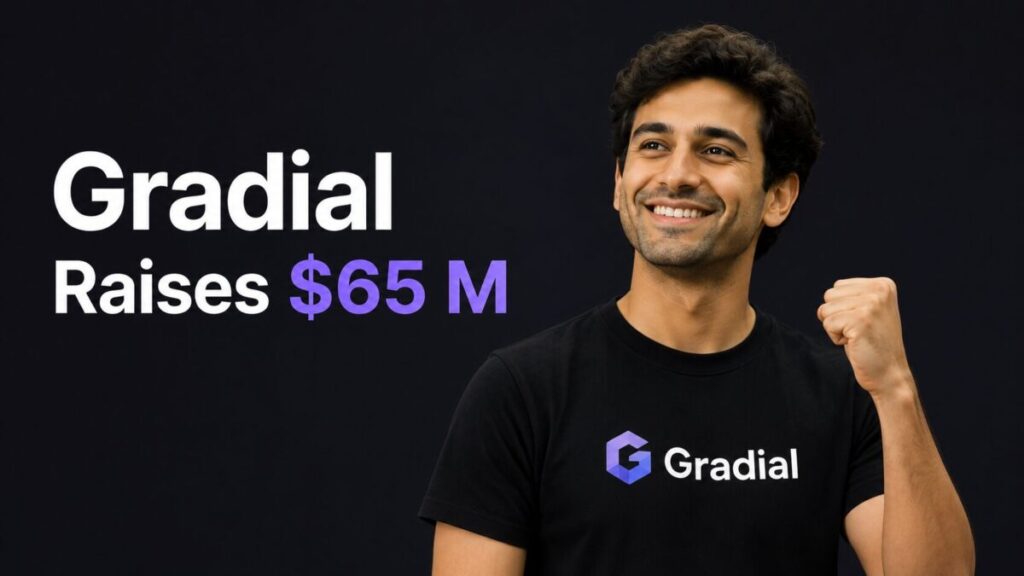
Enterprise marketing has a speed problem. Brands can generate AI content in seconds. But getting that content through approvals, compliance checks, tagging, and publishing across a dozen different tools? That still takes days. Sometimes weeks. Gradial thinks it has the fix. And investors just backed that belief with $65 million.
What Is Gradial and What Does It Do?
Gradial is a Seattle-based AI startup building what it calls an operating system for enterprise marketing. The company deploys AI agents that handle the full content supply chain, from authoring and QA to brand compliance, tagging, assembly, and publishing, across the tools large organizations already use.
The reality is, most enterprise marketing teams are not struggling because they lack talent. They are struggling because their tools do not talk to each other. A marketer working across Adobe Experience Manager, Salesforce, Sitecore, and Jira is constantly switching contexts, routing tickets, and chasing approvals. Gradial sits on top of all of that and orchestrates the entire workflow automatically. No manual handoffs. No waiting in queues.
Founded in 2023, shortly after the launch of ChatGPT, Gradial was built by four co-founders who met at Dartmouth. CEO Doug Tallmadge and CTO Deip Kumar both previously worked as engineers on SpaceX’s Starlink program. Chief Growth Officer Anish Chadalavada brought AI strategy experience from Microsoft and deep tech investment experience from Point72 Ventures. COO Anup Chamrajnagar also came from Point72. A tight, technically sharp founding team. And that background shows in what they have built.
Gradial Raises $65 Million in Series C Funding
On June 17, 2026, Gradial closed a $65 million Series C funding round, bringing its total capital raised to over $120 million. The round values the company at $675 million post-money, nearly double its $350 million valuation from just six months ago.
Here is the kicker: Gradial has raised more than $110 million in just 16 months. That is not a company slowly building momentum. That is a company running.
The funding trajectory tells the whole story. Gradial raised a $13 million Series A in March 2025, led by Madrona. Nine months later, in December 2025, it closed a $35 million Series B led by VMG Partners. And now, six months after that, a $65 million Series C. Each round has been significantly larger than the last. That pattern does not happen by accident. It signals strong product-market fit and the kind of investor conviction that is very hard to manufacture.
Who Led the Funding Round and Which Investors Participated?
The Series C was led by Insight Partners, one of the most active growth-stage technology investors in the world. Insight Partners Managing Director Teddie Wardi put it plainly: businesses are entering a period of fundamental transformation as AI reshapes how consumers discover, evaluate, and engage with brands. Enterprises need a new operating model. One that lets them move at AI speed. Gradial, in Wardi’s view, has built the platform to make that possible.
Existing investors doubled down too. VMG Partners, Madrona, and PruVen Capital all participated in the round.
And that matters more than most people realize. Re-ups from existing backers who have watched the company’s books up close are one of the cleanest signals of real business health. Anyone can pitch a new investor with a great deck. Getting the people who already know your numbers to write another check? That is a different story entirely.
How Gradial’s AI Agents Work Inside Enterprise Marketing Teams
Most AI tools built for marketing work inside a single platform. Gradial’s approach is fundamentally different. Its agents work across platforms, connecting the tools enterprises already have rather than replacing them.
Here is how it plays out in practice. A brand publishes content across Adobe Experience Manager for its website, Bynder for digital asset management, Figma for design, and Salesforce for customer engagement. Traditionally, getting a piece of content from brief to live required a human to manually coordinate across all of these systems. Routing tickets. Chasing sign-offs. Waiting. With Gradial, an AI agent handles authoring, runs QA, checks brand compliance and accessibility standards like WCAG, tags assets, routes everything through existing approval chains, and publishes. Without a human queuing up an agency ticket.
The platform also addresses one of the sharpest emerging problems in digital marketing: generative engine optimization. Consumers are increasingly getting answers directly from AI tools like ChatGPT and Claude instead of clicking through search results. If a brand is not mentioned in those AI-generated answers, it is invisible, regardless of where it ranks in traditional search. Gradial’s agents monitor for these gaps and can automatically draft updates, push them through approval, and publish fixes across systems.
So when Tallmadge describes Gradial as “the AI glue that makes it all work together and makes it delightful for the marketer and super efficient,” he means it literally. The agents do not just generate content. They execute the entire operational workflow required to get content live, faster, at scale, and in compliance.
Gradial’s Revenue Grew 10x in 12 Months – Here’s Why
Let’s be honest. Valuation numbers and funding rounds are easy to dress up with the right narrative. Revenue growth is harder to fake.
Gradial’s annual recurring revenue grew more than 10x over the past 12 months off a substantial enterprise base. Earlier reports pointed to 30x year-over-year revenue growth in 2024, with projections for 200%+ growth heading into early 2025 quarters.
Why is it growing this fast? A few reasons worth paying attention to.
First, the problem Gradial solves is real and expensive. Enterprise marketing teams operating at scale, think Fortune 500 brands managing thousands of web pages, campaigns across multiple regions, and complex approval chains, are spending enormous amounts of headcount on operational work that does not require human creativity. Gradial automates that work. And the savings show up immediately on the budget line.
Second, the shift to AI-driven content discovery is forcing urgency. Brands that cannot update their content operations fast enough are losing visibility to competitors who can. That urgency converts marketing leaders into paying customers faster than any sales motion could.
Third, and this one is underrated: Gradial integrates with existing tools rather than replacing them. Enterprise software decisions take months. Asking a marketing team to rip out their entire tech stack is a non-starter. Asking them to plug a smarter layer on top of what they already have? That is a much easier yes.
Big Clients Already on Board: T-Mobile, AWS, Vanguard, and More
Gradial is not selling to early adopters or small teams testing a side workflow. It is selling to some of the largest and most compliance-sensitive enterprises in the world.
Current customers include T-Mobile, AWS, Vanguard, Prudential Financial, Kaiser Permanente, and U.S. Bank.
Think about what that list actually means. Financial services and healthcare are two of the most heavily regulated industries on the planet. Brand compliance, accessibility requirements, and legal review are not optional. They are mandated. If Gradial’s agents can execute marketing workflows that meet those standards autonomously, the platform is solving one of the hardest operational problems in enterprise content management. Not just one of the most annoying ones.
Customers have reported outcomes like modernizing high-volume campaigns, migrating thousands of pages with far less overhead, and enabling personalization at scale without proportional increases in production headcount. These are not marginal improvements. These are the kinds of results that make a platform sticky. Hard to remove once it is embedded in daily operations.
But that stickiness is also the strategy. Gradial is not building a point solution. It is building infrastructure, a system of work that becomes core to how marketing teams operate every single day.
What Gradial Plans to Do With the $65 Million
Gradial is a 100-person company right now. The $65 million is designed to change that fast.
The company plans to hire aggressively across engineering, sales, and marketing. Engineering growth will accelerate development of the agent platform, expand integrations with additional enterprise tools, and deepen capabilities around generative engine optimization. Sales and marketing hires will push Gradial further upmarket and expand its enterprise customer base.
And the competitive pressure is real. Salesforce, Adobe, and ServiceNow are all building AI agent capabilities inside their own platforms. The incumbent players are not sleeping. Gradial’s core bet is that a cross-platform orchestration layer, one that makes all of those tools work together rather than competing with them, is more valuable than any single vendor’s internal agent. The $65 million buys time and firepower to prove that thesis before the incumbents close the gap.
The vision is straightforward: every marketer at every enterprise should be able to go from brief to live in minutes. Not days. Not weeks. Minutes.
With $120 million raised, a $675 million valuation, 10x ARR growth, and clients like T-Mobile, AWS, and Vanguard already running on the platform, the early evidence is hard to argue with. Now comes the harder part. Scaling it.
What Is Gradial: The AI Startup Turning Enterprise Marketing Into a Machine
Read about – Startup business models
Read in – Startup Directory
Read about Solo businesses

Hi Friends, This is Swapnil; I love reading and sharing knowledge. Currently working as a content writer at startupsunion.com. You all can hang out with me here.