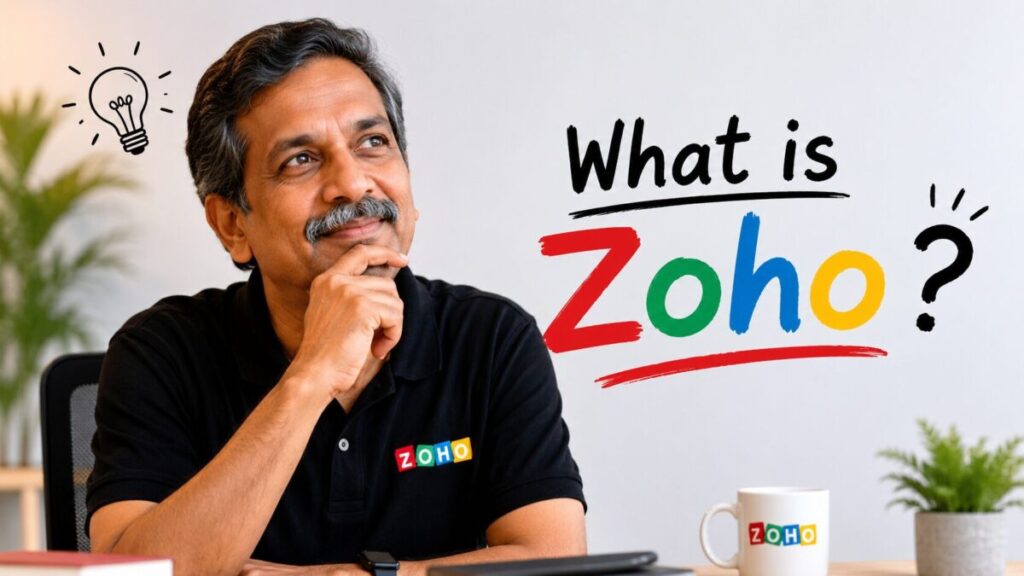
There is a company quietly powering over 100 million users across the globe. No flashy Super Bowl ads. No celebrity endorsements. Just relentless product building. That company is Zoho.
While Silicon Valley unicorns burn cash on marketing, Zoho has spent decades doing the opposite. Staying profitable. Staying private. And building one of the most comprehensive business software ecosystems on the planet. If you have never taken Zoho seriously, this article will change that.
What Is Zoho and What Does It Do?
Zoho is an Indian multinational software company that develops cloud-based business applications for sales, marketing, customer support, finance, HR, and operations. Founded in 1996 by Sridhar Vembu and Tony Thomas, the company is headquartered in Chennai, India, with major offices in Austin, Texas.
Here is what makes Zoho genuinely different. It is one of the few major SaaS companies in the world that is completely bootstrapped. No venture capital. No IPO pressure. Sridhar Vembu has repeatedly turned down acquisition offers to keep the company independent.
The reality is, Zoho’s entire business philosophy revolves around long-term thinking over short-term profits. That independence shows up directly in how they build products. Slower. More deliberate. And deeply integrated.
Zoho Corporation operates across 55+ countries and serves businesses of every size, from solo freelancers to Fortune 500 enterprises. And they are doing all of it without taking a single rupee or dollar from outside investors.
Zoho’s Full Suite of Business Tools Explained
This is where Zoho separates itself from almost every competitor. Most software companies do one thing well. Zoho does fifty things. And most of them, extremely well.
The Zoho One suite, launched in 2017, is the flagship offering. It bundles 45+ integrated business applications under a single subscription. Think of it as an operating system for your entire business.
Here is what that actually covers:
- Sales and CRM — Zoho CRM, Zoho Bigin for small teams, and SalesIQ for live chat and visitor tracking.
- Marketing — Zoho Campaigns for email marketing, Zoho Social for social media management, and Zoho Marketing Automation for full-funnel campaigns.
- Finance — Zoho Books, Zoho Invoice, Zoho Expense, Zoho Payroll, and Zoho Inventory.
- HR and People — Zoho People for HR management, Zoho Recruit for hiring, and Zoho Workerly for workforce management.
- Collaboration — Zoho Mail, Zoho Meeting, Zoho Cliq for team messaging, Zoho WorkDrive for cloud storage, and Zoho Projects for project management.
- IT and Development — Zoho Creator, a low-code app builder, Zoho Analytics, and Zoho Desk for customer support ticketing.
The point is this. A business can theoretically replace Google Workspace, Salesforce, QuickBooks, Slack, and a dozen other tools using only Zoho products. The integration between apps is native, not stitched together through clunky third-party connectors. That keeps data cleaner and workflows far more reliable.
How Much Does Zoho Cost? Pricing Plans Breakdown
Let’s be honest. Pricing is where Zoho wins the most converts.
Compared to Salesforce or HubSpot, Zoho’s pricing is dramatically more accessible. Here is what the major tiers look like.
- Zoho One costs approximately $37/user/month in the US when billed annually. In India, that comes to around ₹1,994/user/month. For 45+ apps under one roof, that number is hard to argue with.
- Zoho CRM starts at a free plan for up to 3 users. Paid plans begin at $14/user/month on the Standard tier and go up to $52/user/month on the Ultimate plan, both billed annually.
- Zoho Books is free in India for businesses with revenue under ₹1.5 crore. Paid plans start at ₹749/month.
- Zoho Mail has a forever free plan for up to 5 users with 5GB storage per user. Paid plans start at just $1/user/month.
- Zoho Analytics starts at $30/month for 2 users and supports up to 5 million rows of data.
So why is Zoho this affordable? It is not an accident. Sridhar Vembu has long believed that software should be accessible to businesses in emerging markets, not just well-funded Western startups. That philosophy has helped Zoho dominate markets across India, Southeast Asia, the Middle East, and Latin America where competitors have genuinely struggled to gain ground.
Zoho CRM: Features, Benefits, and Who It’s For
If there is one Zoho product that has become a household name in business circles, it is Zoho CRM.
Launched in 2005, Zoho CRM is now used by over 250,000 businesses across 180 countries. It has won multiple G2 and Gartner Peer Insights awards and sits consistently among the top-ranked CRM platforms globally.
Here is the kicker. The features that usually live behind enterprise price tags are available right here.
- Zia, the AI sales assistant built into Zoho CRM, predicts deal closure likelihood, detects sales anomalies, auto-tags leads, and recommends the best time to contact a prospect. That is enterprise-grade intelligence at a mid-market price.
- Omnichannel communication lets sales reps reach leads through email, phone, live chat, social media, and WhatsApp. All from within the CRM. Every interaction logged automatically. No manual data entry needed.
- Canvas, the no-code CRM designer, lets teams rebuild the entire interface without writing a single line of code. You shape the CRM to match your workflow, not the other way around.
- Blueprint, the visual process builder, handles complex multi-step automation. Lead assignment, follow-up sequences, deal stage transitions, and approval workflows. All of it runs without anyone having to remember to do it manually.
And the integrations are genuinely broad. Zoho CRM connects natively with every Zoho product and supports 1,000+ third-party integrations, including Google Workspace, Microsoft 365, Mailchimp, WhatsApp Business, and Shopify.
Who is it actually for? Zoho Bigin handles solo operators and micro-teams. Standard and professional plans serve growing SMBs well. Enterprise and Ultimate plans are built for large sales organizations with complex pipeline requirements and compliance obligations.
Frankly, very few CRM platforms in this price range offer the depth that Zoho CRM delivers. It is the product that most often convinces skeptics that Zoho belongs in the same conversation as Salesforce.
Is Zoho Good for Small Businesses and Startups?
Short answer. Yes. And possibly better suited for them than anything else out there.
Here is the thing. Zoho was built with the resource-constrained business in mind. Sridhar Vembu started the company in a small town in India with a lean team and zero external funding. That origin story is baked directly into the product thinking.
For early-stage startups, Zoho One offers a value proposition that is genuinely hard to match. Instead of paying separately for a CRM, an email tool, a project management app, HR software, and accounting software, which can easily run to $500 to $800 per month for a 5-person team, Zoho One wraps everything into a single subscription at a fraction of that cost.
Zoho also runs a dedicated Startup Program offering early-stage companies access to Zoho One at deeply discounted rates for the first year. Several incubators and startup ecosystems across India, the US, and Europe have formal partnerships with Zoho built around this.
And beyond cost, the setup speed is genuinely impressive. Most Zoho products go live within hours. Zoho Books can be fully configured and GST-compliant for Indian businesses in under a day. Zoho CRM can have your first pipeline running in under 30 minutes.
Because all Zoho tools share the same user interface design and data layer, your team is not learning multiple disconnected systems. One login. One ecosystem. One vendor relationship to manage.
For bootstrapped founders, the alignment runs deeper than just pricing. Zoho itself has never raised external capital. It understands, at an organizational level, what it means to build under constraints. That empathy is visible in the product decisions, the pricing tiers, and the way customer support is structured.
The Business Model Behind Zoho’s Growth
Zoho runs on a classic SaaS subscription model. But with a few structural choices that make it genuinely different from the rest of the industry.
The company crossed $1 billion in annual revenue in 2022. And it has been profitable every single year since it was founded. That kind of sustained profitability, without any venture funding, is rare in enterprise software. Honestly, it is almost unheard of at this scale.
The business model operates across three distinct layers. Individual product subscriptions like Zoho CRM or Zoho Books bring in SMBs who need one or two tools. Zoho One bundles create high lifetime value customers who consolidate their entire software stack onto the platform. Enterprise contracts, large custom deployments with dedicated support, bring in significant recurring revenue from multinationals.
Zoho Marketplace adds another revenue channel. Third-party developers and agencies sell extensions, integrations, and custom-built apps there. This expands product capability without Zoho having to absorb the full R&D cost internally. Smart model.
But here is what really makes the business sustainable. Low churn, driven by deep integration. Once a business runs payroll, accounting, CRM, and email all through Zoho, the switching cost becomes enormous. That stickiness is not accidental. It is engineered intentionally into how the products connect.
Sridhar Vembu has also made a deliberate choice to build Zoho offices in rural India, including towns like Tenkasi and Renigunta. This taps lower-cost engineering talent while creating real economic opportunity outside major metros. Lower operating costs fund deeper R&D. And the approach aligns with a broader social mission that Vembu has spoken about publicly for years.
The result is a Zoho that is quietly profitable, methodically expanding, and structurally built to outlast market trends and economic cycles. Most venture-backed SaaS companies would trade a great deal to have a business model like that.
How Zoho Built a $12.5 Billion SaaS Empire
Is Zoho Worth It for Your Business? Real Ratings, Pricing, and Reviews
Read about – Startup business models
Read in – Startup Directory
Read about Solo businesses

Hi Friends, This is Swapnil; I love reading and sharing knowledge. Currently working as a content writer at startupsunion.com. You all can hang out with me here.