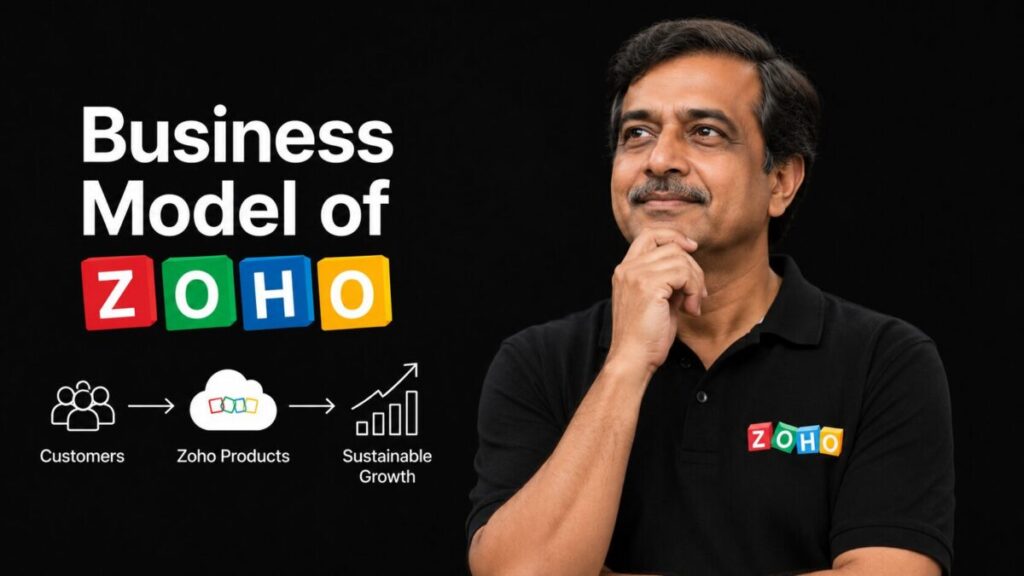
Most software companies talk about growth. Zoho just went and built it. No venture capital. No IPO. No advertising budget worth mentioning. Just three decades of stubborn product-building and a founder who bet on engineers over evangelists. The result is a company serving 150 million users across 150 countries, still privately held, still profitable, and still entirely owned by its founders. Let’s break down exactly how Zoho got here.
How Zoho Started
Zoho was founded in 1996 by Sridhar Vembu and Tony Thomas as AdventNet, Inc., in New Jersey, initially building network management software called WebNMS. The problem they were solving wasn’t sexy. Enterprise software was expensive, bloated, and designed exclusively for companies that could afford a six-figure implementation budget. Small and medium businesses were either ignored or handed stripped-down toys that barely worked.
AdventNet stood out early by offering flexible, cost-effective tools for OEMs and enterprise IT teams. Then came the real pivot. In 2005, they launched Zoho Office, which included word processing, spreadsheet, and presentation software, marking the company’s shift toward cloud-based applications.
And that changed everything.
What followed was a wave of innovation: Zoho Writer, Zoho Sheet, Zoho Show, and then the product that became the cornerstone of the entire platform, Zoho CRM. Their target was always clear. SMBs that needed real tools at prices a founder could actually approve. The company was officially renamed Zoho Corporation in 2009. Eight years later, Zoho One arrived, bundling 40+ integrated apps under a single subscription. One login. One bill. One platform to run an entire business.
Competitive Advantage
Let’s be honest. Surviving in a market dominated by Salesforce, Microsoft, and HubSpot is not an accident. You have to be structurally different. Zoho is.
Zoho built its own data centers instead of renting from AWS or Azure and developed its own AI infrastructure rather than licensing from OpenAI or Google. This control kept costs low and margins high while competitors paid cloud providers and AI vendors. That’s a compounding cost advantage most people underestimate.
The decision not to take venture capital, not to go for an IPO, and not to be acquired gave Zoho immense freedom, the freedom to innovate, to learn from mistakes, and to think long-term. No quarterly earnings pressure. No board demanding hockey-stick projections. Just building.
Zoho One bundled all 55+ applications at pricing that competed favorably against buying best-of-breed tools separately. A company using Salesforce for CRM, Slack for communication, Asana for projects, and Expensify for finance paid far more than Zoho One’s bundled price.
And then there’s the talent angle. Zoho launched Zoho University, a 100% free institution targeting young people from rural India, training them over 24 months in English, mathematics, and computer science, then hiring them directly. This solved a talent problem while enabling thousands of people from rural India to launch technology careers. That’s not just good PR. That’s a structural moat most competitors couldn’t replicate even if they tried.
Zoho CRM connects natively to Zoho’s own tools for email marketing, customer support, accounting, and project management. For businesses already using multiple Zoho products, that integration is a genuine advantage. Switching away becomes genuinely painful over time. That’s the point.
Marketing Techniques
Here is the kicker. Zoho barely advertises. And yet it has 150 million users. So how does that actually work?
- Product-led growth. Free tiers and trials pull users in. Once one app gets adopted, the integrated ecosystem creates natural expansion into other Zoho products. Retention drives referrals. Referrals drive growth. Without a single billboard.
- SEO and organic authority. The Zoho brand has been around nearly as long as the Google search engine itself. That accumulated domain authority and link equity immediately shows up when you look at the channel-by-channel breakdown of Zoho’s marketing engine, which is led by organic search. Decades of consistent content production have made Zoho a default result for thousands of SMB software queries.
- Flanking via dual products. Instead of focusing exclusively on a single product or target audience, Zoho launched two distinct CRM solutions: Zoho CRM for enterprise-level clients and Bigin, a user-friendly platform for small businesses. This dual approach allowed Zoho to reach a wider market segment and disrupt competitors.
- Low-cost acquisition compounding. Because Zoho does not spend much on marketing, its cost of customer acquisition is low relative to competition. This made it possible for the company to lower its prices and capture a wider market share. Happy customers who save money talk. That loop runs itself.
- Analyst credibility. Gartner recognized Zoho as a Visionary in the 2025 Magic Quadrant for Sales Force Automation, reflecting its investment in AI and continued relevance in the mid-market. Earned recognition like that functions as marketing Zoho never had to pay for.
How Zoho Makes Money
The model is subscriptions. But the execution is layered.
Zoho embraced the SaaS model, offering its applications on a subscription basis, making high-quality business software accessible and affordable, particularly for SMEs. Bundling via offerings like Zoho One encourages multi-product adoption, creating recurring revenue and ecosystem stickiness.
Revenue flows from three primary directions. CRM and sales tools. Workplace productivity and collaboration via Zoho Workplace. And IT management through its ManageEngine division, which operates largely independently and serves enterprise clients at a different price tier. Upsells, premium tiers, and professional services layer additional revenue on top.
Zoho crossed $100 million in 2010, $500 million in 2019, and then accelerated sharply through the SaaS boom of the pandemic era. By 2024, Zoho reported $1.4 billion in annual revenue, up from $1.1 billion in 2023.
The most recent figures show revenue of ₹12,313 crore with ₹3,191 crore in profit. A 25%+ margin business at scale. That’s not survival. That’s a machine.
Market Share of Zoho
The reality is, Zoho owns a specific and defensible slice of a market worth tens of billions of dollars.
Zoho’s CRM product alone commands an estimated 8.4% of the global CRM market, putting it among the top five providers worldwide, competing directly with Salesforce, Microsoft Dynamics, and HubSpot.
In 2024, more than 250,000 businesses actively used Zoho CRM, representing growth of nearly 30% year over year. Over 50% of Zoho CRM users are small and medium-sized enterprises. Research from Enlyft puts Zoho CRM’s share of the broader CRM category at approximately 7.53%.
But CRM is just one product. In February 2026, marking its 30th anniversary, the company announced 20% year-on-year revenue growth and 32% customer growth. And those 150 million total users span CRM, productivity, finance, HR, and IT management. Raw market share numbers dramatically understate Zoho’s actual footprint.
Business Model Canvas of Zoho
- Customer Segments: SMBs are the core. The majority of Zoho CRM users come from companies with 1 to 50 employees. Mid-market companies sit in the middle tier. Enterprises are served primarily through ManageEngine.
- Value Proposition: An integrated, affordable alternative to stitching together five different tools from five different vendors. One login, one bill, one ecosystem. Privacy-first, ad-free, with no monetization of user data.
- Channels: Organic search leads. Freemium and free trials convert. A partner and reseller network handles enterprise sales. Word of mouth does the rest.
- Customer Relationships: Self-serve onboarding for smaller teams. Dedicated account management for enterprise. Community forums, documentation, and Zoho University resources for ongoing support.
- Revenue Streams: Monthly and annual SaaS subscriptions. Zoho One bundles. ManageEngine enterprise licensing. Premium feature tiers. Professional services.
- Key Resources: Proprietary technology stack. Owned data centers across 18 global locations. Over 17,800 employees as of 2025. Zoho University as a talent pipeline. Thirty years of brand equity built without advertising.
- Key Activities: In-house R&D across 55+ products. Data center operations. AI development. Global expansion into new markets.
- Key Partners: Independent resellers. Technology integration partners. Indian government bodies, particularly after Zoho products were promoted as homegrown alternatives to foreign-owned apps.
- Cost Structure: R&D and engineering dominate. Employee expenses rose 49% to ₹2,722 crore in FY23, reflecting aggressive talent investment. Data center infrastructure and selective marketing round out the rest.
Conclusion: Is Zoho a Viable Business?
Not just viable. Structurally rare.
Zoho is proof that growth does not have to come at the expense of profitability and that building for customers is a better long-term strategy than building for investors. Thirty years in. Still profitable. Still private. Still run by the same founding family.
The risks are real. Security vulnerabilities have surfaced more than once. Competition from Salesforce and Microsoft does not soften. But Zoho holds advantages that money alone cannot build overnight: zero debt, zero investor pressure, a captive talent pipeline, and an ecosystem so deep that switching away is genuinely painful.
Nearly all of the revenue Zoho earns from product sales is reinvested straight back into product development. So Zoho’s products get better every year, while competing companies get complacent with one or two successful products.
That’s the compounding advantage most founders never get to build. Because they take the VC money. Because they chase the IPO. Because they optimize for the exit instead of the product. Zoho didn’t. And 30 years later, it shows.
Is Zoho Worth It for Your Business? Real Ratings, Pricing, and Reviews
Read about – Startup business models
Read in – Startup Directory
Read about Solo businesses

Hi Friends, This is Swapnil; I love reading and sharing knowledge. Currently working as a content writer at startupsunion.com. You all can hang out with me here.