The AI boom has a power problem. Data centers are multiplying at a pace the grid simply cannot keep up with. Interconnection queues stretch five to seven years in many regions. And hundreds of data center developers are sitting on shovel-ready projects they cannot turn on because the utility will not let them plug in.
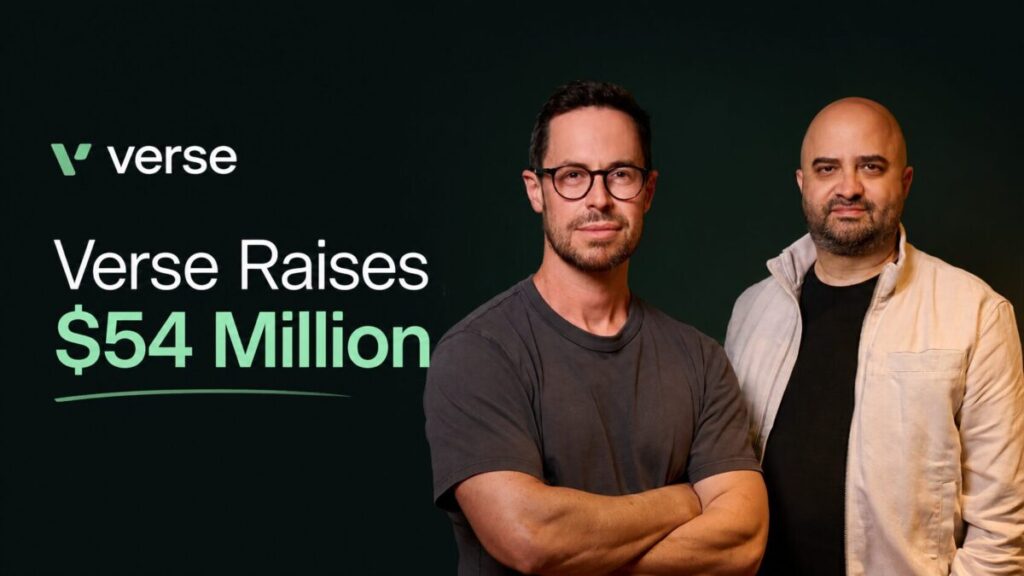
That is the wall Verse is trying to knock down. On June 18, 2026, the San Francisco-based company announced an oversubscribed $54 million Series B. Not just funded. Oversubscribed. That detail matters.
What Is Verse and What Does It Do?
Let’s start from the beginning.
Verse is an energy infrastructure platform built for the AI economy. Founded in 2022 by Seyed H. Madaeni, Ph.D., and Matt Penfold, the company was built around a single uncomfortable truth: large electricity consumers, especially data centers, are flying blind when it comes to managing complex energy portfolios. The bills stack up. The contracts are scattered. The procurement decisions are made on gut feel and incomplete data.
Their core platform, Aria, is already used by Fortune 500 companies. It pulls together utility bills, contracts, and power purchase agreements across thousands of sites. One unified view. Better forecasting. Smarter procurement. Real cost reduction.
But the founders are not average energy software people. Madaeni ran AMS, a wholesale market bidder software company that was later acquired by Fluence, and helped Fluence navigate its $1B+ public IPO. Before that, PG&E. SolarCity. Tesla’s grid services. Co-founder Matt Penfold spent years as VP Commercial at Fluence. Together, they built Fluence’s Mosaic and Tesla’s Autobidder, two of the largest energy storage software platforms ever deployed at scale.
These are not first-time founders trying to figure out energy. They built the infrastructure that others sit on top of.
Why Verse Raises $54 Million in Series B Funding
Here is the kicker. The problem Verse is going after is not a software gap. It is a trillion-dollar infrastructure bottleneck.
US interconnection queues currently hold roughly 2,600 GW of projects. Median wait times exceed five years, according to Lawrence Berkeley National Laboratory data. Verse estimates 700 data centers above 50 MW are stuck in those queues right now. Stuck. Not planned. Not in progress. Stuck. And that backlog represents over $1 trillion in potential missed revenue at current GPU rental rates.
Goldman Sachs projects US data center power needs will double from 31 GW in 2025 to 66 GW by 2027. Traditional grid upgrades simply cannot move at that speed. Building new transmission lines and substations takes five to ten years. The math does not work.
The reality is, the race to build AI has become a race to access power. And data center developers are losing months, sometimes years, stuck waiting for utility approvals while compute demand keeps climbing.
So that is what this round is for. The $54 million Series B will fund continued product development, new deployment rollouts, and Verse’s goal of onboarding more than 100 data center sites over the next 12 months.
Worth noting where they started. A seed round of roughly $5.75 million in 2023. Then a $20.5 million Series A led by GV in May 2024. Now $54 million. Total disclosed funding now exceeds $74 million. Four years old. That trajectory tells you something.
Who Invested in Verse’s $54M Round?
The investor lineup is worth reading carefully.
Bessemer Venture Partners led the round. GV came back in, having led the Series A. NVIDIA joined. Norrsken VC participated. The round was oversubscribed, which means Verse had more capital offered than it took.
GV coming back is a signal of conviction, not just relationship. But honestly, the move that stands out is NVIDIA. Think about what it means for a chip company to back an energy infrastructure startup. NVIDIA has a very direct business interest in data centers coming online faster. Every month a data center sits delayed in a grid queue is a month NVIDIA does not see revenue from GPU deployments inside that facility. Backing Verse is, in part, backing the layer that unblocks NVIDIA’s own customers.
And NVIDIA is not just writing a check. But more on that in a moment.
Bessemer VP Lindsey Li was direct about the thinking: Verse is building the technology every AI infrastructure company will need in a world increasingly constrained by power. Hard to argue with that.
What Is Dispatch Intelligence and How Does It Work?
Alongside the funding, Verse launched Dispatch Intelligence, its biggest product expansion since Aria.
Here is how it works in plain terms.
Data centers wait years for grid interconnection because utilities need confidence that new loads will not destabilize the grid. They want to see that a new facility can behave flexibly, not just pull maximum power at all times. Dispatch Intelligence gives them that proof. It deploys behind-the-meter battery storage on-site and actively manages how the facility presents its load to the grid. During specific periods, the system draws from on-site batteries instead of pulling from the grid. To the utility, the facility looks flexible and manageable. That flexibility can cut interconnection approval timelines by years.
And here is the part that matters most: compute never slows down.
Most competing approaches ask data center operators to throttle workloads during peak periods to look grid-friendly. Dispatch Intelligence does not do that. The grid sees flexibility. The data center runs at full capacity. The grid sees a managed load. The operators see zero performance impact. That is the core differentiation, and it is not a small one.
Verse’s first large-scale deployment, Lone Star Site 01 in ERCOT, West Texas, pairs an 80 MW / 320 MWh battery energy storage system with 40 MWp of solar. Faster interconnection. And additional revenue streams from grid services on top of that.
How Verse Helps AI Data Centers Get Power Faster
The scale of what Verse is solving is hard to overstate.
Denmark recently paused new grid connections entirely after AI data centers overwhelmed its system. The EU asked households to cut power use at peak times. In the US, interconnection queues in PJM and ERCOT stretch well beyond five years in many cases. Verse estimates the industry is leaving $500 billion in annual revenue on the table because hundreds of data centers simply cannot get online.
Let’s be honest about what that means. It means that the bottleneck for AI growth right now is not chips. It is not software. It is not talent. It is power. Access to power. The ability to plug in. That is what is slowing things down.
Verse’s approach cuts through the wait by using on-site intelligence instead of waiting years for grid upgrades. Through Dispatch Intelligence, data centers demonstrate real grid responsiveness to utilities, which fast-tracks the approvals that would otherwise drag on for years. The platform also brings long-term price stability in markets where energy pricing has become increasingly volatile, and it reduces overall grid and system costs in ways that benefit the broader network, not just the data center.
So the value for a developer is simple: skip the queue. Come online faster. Keep compute running at full speed. The whole time.
Verse’s Partnership With NVIDIA and Calibrant Energy
Two partnerships are doing a lot of the heavy lifting in this funding round.
The first is with Calibrant Energy, a provider of on-site energy solutions for large power users backed by Macquarie Asset Management, the world’s largest infrastructure fund manager with over $580 billion in global assets. Calibrant handles the full physical layer: financing, building, owning, and operating on-site solar, battery energy storage, and microgrid solutions. Zero upfront capital required from the data center operator. Verse provides the software intelligence layer managing those assets in real time. Together they form a full-stack offering.
Developers get the hardware. The financing. The platform. They do not have to own any of it.
Philip Martin, CEO of Calibrant, put it plainly: the main limiting factor for AI supremacy is access to power. Together with Verse, they are enabling a model where power can be delivered on-site, on-demand, without waiting years for grid upgrades, and without pushing electricity costs onto others.
The second partnership is with NVIDIA. Verse is integrating Dispatch Intelligence with NVIDIA’s DSX AI Factory reference design, a framework built to speed the construction, simulation, and operation of gigascale AI data centers. NVIDIA functions here as both investor and integration partner. That dual role is a strong technical endorsement. It places Verse as a native component inside the infrastructure stack for next-generation AI facilities, not a bolt-on. Not an afterthought.
What’s Next for Verse After the $54M Raise?
The near-term plan is specific. Verse is targeting more than 100 site onboardings over the next 12 months and plans to expand the on-site battery capacity under its management. Dispatch Intelligence is already rolling out, with the Lone Star deployment in ERCOT as the reference case for what the full-stack model looks like operating at scale.
The broader market numbers are hard to ignore. The energy management systems market is projected to grow from $68.8 billion in 2026 to $158.6 billion by 2033, at a 12.7% compound annual growth rate. Demand response systems are growing even faster, at a projected 27% CAGR. Verse is not chasing a niche. It is positioning at the center of one of the fastest-growing infrastructure categories on the planet.
But what makes Verse raises $54 million feel different from a typical Series B is not the market size. It is the precision of the founders and the specificity of the problem they are solving.
Madaeni and Penfold did not stumble into energy storage software. They built the platforms that defined the field at Tesla and Fluence. They understand both sides of the grid: the seller side that built and bid storage into markets, and the buyer side that now needs to manage it intelligently. That combination is rare. Most investors reward specialists on one end or the other. Verse’s founders have lived both.
The AI economy needs power. Power access has quietly become the defining infrastructure constraint of this decade. And Verse is building the software layer that bridges where the grid is today and where AI needs it to be.
Resources Used to write this Article
Read about – Startup business models
Read in – Startup Directory
Read about Solo businesses

Hi Friends, This is Swapnil; I love reading and sharing knowledge. Currently working as a content writer at startupsunion.com. You all can hang out with me here.