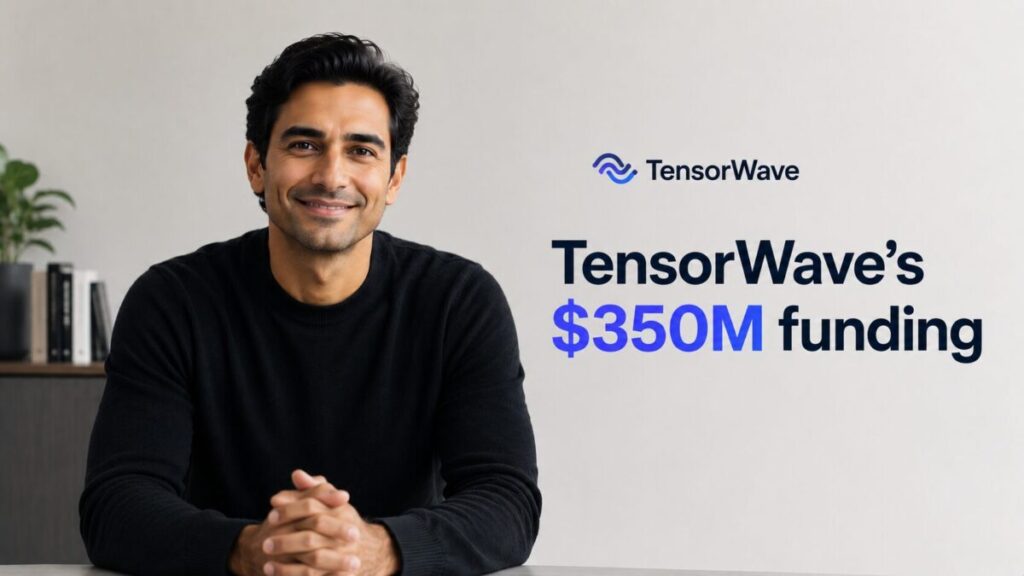
Let’s be honest. Most startup funding announcements blur into noise after a while. Another round, another valuation, another press release that says nothing real. But TensorWave raised $350M and this one is different. Not because of the number, though the number is staggering. Because of what the company is actually doing, and why the people backing it keep writing bigger checks.
This is the story of a three-year-old startup from Las Vegas that decided to go head-to-head with one of the most dominant companies in tech. And so far? It is working.
What Is TensorWave and What Does It Do?
TensorWave is an AI cloud company. Founded in 2023 and based in Las Vegas, Nevada. That alone sounds unremarkable until you hear what they actually built.
The company runs its entire AI infrastructure on AMD chips exclusively. Not mostly AMD. Not AMD where Nvidia is unavailable. Exclusively AMD, from day one, by design. They specialize in the kind of workloads that keep AI teams up at night: large language model training, high-throughput inference, and generative AI at production scale. These are memory-hungry, compute-intensive jobs that need serious hardware and serious uptime.
Right now, TensorWave operates one of the largest all-AMD GPU clouds in North America. Over 8,192 MI325X GPUs already deployed. More than two gigawatts of long-term data center capacity secured. These are not prototype numbers. This is real infrastructure, running real workloads for real customers.
Co-founder and CEO Darrick Horton is a Forbes 30 Under 30 honoree. Co-founder Jeff Tatarchuk rounds out the leadership. Together they built something that most people said could not be done.
TensorWave Raises $350M in Series B Funding
Here is the kicker. When TensorWave raised $350M in its Series B round, it broke the record for the largest Series B funding ever secured in Nevada history. Not AI funding in Nevada. All funding. Ever.
The round was co-led by Magnetar Capital and AMD Ventures. Also participating: Maverick Silicon, Nexus Venture Partners, and Western Frontier.
But zoom out for a second and look at the full picture. TensorWave raised $43 million in seed funding in October 2024. Then $100 million in a Series A in May 2025. Now $350 million more. Total funding since founding: approximately $493 million. In under three years. The fundraising pace is, frankly, almost hard to believe.
And each round broke a Nevada record. Seed. Series A. Series B. Three for three.
TensorWave Is Now Valued at $1.55 Billion
One year ago, TensorWave was valued at roughly $400 million. Today, after the $350M raise, the post-money valuation sits at $1.55 billion. That is nearly four times the valuation in twelve months. Stop and sit with that for a second.
TensorWave is now an official AI unicorn. And it got there faster than almost anyone expected.
The reality is, this valuation growth is not hype-driven. Revenue has grown significantly alongside it. Investors are not just betting on a story. They are backing a business that is already operating at serious scale with paying customers who need what TensorWave is selling.
For Las Vegas and Nevada more broadly, this is also a big deal economically. The company is expanding its Town Square headquarters and plans to grow its team from around 160 people to between 300 and 400 employees in the next 12 months. Engineering, infrastructure, operations, sales, customer success. President and co-founder Piotr Tomasik put it plainly: it is a great thing for diversifying the Nevada economy and keeping tech growing in the region.
Why TensorWave Uses AMD Chips Instead of Nvidia
This is the question that stops most people. Why AMD? Why deliberately choose the underdog?
Darrick Horton has been straight about it. When TensorWave launched in 2023, Nvidia was what he called a monopoly by default. Not because they played dirty. Just because no serious alternative cloud infrastructure existed to run AMD chips at scale. Customers wanted options. They just had nowhere to go. So TensorWave built the place.
He has also said he does not like buying from monopolies because customers lose leverage. That is not an ideological stance. That is practical business thinking.
And the timing was right. Nvidia GPU supply has been severely constrained for years. Long lead times, sky-high prices, limited availability. Companies that need to scale fast cannot wait six months for an Nvidia allocation. TensorWave offers an alternative that is available now, optimized for real workloads, and backed by AMD’s most capable hardware. The current fleet runs on AMD Instinct MI355X GPU clusters, designed specifically for high-bandwidth, memory-heavy AI jobs.
In February 2026, TensorWave also partnered with Credo, a networking technology company, to strengthen network reliability across large-scale GPU clusters. Because at this size, reliability is not a nice-to-have. It is everything.
Who Invested in TensorWave’s Latest Funding Round?
Look at who is writing the checks and you start to understand why this round matters beyond the dollar amount.
Magnetar Capital co-led the round. Magnetar is a major Chicago-based hedge fund known for concentrated, high-conviction bets. This is their third consecutive lead investment in TensorWave. Seed. Series A. Series B. When a fund of that caliber keeps doubling down, it tells you something.
Then there is AMD Ventures. This is the part that really matters. AMD is not just a financial investor here. AMD is TensorWave’s primary chip supplier. So AMD is literally funding a company to build the ecosystem that proves AMD chips can compete at scale in production AI environments. That is a strategic bet, not just a financial one. It mirrors the exact playbook Nvidia used for years to lock in its own infrastructure partners.
Also in the round: Maverick Silicon, a semiconductor-focused investor. Nexus Venture Partners, a deep-tech VC. And Western Frontier, a growth-stage technology investor. The investor mix here is not random. It is a group of people who deeply understand chips, infrastructure, and enterprise software. They are not betting on a pitch deck. They are betting on a business.
How TensorWave Plans to Use the $350M
No vague answers here. TensorWave has been specific about where the money goes.
The biggest piece goes toward expanding global AI infrastructure. Specifically, deploying more AMD Instinct MI355X GPU clusters at scale. These are not small installations. TensorWave is building for the most demanding AI workloads in the world: LLM training, high-throughput inference, generative AI at production volume.
The company has already secured over two gigawatts of long-term data center capacity. So the physical footprint is ready. Now the capital fills it with hardware and people.
Speaking of people: headcount is set to roughly double. From about 160 employees today to between 300 and 400 within the next year. The hiring spans technical and commercial roles alike. That split matters. It means TensorWave is not just building more infrastructure. It is building the sales and customer teams needed to fill that infrastructure with enterprise clients.
So the $350M is not going into a war chest. It is going directly into growth. Fast.
Can TensorWave Really Compete with Nvidia?
Okay. Real talk.
Nvidia is not going anywhere. They are enormously profitable, technically excellent, and deeply embedded in the AI ecosystem through years of software investment. Anyone who tells you TensorWave is about to knock Nvidia off its perch is selling something.
But here is what people miss. TensorWave does not need to beat Nvidia. It needs to win enough of the market to matter. And the conditions right now are about as favorable as they could be for an alternative.
Nvidia supply is constrained. Prices are high. Lead times are brutal. Enterprises that need compute now cannot always get it through Nvidia channels. TensorWave is available, optimized, and operationally mature enough to actually deliver. That is a real competitive opening, not a theoretical one.
Horton said it clearly: “We were created to restore competition to the market. The next phase of AI will be defined by who can access enough compute to move from experimentation to production.”
With $493 million in total funding, a $1.55 billion valuation, 8,192 GPUs already running, and AMD itself betting on the outcome, TensorWave has more than a fighting chance. It has a plan. It has capital. It has customers.
The era of one company controlling the AI compute market may not last much longer. And TensorWave raised $350M to make sure of it.
Read about – Startup business models
Read in – Startup Directory
Read about Solo businesses

Hi Friends, This is Swapnil; I love reading and sharing knowledge. Currently working as a content writer at startupsunion.com. You all can hang out with me here.