Most food startups talk about changing the world. Solar Foods might actually be doing it.
This Finnish company has built a proprietary microbe that feeds on carbon dioxide and hydrogen to grow a high-protein food ingredient called Solein. No farms. No soil. No sunlight. And now, with the biggest funding decision in its history, it is ready to go industrial.
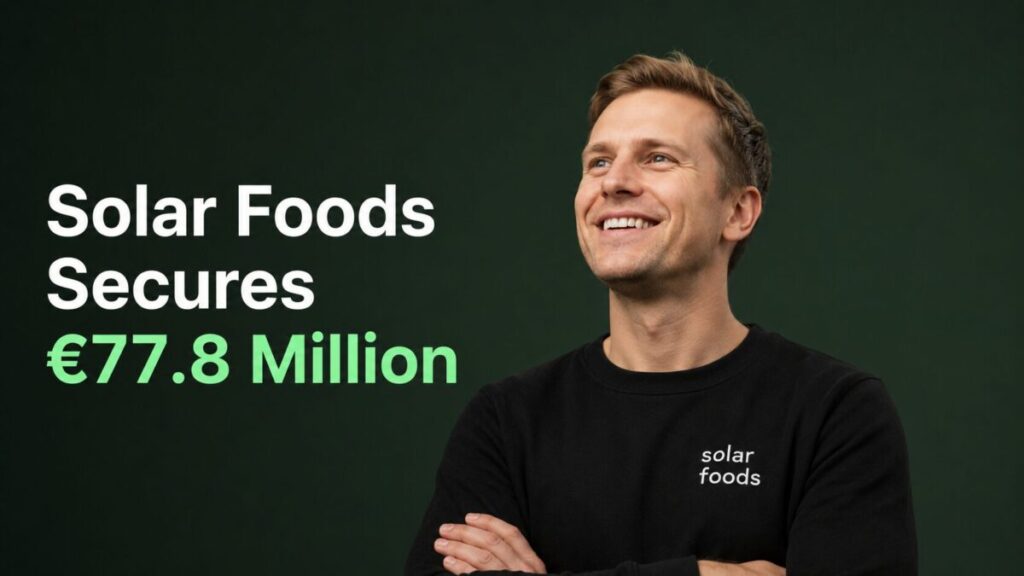
Solar Foods has secured €77.8 million in grant and loan financing to support the construction and commissioning of Factory 02. That is not a small number. And the story behind it is worth understanding properly.
What Is Solar Foods and What Does It Make?
Solar Foods was spun out from the VTT Technical Research Centre of Finland and LUT University in 2017 to commercialize Solein, a protein produced by feeding microbes on carbon dioxide, hydrogen, and oxygen instead of sugar. The company is listed on the Nasdaq First North Growth Market in Finland.
So this is not a garage startup. It came out of serious institutional science.
The microbes are grown in a liquid form, in a process that eliminates the need for farmland, water for irrigation, and fertilizers and pesticides. They are then dried into a flavorless powder that has 78% protein, 6% fat, and 10% dietary fiber.
That powder is Solein. And here is the kicker. It contains all the essential amino acids and can be used to replace existing proteins in a variety of foods, from alternative dairy and meat to snacks, beverages, noodles, pasta, breads, and spreads.
The reality is this is not another oat milk or pea protein play. This is a genuinely different category of food production. One that did not exist before Solar Foods built it.
Solar Foods Raises €77.8 Million: Where Is the Money Coming From?
Not from venture capital. That is the first thing to understand.
The company has received €77.8 million from Business Finland, an arm of the Finnish economic affairs ministry. It comprises a €39.6 million grant and a €38.1 million R&D loan, both part of the firm’s €600 million financing program under the EU Commission’s hydrogen-based Important Project of Common European Interest (IPCEI).
The R&D loan carries a 1% interest rate over ten years, with a five-year grace period and no collateral required. Think about that for a second. A 1% loan, no collateral, five years before you start repaying. That is the kind of structure that changes what a company can build.
The €39.6 million grant covers a maximum of 48% of the total eligible costs during 2027 to 2031.
The Solar Foods €77.8 million funding decision is part of the financing plan communicated by Solar Foods in October 2025. The company’s financing needs consist of equity, debt, and grants. Solar Foods also raised approximately €25 million through a private placement earlier this year.
And the history of public backing here is substantial. Solar Foods has previously raised around €83 million in equity and debt funding for its two facilities, with backers including the European Commission and Business Finland. Business Finland has made a total of €110 million in grants available to Solar Foods until 2035.
So the Solar Foods €77.8 million is not a one-off. It is part of a long-term institutional commitment to what this company is building.
What Is Factory 02 and Why Is It a Big Deal?
Factory 01 proved the idea works. Factory 02 is where it gets real.
Factory 01, Solar Foods’ first commercial-scale production facility, began operation in spring 2024 in Vantaa, Finland. It can grow a maximum of 160 tonnes of Solein annually. Meaningful. But not nearly enough to feed a global ingredient supply chain.
Factory 02 is a planned large-scale facility in Selkäharju, Lappeenranta, with a phased capacity of up to 12,800 tonnes of Solein every year. That is around a hundred times greater than Factory 01.
A hundred times. Let that sink in.
The Solar Foods €77.8 million will be allocated to the implementation phase of the Factory 02 project, including construction and contract management, the delivery of key process equipment, installation, commissioning, and production ramp-up prior to the start of mass production.
Solar Foods aims to make the final investment decision for Factory 02 during 2026. The work is focusing on securing sufficient binding customer agreements, building the company’s partner network, advancing the design of the production facility, and pursuing novel food approval in the EU and a no-questions letter from the US Food and Drug Administration.
Factory 02 is aimed to begin operations in 2028. If that holds, this becomes one of the most consequential food infrastructure projects in Europe this decade.
What Is Solein: The Protein Made From Air and CO2?
Let’s be honest. When you first hear “protein made from air,” your brain wants to file it under gimmick.
It is not.
The bioprocess resembles winemaking, with carbon dioxide and hydrogen replacing sugar as the source of carbon and energy, respectively. Solein is 65 to 70% protein, 5 to 8% fat, 10 to 15% dietary fiber, and 3 to 5% mineral nutrients.
Solein is versatile enough to replace protein in virtually any food. It can also work as a fortifier, contributing iron, fiber, and B vitamins, while bringing different functional properties into food products.
And then there are the sustainability numbers. Solein can be grown anywhere, taking just 0.1% of the land and 1% of the water that a similar amount of beef would require. The process uses 95% less land than traditional animal proteins and can be 20 times more efficient than plant-based alternatives.
Solar Foods CEO Pasi Vainikka put it simply: “I’d compare this to the discovery of the potato: we are introducing an entirely new ingredient to the world of food.”
Bold claim. But the science backs it up. And the EU just bet €77.8 million on it.
How Does Solar Foods Plan to Use the €77.8 Million?
Every euro in the Solar Foods €77.8 million package has a defined purpose. This is not growth capital sitting in a bank account.
The funding will go toward construction and contract management, the delivery of key process equipment, installation, commissioning, and production ramp-up prior to the start of mass production.
But here is what most coverage misses. This funding does not stand alone. It is conditional upon the final investment decision for Factory 02 and securing the total financing. The company still needs to close enough customer agreements to justify the full build.
That process is already moving. A letter of intent with a leading international health and performance nutrition brand, if it leads to a binding agreement, would see 500 to 1,650 tonnes of the gas-fermented protein enter the market annually between 2026 and 2030.
So the money is not the finish line. It is the starting gun. And Solar Foods has been preparing for this moment since Factory 01 opened its doors.
Is Solar Foods’ Factory 02 Ready to Start Production?
Not yet. But it is closer than most people think.
The pre-engineering phase of Factory 02 began in February 2025. Since then, the team has been running site studies, completing basic design work, progressing permit processes, and figuring out co-location opportunities. The behind-the-scenes work has been ongoing for over a year.
Factory 01 is also undergoing an efficiency upgrade that will lift its annual capacity to 230 tonnes by the end of 2026. That matters because every insight from Factory 01 feeds directly into how Factory 02 gets designed and run. You do not build a facility 100 times bigger without learning everything you can from the smaller one first.
The Business Finland funding is conditional upon the final investment decision for Factory 02, expected this year, and securing the total financing.
So the question is not whether Factory 02 gets built. The question is how fast the final investment decision closes. And with €77.8 million now committed by Business Finland, the pressure to move is real.
Why Is the EU Funding a Company That Makes Food From Thin Air?
Because food security and climate are the same problem now.
The funding is part of the EU Commission’s hydrogen-based Important Project of Common European Interest program called Hy2Use, which focuses on research, innovation, and first industrial deployment of relevant infrastructure and technologies.
The EU is not funding Solar Foods as a charity. It is funding it because a protein that needs no farmland, no irrigation, and no pesticides is a strategic asset in a world where climate volatility is already disrupting agriculture.
This production method is independent of weather and climate conditions, eliminating the need for traditional agriculture entirely. That is not just a sustainability pitch. That is a food independence argument.
And the regulatory picture is opening up fast. Solar Foods has secured regulatory approval in Singapore and GRAS status in the United States. The company expects to receive novel food regulatory approval in the EU during 2026. Solar Foods also estimates it will obtain the FDA No Questions Letter by the end of 2026, which would widen commercial possibilities with customers who require that step before buying.
The reality is, the Solar Foods €77.8 million story is not just about one funding round or one factory. It is a signal. Governments are starting to treat air protein as real infrastructure, not a science experiment. And when Factory 02 comes online in 2028, the food industry is going to have to take a long, hard look at what it thought it knew about where protein comes from.
Read about – Startup business models
Read in – Startup Directory
Read about Solo businesses

Hi Friends, This is Swapnil; I love reading and sharing knowledge. Currently working as a content writer at startupsunion.com. You all can hang out with me here.