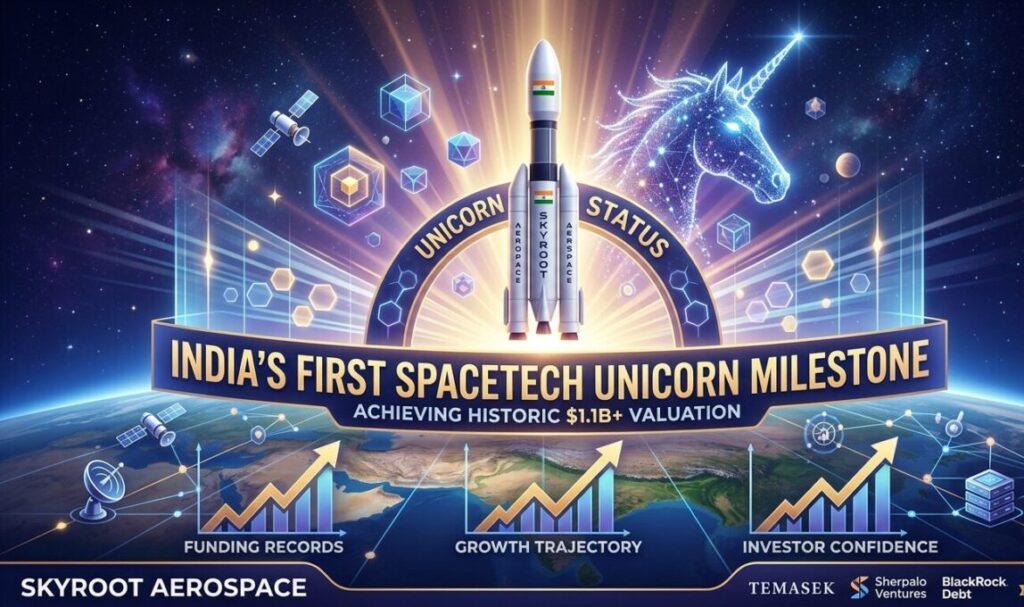
Let’s be honest. Building a startup is brutally hard. Building a deep-tech space startup in a market historically monopolized by the government? That requires a special kind of madness. But it works. Take Skyroot Aerospace. They just pulled off a $60 million funding round, co-led by Ram Shriram’s Sherpalo Ventures and Singapore’s GIC, hitting a massive $1.1 billion valuation. They are officially India’s first spacetech unicorn.
Grab a coffee, and let’s break down exactly what is happening here, why the smart money is pouring in, and where this rocket is actually headed.
What does the company do (problem and solution)
The reality is, getting to space has always been a bureaucratic, expensive nightmare. For decades, state-run agencies called all the shots. It was rigid. It was slow. If you were a commercial player wanting to launch a small satellite, you had to wait in line for years and pay exorbitant fees. Enter Pawan Kumar Chandana and Naga Bharath Daka. Both are former scientists from the Indian Space Research Organisation (ISRO). They saw this massive bottleneck first-hand. So, in 2018, they founded Skyroot Aerospace in Hyderabad to fix it.
Their solution is the Vikram series of rockets. They build small and medium-lift launch vehicles specifically for the global satellite market. Their flagship, Vikram-1, is engineered to carry payloads of up to 480 kg into low Earth orbit. They aren’t trying to build the biggest rocket. They are trying to build the most efficient one. They want to provide on-demand, cost-effective, and flexible satellite launch services.
And they are not just pitching decks. They are flying hardware. In November 2022, they made history by successfully launching Vikram-S. It was India’s first privately built rocket to reach space. That launch fundamentally changed the narrative. It proved a private Indian company could execute on the hardest engineering challenges imaginable.
Why this company raised $60million- main reasons?
Here is the kicker. You don’t get $60 million from heavyweights like GIC, BlackRock, and Ram Shriram just for a cool science project. Investors at this level want to see a clear path to commercial dominance. This new round brings Skyroot’s total funding to roughly $160 million. So, where is the cash actually going?
Scale. It is all about scale. A significant chunk of these funds will be poured straight into ramping up their manufacturing capacities. They are heavily investing in specialized machinery and advanced testing facilities. The goal is incredibly aggressive. They are setting up their new Infinity campus in Hyderabad to churn out one fully built rocket every single month.
But right now, the immediate focus is Vikram-1. The funds are financing the final, critical preparations for this orbital rocket’s maiden launch. They are planning a 15-minute mission that will carry a mixed payload of earth observation satellites and in-orbit experimental modules. These payloads will be deployed at an altitude exceeding 400 km.
They are also looking ahead to heavier payloads. A portion of the capital is earmarked for developing Vikram-2. This will be a much larger, 1-tonne class launch vehicle powered by an advanced cryogenic upper stage. That upgrade is crucial for expanding the range of missions they can handle.
Vision and Future plans of Skyroot aerospace
Founders love to talk about vision. For Skyroot, the vision is cold, hard execution. They want to build the foundational infrastructure for future space access, offering the absolute best cost-to-performance ratio in the orbital-launch industry. The global small satellite launch market is booming. It already accounts for nearly 38% of total launch activity globally. Skyroot wants a massive piece of that pie. And they are getting noticed. They are already fielding serious interest from customers across the United States, Europe, and South East Asia.
Right now, the company is still in the pre-revenue stage. That is normal for deep tech. Heavy R&D comes first. But they expect to start making real money later this year when the commercial launches officially kick in.
Before they open the floodgates for full commercial operations next year, they plan to conduct two to three more test launches. Customers in this industry are pragmatic. They want to see a rocket fly successfully before they commit to long-term contracts. Skyroot knows this. Once Vikram-1 proves itself in orbit, they fully expect their contract book to improve significantly. It’s lonely. It’s hard. But they are positioning themselves to be the go-to choice for small satellite operators globally. If they hit their cadence of one launch a month, they won’t just be participating in the space economy. They will be driving it.
Resources used in this article
- Ram Shriram’s Sherpalo Ventures to lead $60 million funding round in Skyroot; valuation hits $1.1 billion – The Economic Times
- Skyroot becomes India’s first spacetech unicorn, 4th in 2026 – The Times of India
- How Much Did Skyroot Aerospace Raise? Funding & Key Investors – Clay
Read about – Startup business models.
Read in – Startup Directory
Read about Solo businesses

Hi Friends, This is Swapnil; I love reading and sharing knowledge. Currently working as a content writer at startupsunion.com. You all can hang out with me here.