Grab a coffee and let’s break down how a solo founder named Vikash built a $12,000-month business. The reality is, he didn’t do it by building the next massive social network. He did it by solving one very boring, very specific problem.
What the company actually does
Imagine you run an online shop selling custom t-shirts. You have 10 new art designs, and you need to show them on 5 different blank t-shirt photos (which are called templates). That is 50 total images you need to create.
Doing that manually in Photoshop takes 30 to 40 minutes. It’s mind-numbing, repetitive work.
So, Vikash built a Photoshop plug-in called Bulk Mockup. You select your folder of templates, select your folder of designs, and hit a button. The plug-in automatically creates all 50 mockups in about one minute. He charges a monthly subscription for this tool, saving his customers massive amounts of time. Simple. Effective.
The Growth Framework & Distribution Strategy of Vikash
Let’s be honest, most founders get obsessed with going viral. Vikash completely ignores that.
His entire distribution strategy relies on a “content flywheel.” The fuel for that flywheel? Pure customer pain. He finds exactly what is frustrating his target audience and creates straightforward, unpolished YouTube tutorials solving that exact issue.
Here is the kicker. He gathers this pain from four specific places:
- Lurking in communities: He silently reads where his customers hang out to spot repeated problems before ever trying to sell to them.
- Onboarding emails: When someone signs up, he emails them asking if they want a custom tutorial made just for them.
- Customer support: He treats support as an education channel. He gets on Zoom calls, records the workflow, and turns those edge-case problems into content.
- YouTube comments: He reads the comment sections of other videos in his niche to find unresolved complaints.
But finding the pain is only half the battle. Then comes distribution.
He relies heavily on YouTube and Google Search. Before he hits publish, he optimizes his videos for SEO. He drops the exact search keywords his customers use into the video title, the description, and-this is crucial-the first 30 seconds of the spoken transcript. Because Google pushes YouTube videos to the top of search results, 22% of his channel’s views come directly from Google Search.
And it works. One of his videos only has 370 views. But it brought in three paying customers, making him $45 in monthly recurring revenue. It sits there forever. A permanent asset.
The Tech Stack used by vikash
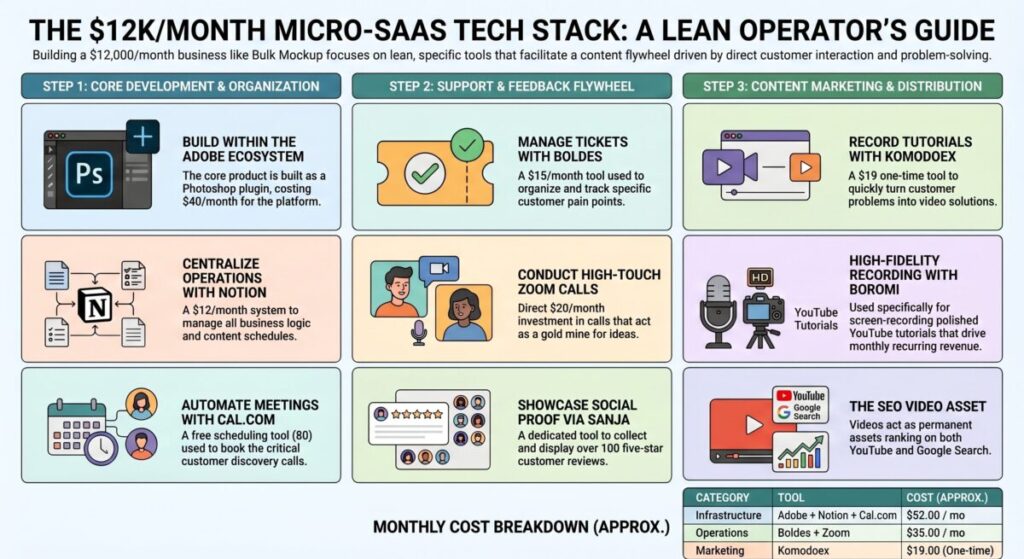
You don’t need a massive enterprise budget to run something like this. Here is the exact stack he uses to build the product, talk to customers, process payments, and market his business:
- Adobe (Photoshop): The core software where his plug-in lives. $40 a month.
- Komodoex: A tool to record quick video tutorials for customers. $19 for a lifetime deal.
- Boldes: Customer support ticket management. $15 a month.
- Zoom: For live support and screen-sharing calls. $20 a month.
- Notion: To organize his entire content strategy. $12 a month.
- Cal.com: For scheduling calls with customers. $0 (totally free).
- Sanja: To display customer reviews on his website.
- Boromi: A screen recorder for his main YouTube tutorials.
- Gumroad: To host his sales dashboard and handle transactions.
Talk to your customers. Find their pain. Build the solution. It’s lonely. It’s hard. But it works.
Read more about Solo businesses.
More Solo businesses – Maddox, Ivonne, Super Demo, Journalable
Read about – Startup Business Model
Read in – Startup Directory

Hi Friends, This is Swapnil; I love reading and sharing knowledge. Currently working as a content writer at startupsunion.com. You all can hang out with me here.