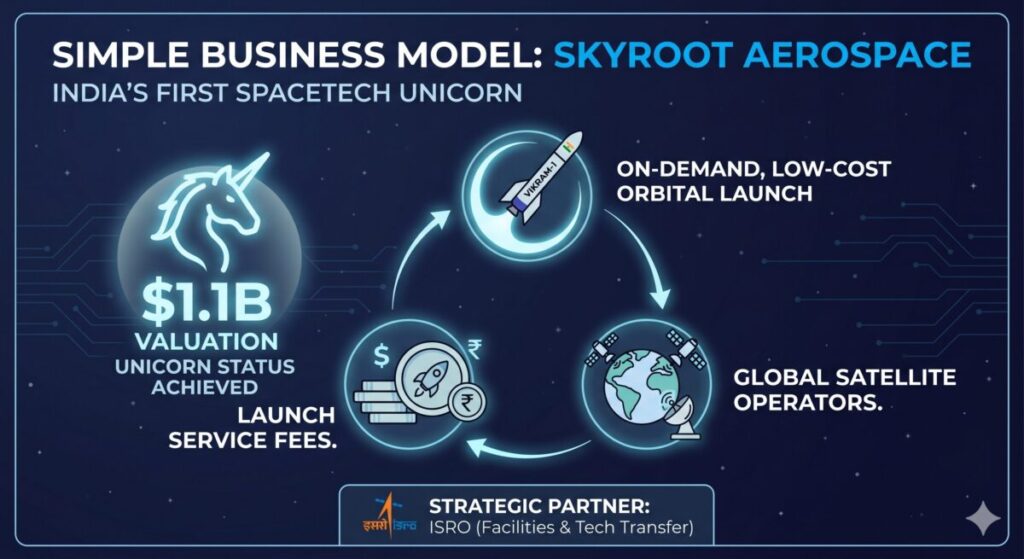
Getting to orbit used to be a rich nation’s game. It was slow, and state-run agencies called all the shots. Right now, there are over 20,000 satellites either in orbit or waiting in a massive backlog to get there. Grab a coffee, and let’s break down how Skyroot Aerospace is tackling this.
How Skyroot Aerospace started ?
The reality is, the launch bottleneck was suffocating commercial growth. Enter Pawan Kumar Chandana and Naga Bharath Daka. These guys are former ISRO scientists who saw the problem first-hand, left the mothership in 2018, and founded Skyroot Aerospace to fix it.
Their solution is the Vikram series of rockets. Their main workhorse, Vikram-1, is explicitly designed to haul payloads up to 480 kg into low Earth orbit. And their target audience is laser-focused: global small-satellite operators who desperately need reliable, on-demand, and flexible access to space.
Competitive advantage
You don’t survive in deep tech without a serious edge. Skyroot has a few.
- Cost: Here is the kicker. They are positioned to undercut established global players like SpaceX and Rocket Lab by 30 to 40 percent. That is a massive margin advantage.
- Rapid Cadence: They are scaling up their new Infinity campus in Hyderabad with one very aggressive goal. They want to manufacture and launch one rocket every single month.
- First-Mover Execution: They aren’t just pitching decks. In November 2022, they actually launched Vikram-S. It was India’s first privately built rocket to reach space.
- Lean Supply Chain: They ditched the slow government procurement cycles. Instead, they rely on agile, precision domestic partners like MTAR Technologies to build their hardware.
Marketing Technique of Skyroot Aerospace
- Product Demonstration: In rockets, PR doesn’t sell payloads. Successful hardware does. Executing the Vikram-S launch built the ultimate credibility needed to win over clients.
- Direct B2B Outreach: They are dealing directly with international commercial and government players. And they are already fielding serious interest from the US, Europe, and South East Asia.
- Pre-Launch Contracts: Their strategy is to secure long-term contracts the second a test flight proves the rocket is reliable. Customers want to see successful launches before committing, and Skyroot expects the contract book to fill up quickly once Vikram-1 flies.
How Skyroot Aerospace makes money
The reality is, they don’t make money yet. They closed out FY25 still in the pre-revenue stage, posting widened losses of Rs 99.70 crore because of heavy R&D investments. But that is just how the deep tech game is played. They expect the actual revenue to kick in later this year. So, how do they monetize? By charging a fee to place commercial and government payloads-like earth observation satellites and experimental modules-into orbit.
Market share
| Market Metric | Percentage Share |
|---|---|
| Commercial Launches (Share of overall market demand) | 55% |
| Small Satellite Segment (Share of total global launch activity) | 38% |
| Skyroot’s Target Capture (Bull case estimate of global market) | 5% |
Business Model canvas of Skyroot Aerospace
- Key Partners: You need deep pockets and smart friends. They partner with ISRO, IN-SPACe, and domestic vendors like MTAR and Solar Industries. Plus, they have heavy hitters like GIC, Temasek, and BlackRock backing them.
- Key Activities: Hardcore R&D and manufacturing the Vikram series of launch vehicles.
- Value Proposition: Cost-effective, flexible, and on-demand satellite launch services.
- Customer Relationships: Long-term B2B contracts built entirely on flight heritage and trust.
- Customer Segments: Global satellite operators needing space access for telecom, agriculture, weather forecasting, and defense.
- Channels: Direct B2B sales and international partnerships.
- Cost Structure: Brutal. Heavy capital expenditure on R&D, specialized machinery, and their Infinity manufacturing campus.
- Revenue Streams: Launch fees from placing mixed payloads into low Earth orbit, expected to roll out soon.
Conclusion: Is it a viable business
Absolutely. But it is high stakes. They have raised around $160 million in total funding. They hit a massive $1.1 billion unicorn valuation. They even recently pulled down Rs 100 crore in debt financing from BlackRock to keep the working capital and operations moving smoothly.
It’s lonely. It’s hard. But it works. With the small satellite market booming, their aggressive cost reduction strategy is exactly what the industry needs. If they hit their launch cadence, they won’t just survive this transition from R&D to commercial operations. They will dominate it.
Read about – Startup News
Read in – Startup Directory
Read about Solo businesses

Hi Friends, This is Swapnil; I love reading and sharing knowledge. Currently working as a content writer at startupsunion.com. You all can hang out with me here.