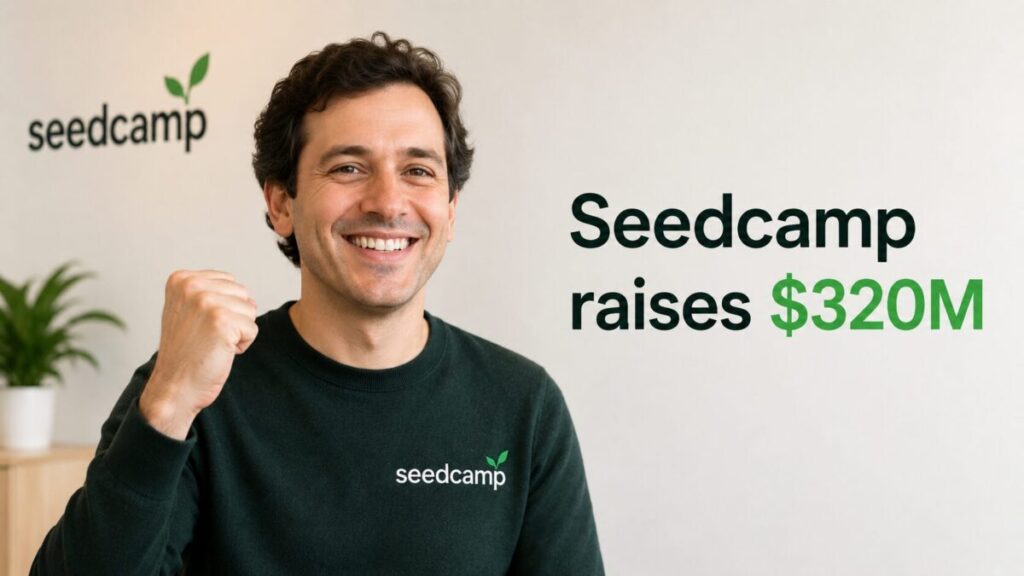
Seedcamp just raised $320 million. Full stop.
And if you’ve been watching European venture for any length of time, you already know that number is worth sitting with. This is Fund VII. The largest fund the firm has ever closed. More than double the $180 million they raised for Fund VI back in 2023. That kind of jump does not happen because of good timing or a favorable market. It happens because the numbers from the previous funds are hard to argue with.
Here’s what they’re building. And why founders should pay attention.
What Is Seedcamp and Why Does This $320M Fund Matter?
Seedcamp started in 2007. First fund: $2.5 million. That is not a rounding error. The firm that just raised $320 million began with a check that most growth-stage funds today would consider a rounding error in their reserve pool.
But they did something most early-stage investors talk about and very few actually do. They wrote the first cheque. Not the second. Not the bridge round after someone else took the risk. The very first institutional money into a company, before the category had a name, before the product had users, before anyone else was sure it was worth a meeting.
That is what “first-check investor” actually means. And Seedcamp has been doing it for nearly two decades.
The firm now manages over $1 billion in assets under management. The reality is, this $320 million raise is not just a fundraising milestone. It is a signal that Seedcamp is no longer operating purely as a European seed fund. They are building something with a much longer time horizon and a much wider geographic reach.
How the $320M Is Split: Seedcamp VII vs. the Select Fund
The $320 million is not sitting in one pot. Seedcamp is splitting it deliberately across two funds, each with a separate job to do.
$220 million goes into Seedcamp VII. That is the core fund. First cheques, pre-seed and seed stage, checks of up to $1.3 million. The firm plans to back roughly 35 new companies per year, totalling 100 to 120 startups across the life of the fund. They expect to lead about 70% of those deals, targeting 5% to 10% ownership at entry. Around 40% of the fund is set aside for follow-on rounds at seed and Series A.
The other $100 million goes into the Select fund, formally called Seedcamp Nation II. Here’s the kicker: this fund does not back new companies at all. It backs winners that are already in the Seedcamp portfolio. About 90% of Select’s investments come from within the existing portfolio, with average check sizes of $2 million to $3 million at Series B.
The reasoning is simple. Finding a great company early is genuinely hard. But once you’ve found one, walking away at Series B because you ran out of follow-on capital is an expensive mistake. The Select fund is Seedcamp fixing that problem.
Limited partners in Fund VII include British Business Bank, HarborVest, Schroders, and Sofina. And more than 80 founders from previous Seedcamp portfolio companies have reinvested in the fund as angels. When the people who actually went through the programme put their own money back in, that tells you something.
Seedcamp’s Biggest Wins: Revolut, Wise, UiPath, and More
Let’s be honest. Nobody raises $320 million on a good pitch deck alone.
Seedcamp raises $320M because the previous funds actually returned money. Real money. Not paper valuations. Not markups on the last round. Actual cash distributed to LPs.
Fund III has returned more than 13 times its investors’ capital on a distributed basis. That is 13x DPI. In European venture, where exits are slow and liquidity events are rarer than anyone likes to admit, that number is genuinely exceptional. Fund IV sits at over 5x net total value and is still being realised.
The portfolio explains how. Revolut is one of the most valuable fintech companies in the world. Wise changed how people move money across borders. UiPath became a global leader in enterprise automation and listed on the NYSE. Synthesia is defining AI video generation. Fluidstack is building GPU infrastructure for the AI era.
These were not obvious bets at the time. That is the point.
The firm has backed over 550 companies since its founding. So this is not a story about a handful of lucky picks. It is a portfolio with real depth, built through a process that has been refined over nearly 20 years.
Seedcamp Is Expanding Into the US: Here’s What That Means
The most interesting part of this raise is not the size. It is the direction.
Seedcamp already has offices in New York City and Miami. But with Fund VII, the firm is explicitly growing its US team and positioning what they call the “Transatlantic Bridge” as a core part of the investment thesis. Not a side project. Not a nice-to-have. A structural pillar.
Here is the thing about European founders in 2026. They are not building for their home market and then figuring out America three rounds later. They are thinking globally from the first week. A teenage dropout in Warsaw, a repeat founder in Paris, a deep-tech spinout in Zurich. The ambition is immediate. The challenge is access.
Access to US capital. US customers. US technical hires. That has always been the gap for European founders, and Seedcamp is building the infrastructure to close it.
Hilary Howe, who runs the New York office, described the shift clearly. Historically, European companies would build locally, dominate their market, raise a few rounds, and then eventually come to the US. Now they are coming right from the start.
San Francisco and Silicon Valley have also regained serious gravity in recent years, particularly around AI. Seedcamp wants to be the firm that sits on both sides of that bridge.
What Kind of Startups Will Seedcamp Back With Fund VII?
There is a clear answer here, and an equally clear list of things Seedcamp will not do.
Start with the exclusions. Capital-intensive businesses are out. Mobility companies, marketplaces that need to fund working capital, anything that burns through cash before proving the unit economics. Managing partner Reshma Sohoni said it directly: “We’re definitely a commercial-driven investor.” The fund is not here to subsidise supply-side economics on someone else’s marketplace.
Within those guardrails, Fund VII targets pre-seed and seed stage companies primarily in Europe and Israel, with selective bets in the US. Seedcamp typically invests as the first institutional investor and leads most of its initial rounds.
So what does the ideal founder look like? The profile has not changed much. Commercial instincts. Global ambition from day one. The ability to see a real problem and move fast on it. What has changed is how quickly the early signals appear. AI has compressed the timeline from idea to product-market fit significantly. Signals that once took two years to surface are now visible in months. That changes how Seedcamp evaluates companies, and how quickly they need to move.
Why Seedcamp Is Betting Big on Physical AI and Robotics
This is where it gets interesting.
For nearly two decades, Seedcamp’s portfolio has skewed heavily toward software. That is shifting. Not completely, not overnight. But the firm’s recent investments signal a clear directional change.
BioOrbit raised $13.2 million at seed in April. They are building space manufacturing infrastructure. Sunrise Robotics is developing autonomous robotics systems. Dust is an AI agent platform built for enterprise workflows. These are not pure software plays.
Tom Wilson, partner at Seedcamp, put the thesis plainly. LLMs have shown that AI works remarkably well with language and text. But applying that same intelligence to the physical world, to science, to manufacturing, to robotics, is still extremely early. And the markets involved are enormous.
Europe has a real edge here. World-class universities, deep engineering talent, and a growing culture of founders who want to take hard science and actually build companies around it. Seedcamp sees that as a structural advantage the continent has over the next decade.
The firm is also using AI inside its own operations. A two-person internal team is building automation tools to free up the investment team and let them spend more time with founders. Not as a headline. Just as a practical thing a seven-person firm does to stay sharp.
Fund III Returned 13x: Can Fund VII Match That Track Record?
Honestly? Nobody knows.
Venture fund performance takes a decade to fully play out. The conditions that built Seedcamp’s early portfolio, the wave of European fintech, the bull market, the liquidity environment, those exact conditions will not repeat. They never do.
But here is what is real. The team has seven investors, kept deliberately small, running a model where every partner works across the entire portfolio. No siloes. No lone-wolf deal-making. Collective conviction. That model has held up through nearly 20 years and multiple market cycles. That matters.
The LP base is institutional and experienced. British Business Bank, HarborVest, Schroders, Sofina. And more than 80 founders who have been through the Seedcamp experience chose to reinvest their own money. You cannot fake that signal. The people who saw it closest decided it was worth betting on again.
Seedcamp also published the LP fundraising deck used to raise Fund VII. That kind of transparency is unusual in venture. It does not happen unless the firm is confident in what the numbers show.
Whether Fund VII produces another 13x is a question that will take years to answer. But the fact that Seedcamp raises $320M from serious, experienced capital allocators, with founder-LPs backing them a second time, suggests the market thinks the answer might be yes.
Read about – Startup business models
Read in – Startup Directory
Read about Solo businesses

Hi Friends, This is Swapnil; I love reading and sharing knowledge. Currently working as a content writer at startupsunion.com. You all can hang out with me here.