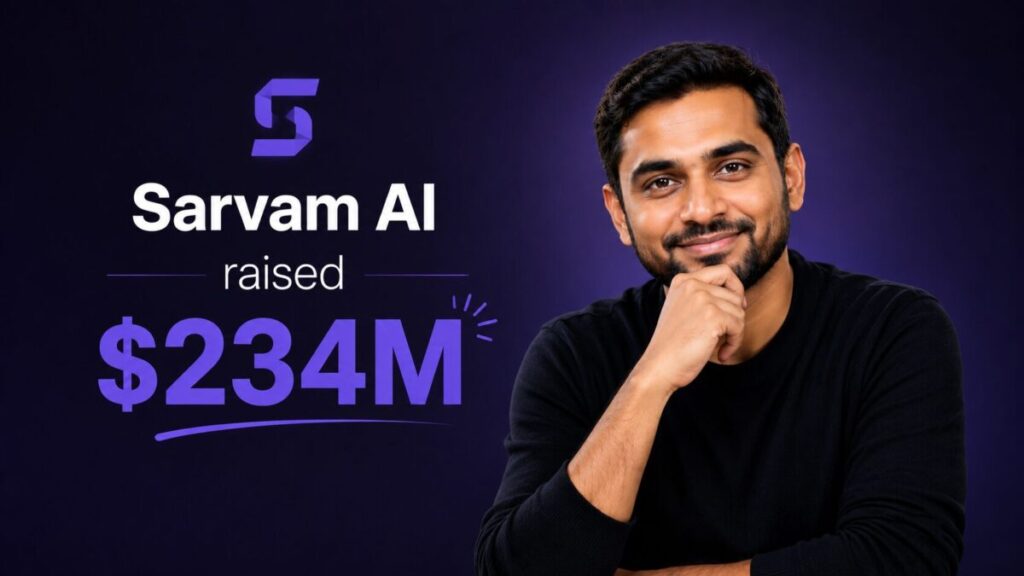
India has been talking about building its own AI for years. A lot of talk. Very little shipping. Sarvam AI just changed that conversation permanently.
On June 15, 2026, Sarvam announced it raised $234 million in the first close of its $300 million Series B round at a post-money valuation of $1.5 billion. That is not just a number. That is a statement. India’s AI ambition now has a real company, real capital, and real models behind it. And the world is paying attention.
What Is Sarvam AI and What Does It Do?
Sarvam was founded in August 2023 by Dr. Vivek Raghavan and Dr. Pratyush Kumar. Vivek brings experience building India’s digital public infrastructure, while Pratyush has led the country’s open-source AI efforts across Indian languages.
These are not startup tourists. Kumar holds a PhD from ETH Zurich and a bachelor’s degree from IIT Bombay, and before Sarvam, he worked at Microsoft Research and IBM Research. Raghavan is an IIT Delhi graduate who earned his PhD in electrical and computer engineering from Carnegie Mellon University. Both spent years at AI4Bharat, building Indian-language AI tools at IIT Madras long before generative AI became a buzzword in boardrooms.
The reality is, the founders understood one thing most people missed: India’s languages, its documents, its voice patterns, its context, none of it fits neatly into models built primarily on English data.
Sarvam builds across training and inference infrastructure, frontier models across text and other modalities, and AI products for enterprises, developers, and government, with focus verticals in banking, insurance, government technology, and defence.
So it is not just a model company. It is not just a product company. It is the full stack. That distinction matters more than people realize.
Sarvam AI Raises $234 Million and Becomes a Unicorn
Here is the kicker. Sarvam AI raised $234 million, or around Rs 2,210 crore, in a Series B funding round led by HCLTech and Bessemer Venture Partners, with participation from existing investors Khosla Ventures and Peak XV Partners.
Unicorn status. Just like that.
The fundraise marks a sharp jump from Sarvam’s previous valuation of about $196 million in 2025. But valuation alone is not what makes this interesting. What makes it interesting is the usage underneath it. Its conversational platform now handles more than 2 million interactions a day, doubling in two months, while its inference platform processes 10 million API calls daily, tripling in three months.
That is not hype. That is product-market fit showing up in the data.
And the round is not even done. Sarvam did not disclose the timeline for closing the remaining $66 million of the round. More is coming. The question is not whether Sarvam will close it. It is who else wants in.
Who Invested in Sarvam AI’s Series B Round?
Let’s be honest, the investor list here tells a specific story.
HCLTech and Bessemer Venture Partners invested in the round, with continued support from existing investors Khosla Ventures and Peak XV Partners. Early backer Lightspeed Venture Partners did not participate this time around.
Each name brings something real. HCLTech brings enterprise distribution across global markets. Bessemer adds global venture credibility. Khosla Ventures, led by Indian-origin investor Vinod Khosla, has been in since the early days. Peak XV, formerly Sequoia India, has stayed through multiple rounds.
Pankaj Mitra, Partner at Bessemer Venture Partners, said that Pratyush and Vivek have brought together a rare combination of research depth, engineering talent, and institutional trust to meet India’s voice and agentic needs.
But here is what that investor list actually signals to the market. When a company like HCLTech writes a $150 million check, it is not a passive bet. It is a business decision. Enterprise clients notice. Governments notice. Other investors notice.
That is how momentum compounds.
Why Did HCLTech Lead the $150 Million Investment?
Good question. And the answer is more strategic than it looks on the surface.
As part of the transaction, HCLTech will acquire a 10.46 per cent stake in the Bengaluru-based startup for Rs 1,427.25 crore, making it the lead strategic investor. So why does one of India’s largest IT services companies write that kind of check into a three-year-old startup? Because the game has changed. Enterprise clients no longer just want software. They want AI that works inside their walls, on their data, without routing everything through a foreign model.
C Vijayakumar, CEO and Managing Director of HCLTech, said the partnership would combine Sarvam’s AI research capabilities with HCLTech’s enterprise expertise, engineering talent, and global customer relationships to build a comprehensive sovereign AI ecosystem for India and international markets.
That is the real play. HCLTech has decades of enterprise relationships. Sarvam has the models. Put them together and you have something neither can build alone.
By combining Sarvam’s research with HCLTech’s enterprise transformation capabilities, global client footprint, software intellectual property, data assets, and engineering expertise, the partners aim to build an end-to-end sovereign AI ecosystem.
For HCLTech, this is not a financial bet. It is a product strategy. And for Sarvam, it is distribution that would take a decade to build independently.
Smart deal. Both sides knew it.
How Will Sarvam AI Use the $234 Million Funding?
Three buckets. Straightforward.
The investment will fund Sarvam’s continued research on training its next frontier model for agentic, coding, and cybersecurity use cases, as well as access to compute at scale to expand its forward-deployed motion across key verticals.
First, frontier model research. The next generation of models needs to handle complex agentic tasks, write and review code, and operate in high-stakes cybersecurity environments. These are the use cases enterprises will pay serious money for. And Sarvam wants to own that layer.
Second, compute. The company plans to use the capital to secure compute capacity at scale. Building and running large models costs an enormous amount in GPU infrastructure. There is no way around it.
Third, vertical deployment. It plans to expand across four verticals: banking, insurance, government technology, and defence.
And the real-world proof is already there. A nationwide voice campaign for a leading insurance provider facilitated low-cost policy renewals for 45 million policyholders. Sarvam also partnered with SBI Life Insurance to deploy generative AI applications for customer engagement and sales support. A large fintech company is using its agentic AI platform to support a sales force of more than 350,000 people.
These are not experiments. These are live, production deployments at population scale. That is a different category entirely.
How Is Sarvam AI Different from ChatGPT and Other AI Tools?
This is the question everyone keeps asking. And the answer is worth slowing down for.
ChatGPT, Claude, Gemini. They all understand Hindi and Tamil at a surface level. But surface level is not enough when you are building for a country with 22 official languages, hundreds of dialects, and a population that overwhelmingly communicates by voice, not text. Rather than simply adapting a foreign large language model like Gemini, GPT, or Claude, Sarvam built their AI models entirely from scratch in India, doing everything from data collection and model design to training and deployment.
That is a fundamentally different approach. And it shows in the benchmarks.
The company launched a 30-billion-parameter model and a 105-billion-parameter model, both using a mixture-of-experts architecture designed to improve efficiency while maintaining performance across reasoning, programming, and tool-use tasks. The 30B model was trained on 16 trillion tokens and the 105B on 12 trillion tokens, covering code, general web data, specialized knowledge, mathematics, and multilingual content.
The 105B model clocks 98.6 on Math500 and wins 90 per cent of pairwise comparisons in Indian language benchmarks, outperforming models significantly larger in size.
Both models are open-source under the Apache 2.0 license. Any Indian developer, startup, or government body can build on them for free. That is a distribution philosophy that OpenAI and Anthropic simply do not offer.
So when people ask how Sarvam is different from ChatGPT, the honest answer is: it was built for a different world entirely.
What Does Sarvam AI’s Unicorn Status Mean for India’s AI Future?
Timing is everything in this business. And the timing here is not a coincidence.
The funding comes amid growing calls for India to develop sovereign AI capabilities following the US government’s export-control order blocking foreign nationals from accessing Anthropic’s latest models. Sarvam co-founder Pratyush Kumar linked the funding round directly to that development, writing on X: “You should not confuse access with ownership or adoption itself as advantage.”
Read that line again. Access and ownership are not the same thing. India has had access to foreign AI tools. But the moment a foreign government decides to restrict that access, it is gone. Overnight. No warning. Sarvam is building for the world where that switch gets flipped. And as it turns out, that world arrived faster than anyone expected.
Pratyush Kumar put it plainly: “We are clear that research-led innovation to create AI that works at India’s scale is a very large opportunity. That means models that understand our voices, read our documents, and serve intelligence at a cost every enterprise and government can afford.”
Here is what Sarvam AI raising $234 million actually means for India’s AI future. It means the country is no longer just an adoption market. It is becoming a creation market. That shift, from consuming foreign AI to building sovereign AI, is what changes the long-term equation.
The $300 million round is not fully closed. The next frontier models are still in training. Government deployments are still scaling. Revenue is still early relative to the ambition. But the direction is set. And in a space this fast-moving, direction matters more than almost anything else.
India is building its own AI stack. Sarvam AI raised $234 million to make sure that happens on India’s terms.
Read about – Startup business models
Read in – Startup Directory
Read about Solo businesses

Hi Friends, This is Swapnil; I love reading and sharing knowledge. Currently working as a content writer at startupsunion.com. You all can hang out with me here.