Nuclear energy makes a lot of people nervous. It carries decades of political baggage, public skepticism, and genuinely complicated history. And yet, right now, some of the smartest industrial money in France is quietly betting big on a startup that is building a fourth-generation nuclear reactor from scratch.
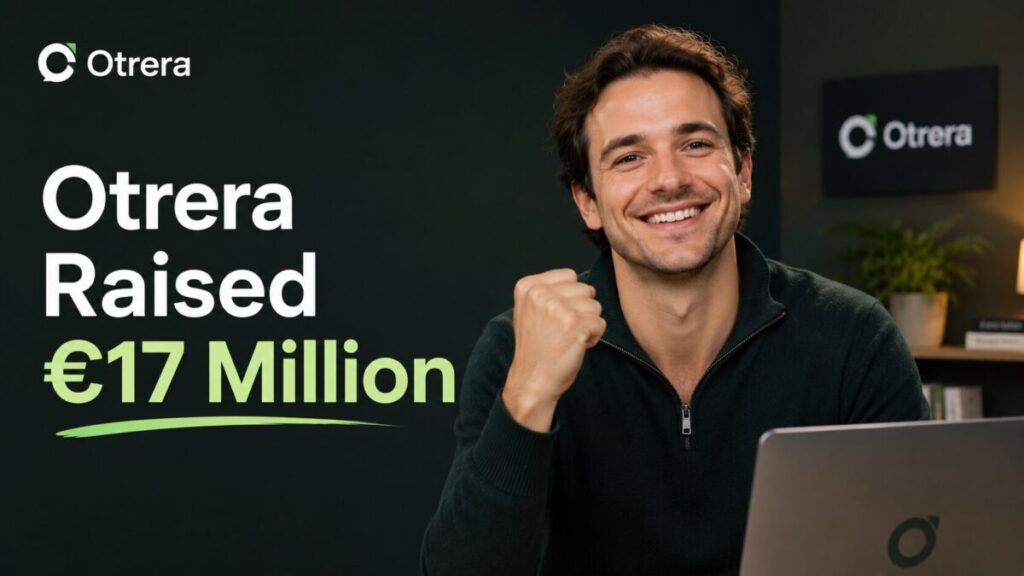
Otrera raised €17 million in May 2026. That is the headline. But the real story is what this company is, why serious players are backing it, and what it is actually trying to build. Because this is not a PowerPoint company. This is getting real, fast.
What Is Otrera and What Does It Do?
Otrera is a French deeptech startup, founded in 2023 and based in Aix-en-Provence. It was spun out of the CEA, which is the French Alternative Energies and Atomic Energy Commission, an organisation with over five decades of nuclear research behind it. So right from the start, Otrera is not starting from zero. It is standing on serious shoulders.
The company was co-founded by Frédéric Varaine, a nuclear specialist, and entrepreneur Jean-Éric Lucas. They lead a team of around 40 people working on one thing: a fourth-generation modular nuclear reactor. Specifically, a Sodium-cooled Fast Reactor, which the industry calls an SFR.
The target customers are municipalities needing district heating, energy-heavy industries, and large data centers. All sectors that need reliable, clean power and cannot afford intermittency.
That is the pitch. Simple. Focused. And technically very ambitious.
Why Did Otrera Raise €17 Million?
Here is the thing about deep tech companies. There is a point in every serious technical program where you move from “proving the concept works” to “actually building the thing.” That transition is expensive. It is also where most companies either grow up or fall apart.
Otrera raised €17 million because it hit that exact moment.
Its first funding round closed in December 2024 and brought in €2.5 million. That was enough to get moving. But the next phase, launching the Avant-Projet Détaillé, which is essentially the detailed preliminary design of the reactor, demands a completely different level of resource.
The reality is, you cannot run serious nuclear engineering on a seed round. You need industrial partners. You need testing infrastructure. You need people who have built real things before.
So the €17 million raise, closed in May 2026, is the funding that takes Otrera from a credible research-stage startup into an engineering and industrial preparation machine. And that distinction matters enormously.
Who Are the Key Investors Behind Otrera’s €17 Million Round?
This is where it gets genuinely interesting. When Otrera raised €17 million, it was not venture capitalists writing checks from a spreadsheet. It was a consortium of nine strategic industrial shareholders, each bringing operational weight to the table alongside capital.
The group includes Groupe ADF, Isospin Exergon, Ingerop, Fortil Group, Normandie Participations, Onet Technologies, Groupe REEL, and SNEF / Ekium.
But the headline name is “Groupe EDF.” France’s national electricity giant entered Otrera’s capital for the first time in this round. EDF is one of the largest nuclear operators on the planet. When they put money into a sodium fast reactor startup, that is not a casual move. That is a signal.
Normandie Participations, the investment arm of the Normandy region, also joined as a minority shareholder and contributed an additional €1.5 million grant separately.
And here is the kicker. These are not passive investors. These are companies that build power plants, manage nuclear sites, and engineer industrial systems for a living. Their involvement means Otrera is gaining partners who can actually help bring the reactor to life, not just fund it on paper.
What Is a Sodium-Cooled Fast Reactor (and Why Does It Matter)?
Fair question. Most people have never heard of one.
A Sodium-cooled Fast Reactor uses liquid sodium as its coolant instead of water. That one change creates a cascade of significant advantages. Sodium allows the reactor to run at higher temperatures and with faster neutrons. And faster neutrons mean the reactor can burn spent nuclear fuel from existing conventional reactors as its primary energy source.
Read that again. It can use nuclear waste as fuel.
France has been running nuclear plants for decades and has accumulated enormous amounts of spent fuel assemblies. Otrera’s reactor is designed to take that spent fuel and extract energy from it. What was a storage problem becomes an energy resource.
The planned output is 110 MWe in electrical capacity and 180 MWth in thermal capacity. Compact enough to be modular. Powerful enough to serve real industrial and community needs.
And unlike solar or wind, this produces baseload power. It runs constantly, regardless of cloud cover or wind speed. For industries that cannot have the lights go out, that reliability is not a nice-to-have. It is the whole point.
How Will Otrera Use the €17 Million Funding?
This is where founders either get specific or lose credibility. Otrera gets specific. The money goes to four areas.
First, launching the detailed preliminary design of the reactor. This is the engineering phase where every component and system gets formally validated on paper before anything gets physically built.
Second, demonstrating technology through dedicated test setups. Otrera will build specific test rigs to validate technical choices around sodium handling, reactor safety systems, and component performance. You do not skip this step. Not in nuclear.
Third, growing the team. More engineers, safety specialists, and industrialization experts. A 40-person team building a fourth-generation reactor is already lean. This capital helps add depth.
Fourth, and this one is worth noting, launching the first operational studies for a factory in Cherbourg-en-Cotentin in Normandy. That factory is targeted for readiness by 2028. Normandy has deep nuclear industry roots, so the location is not random. It is strategic.
What Is France 2030 and How Is It Supporting Otrera?
France 2030 is a €54 billion government investment programme focused on reindustrialising France and positioning the country in future technology sectors. Advanced nuclear is explicitly one of those sectors.
Otrera is a laureate of France 2030. That status is not ceremonial. It means the company receives direct grant funding as part of its capital raises. A portion of the €17 million includes France 2030 subsidies blended with private equity from the industrial consortium.
The reality is, government backing in deep tech does two things. It provides capital that does not dilute founders. And it sends a signal to every private investor in the room that the state has reviewed the technology and believes it is worth funding.
For a company building something as technically complex and long-cycle as a sodium fast reactor, that government conviction matters. It reduces perceived risk. And in fundraising, reduced perceived risk means faster, cleaner closes.
What’s Next for Otrera After This Funding Round?
Otrera raised €17 million and is already announcing what comes next.
Before the end of 2026, the company plans to launch a third funding round targeting at least €40 million. That capital will push critical reactor components to higher Technology Readiness Levels, continue engineering studies, and accelerate the Cherbourg factory build.
The longer-term target is commissioning the first industrial demonstrator reactor by 2032.
But there is something else worth mentioning. Otrera signed a Memorandum of Understanding with JAEA, the Japan Atomic Energy Agency, to exchange knowledge on loop-type sodium-cooled fast reactors. Japan has its own deep history with this technology. Two countries, two institutions, comparing notes on what works and what does not.
That kind of international technical collaboration does not happen with companies that have shaky foundations. It happens with teams that have earned scientific credibility.
Final Thoughts
Here is what I keep coming back to. When Otrera raised €17 million, the company did not just close a funding round. It crossed a threshold. From research credibility to industrial seriousness.
The investors are real operators. The government support is structural, not ceremonial. The technology solves an actual problem, specifically what to do with spent nuclear fuel while simultaneously producing clean baseload power. And the founding team has the scientific pedigree to pull it off.
None of this means it will be easy. Building a fourth-generation reactor is one of the hardest things a company can attempt. The timeline to 2032 is long. The capital requirements ahead are substantial.
But the pieces are in place. And in deep tech, that is actually rare. Watch Otrera. Closely.
Read about – Startup business models
Read in – Startup Directory
Read about Solo businesses

Hi Friends, This is Swapnil; I love reading and sharing knowledge. Currently working as a content writer at startupsunion.com. You all can hang out with me here.