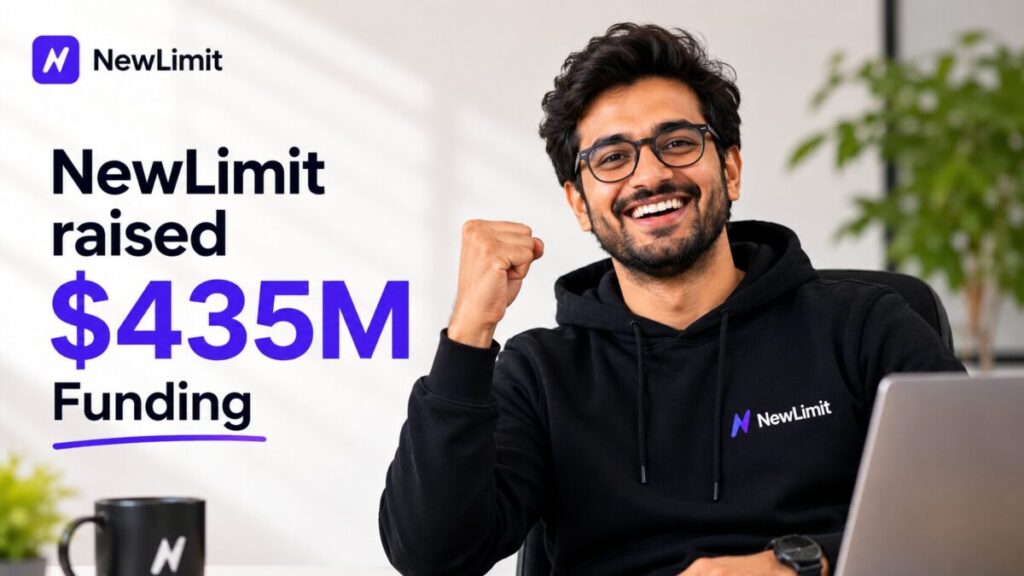
When a biotech startup with zero products on the market raises $435 million, most people raise an eyebrow. But NewLimit raised $435M in June 2026, and the more you dig into why, the more it starts to make complete sense. This is not hype. This is a company that produced data so surprising, it changed its own timeline. And investors noticed.
Here is everything you need to know.
What Is NewLimit and What Does It Do?
NewLimit is a South San Francisco-based biotech company. Founded in 2021. Simple enough. But what it is actually trying to do is anything but simple: reverse aging at the cellular level.
The science behind it is called epigenetic reprogramming. Here is the short version. Your DNA is the instruction manual your cells use to function. But over time, the chemical tags sitting on top of that DNA, the ones that tell cells which genes to switch on and which to ignore, get scrambled. Cells start behaving older than they should. They lose their ability to repair, regenerate, and respond the way young cells do.
NewLimit’s medicines are designed to fix those tags. Not by rewriting your DNA. By reorganizing the instructions your cells already have.
Think of it like this. The book is fine. The bookmarks just fell out. NewLimit is putting them back.
So the company’s lead program targets the liver, and for good reason. The liver is one of the most aging-sensitive organs in the body. Early lab results showed their prototype medicine could reverse cell age in old human liver cells, restoring signs of youthful function. And when those results came in, the whole roadmap shifted. That is what set this fundraise in motion.
Who Led the $435M Funding Round?
When NewLimit raised $435M, the round was led by Founders Fund, Peter Thiel’s venture firm. That alone tells you something. Founders Fund does not back companies for the sake of a press release. They back science they believe will fundamentally change what is possible.
And they were not alone. New investors coming in for the first time included Thrive Capital, Greenoaks, and Quiet Capital. All credible, serious firms. But here is the part worth paying attention to: the investors who already knew NewLimit best chose to come back. Kleiner Perkins, Abstract, Valor Equity Partners, Human Capital, Nat Friedman, Daniel Gross, and Eli Lilly Ventures all returned for this round.
Eli Lilly Ventures is the venture arm of one of the most powerful pharmaceutical companies in the world. These are people who spend their careers evaluating drug science for a living. They looked at what NewLimit is building and said, “We want more of this.” That is not a small thing.
The reality is, this round becoming one of the largest private biotech financings of 2026 was not an accident. It was the product of genuine scientific progress, communicated clearly to the right people at the right time.
NewLimit’s Valuation Hits $3.1 Billion: How Did It Get There?
Here is the kicker. NewLimit raised $435M as a Series C, but to understand what $3.1 billion really means, you have to see the full arc.
The company started with $110 million in seed funding back in 2021. That was a big seed. Then came a $130 million Series B in May 2025. Then another $45 million top-up in October 2025. Before this Series C closed, NewLimit had raised around $325 million in total. After it closed, that number crossed $760 million.
That is a company that has nearly doubled its lifetime capital in a single announcement.
CEO and co-founder Jacob Kimmel confirmed the $3.1 billion valuation. For reference, rival longevity startup Retro Biosciences was last valued at $1.8 billion. Altos Labs, another player in the reprogramming space, launched in 2022, reportedly backed by Jeff Bezos with $3 billion. NewLimit is now in that same conversation but built on scientific results that came faster than even the founders expected.
That is how you get to $3.1 billion without a single product on shelves.
Who Founded NewLimit? The Brains Behind the Startup
Three people built this. And the combination is genuinely unusual.
Brian Armstrong is the co-founder and CEO of Coinbase, one of the world’s largest cryptocurrency exchanges. He brought the founding vision, the network, and early capital to NewLimit in 2021. Armstrong has spoken publicly about his belief that extending healthy human life is one of the most important problems worth solving.
Blake Byers is a former partner at GV, Google’s venture arm, and a trained bioengineer. That combination of scientific training and investment experience made him exactly the kind of co-founder a company like this needs. Someone who can talk to scientists and investors in the same breath without losing either.
And then there is Jacob Kimmel, a computational biologist and stem cell scientist who now serves as CEO. He is the scientific backbone of NewLimit. When he told Fierce Biotech that the team started getting data that was “far more compelling than we had ever expected at that point in time,” that quote carried weight. It is not founder cheerleading. It is a scientist saying the experiment worked better than the model predicted.
That kind of moment, where reality beats your projections, is rare. And it is exactly what changed everything here.
What Will the $435M Be Used For?
So now NewLimit has raised $435M. What happens with it?
The primary focus is getting their lead liver therapy into human clinical trials. The drug is delivered using lipid nanoparticle (LNP) technology, the same delivery method used in mRNA COVID-19 vaccines. It carries RNA instructions that activate specific proteins, called transcription factors, which then reprogram aging liver cells to function more like young ones.
Preclinical results showed the therapy could help livers recover faster from injury. It also improved resilience against dietary stress and alcohol-related damage. That is not nothing. That is meaningful early evidence.
But the liver is just the beginning. Beyond that program, NewLimit is working on therapies targeting endothelial cells in blood vessels, with an eye on chronic kidney disease, and T cells, where the company sees potential in autoimmune conditions like rheumatoid arthritis. The goal is to build a platform that works across organ systems, not just one disease in isolation.
And yes, the capital will also go toward growing the team and expanding laboratory infrastructure in South San Francisco. Good science requires people and space. Both cost money.
NewLimit’s First Human Trial: What Disease Is It Targeting?
This is where things get real. One of the biggest outcomes of NewLimit raising $435M is what it means for their clinical timeline.
Human trials are now expected to begin in 2027. That is a significant acceleration. As recently as May 2025, when NewLimit closed its Series B, company executives were saying human trials might not happen until 2030 or later. The reason for the shift? The data. A prototype medicine reversed cell age in old human liver cells in the lab, and the results came in far earlier than the company’s own models anticipated.
The Phase 1 trial will focus on patients with fatty liver disease, a condition tied to metabolic dysfunction that affects enormous numbers of people globally. Phase 2 plans are aimed at alcohol-related liver disease, where aging liver cells lose regenerative capacity and become increasingly vulnerable to damage.
And here is why this matters beyond NewLimit. If these trials succeed, it would represent one of the very first times an epigenetic reprogramming therapy has ever been tested in human subjects at all. The whole field is watching.
Why Are Investors Betting Big on Anti-Aging Biotech?
The fact that NewLimit raised $435M is not some isolated event. It is part of a much bigger pattern.
Retro Biosciences pulled in $180 million from Sam Altman, the CEO of OpenAI. Altos Labs launched with a reported $3 billion connected to Jeff Bezos. The world’s most successful people in technology are putting serious money into longevity science. Not as charity. As conviction.
Why now? Because the science actually started working. For a long time, cellular reprogramming was a fascinating idea trapped in academic papers. But over the past five years, researchers have demonstrated that aging is not a fixed, irreversible process. It is malleable at the cellular level. That shift in scientific understanding changed what investors thought was buildable.
The economic case is just as strong. Age-related diseases are crushing healthcare systems globally. Liver disease, kidney disease, cardiovascular disease, and autoimmune conditions. These are not rare problems. They affect billions of people and cost trillions of dollars. A therapy that addresses the root cause rather than managing symptoms for decades would be worth an extraordinary amount.
So when you see NewLimit raising $435M and hitting a $3.1 billion valuation with no products yet, it is not irrational enthusiasm. It is a calculated bet that the science is real, the team can execute, and the market is enormous. And right now, the data is telling investors they are probably right.
How NewLimit Compares to Other Anti-Aging Startups
NewLimit’s AI Technology: How It Discovers Anti-Aging Medicines
Read about – Startup business models
Read in – Startup Directory
Read about Solo businesses

Hi Friends, This is Swapnil; I love reading and sharing knowledge. Currently working as a content writer at startupsunion.com. You all can hang out with me here.