Flu vaccines have been around for more than 80 years. Think about that. Eight decades of research, reformulation, and annual rollouts – and we still cannot fully protect the elderly, the immunocompromised, or anyone unlucky enough to encounter a strain that emerged after the prediction window closed. That is not a small gap. That is a structural failure in how the world defends against respiratory viruses.
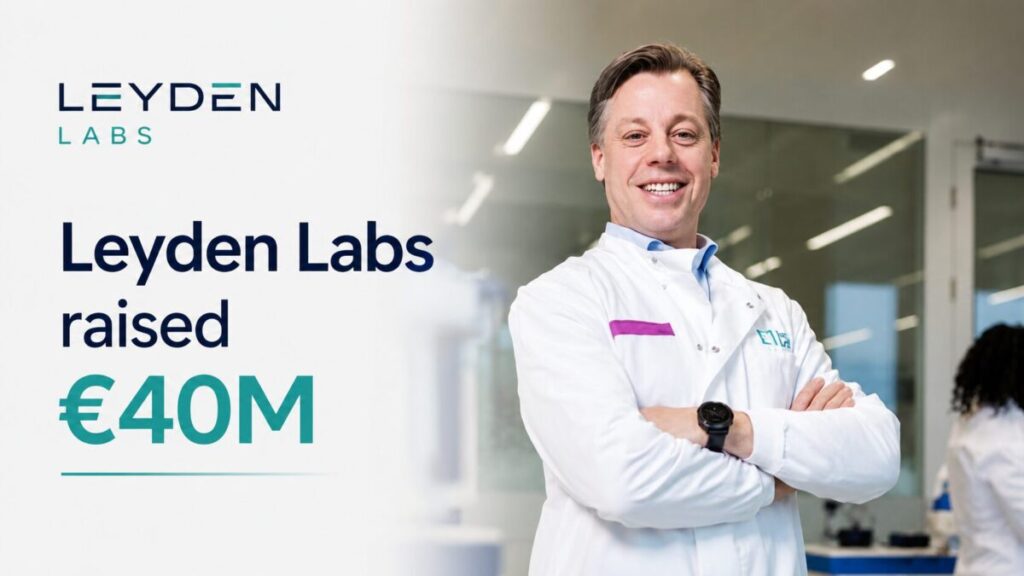
Leyden Labs thinks a nasal spray can do better. And the investor community is starting to agree. The Dutch biotech just closed a €40 million funding round, pulling in European public investors, a national promotional institution, the Gates Foundation, and a Singapore-based life sciences fund. That is not a typical syndicate. That is a signal.
What Is Leyden Labs and What Does It Do
Leyden Labs, formally Leyden Laboratories B.V., is a clinical-stage biotechnology company founded in 2020 and based in the Netherlands. The company was co-founded by Koenraad Wiedhaup, who serves as CEO, alongside Chief Scientific Officer Jaap Goudsmit, Ronald Brus, and Executive Chair Dinko Valerio.
The mission is simple, even if the science is not. Leyden Labs wants to free people from the threat of respiratory viruses. But here is what makes them different. They are not building another vaccine. They are developing a new class of broadly protective nasal sprays that deliver antibodies directly to the nose and upper respiratory tract, blocking viruses at the exact point where they first enter the body.
Let’s be honest, that is the part most platforms have ignored for years.
The company targets the most conserved regions of viruses, the parts that mutate the least, so their products stay effective even as viruses evolve. Leyden Labs currently has 78 employees and is advancing multiple programs through clinical development.
Leyden Labs Raises €40 Million: Who Are the Investors
This was not a quiet fundraise. The €40 million round announced in June 2026 brings together investors spanning Europe, the United States, and Asia. And the composition of that group tells you a lot about where confidence in Leyden Labs currently sits.
The round was made possible through the European Innovation Council’s Strategic Technologies for Europe Platform, known as EIC STEP, which funds companies working in areas critical to European technological readiness, including biotechnology. Invest-NL, the Netherlands’ National Promotional Institution, contributed €10 million to the round. Their mandate covers businesses and projects that drive societal transitions, innovation, and economic resilience.
The Gates Foundation Strategic Investment Fund joins as a first-time investor. So does ClavystBio, a life sciences venture investor established by Singapore’s Temasek. Other participants in the round were not publicly disclosed.
Leyden Labs was also selected for the EIC STEP Scale-Up program, which was a condition for the EIC Fund’s participation. Hermann Hauser, Member of the EIC Fund Board, put it plainly: “Leyden Labs represents the kind of breakthrough biotechnology innovation the EIC STEP Scale Up initiative was designed to support.” CEO Koenraad Wiedhaup described the round as far more than a capital event, calling it a signal of confidence in the scientific approach, the team, and the mission to change how the world protects itself against respiratory viruses.
And when you look at who signed the cheques, it is hard to argue with that read.
What Is PanFlu: The Nasal Spray at the Heart of This Raise
PanFlu is the lead program from Leyden Labs. It is a pan-influenza nasal spray in clinical development, designed to provide broad protection against influenza A and B strains, both seasonal and pandemic, by delivering protective antibodies directly to the respiratory mucosa.
Here is the kicker. Conventional flu vaccines require health systems to predict which strains will circulate months before flu season begins. Get the prediction wrong, and effectiveness drops sharply. PanFlu skips that problem entirely. It targets highly conserved viral regions, the stable parts of the virus, so there is no need for annual reformulation.
Leyden Labs has generated safety data and local delivery data from early-stage human trials. The efficacy case currently rests on preclinical work and results from non-human primate studies. Clinical proof in humans is still the work ahead.
The new €40 million will advance PanFlu through continued clinical development and also fund Leyden Labs’ broader mucosal pipeline targeting coronaviruses and other respiratory viruses. So this round is not just about flu. It is about building a platform that works across viral families.
How Leyden Labs’ Mucosal Protection Platform Works
The reality is, most immunological tools built over the last century protect people from the bloodstream outward. Vaccines and systemically administered antibodies generate systemic immune responses. That works well for many diseases. But for respiratory viruses, it means protection kicks in only after the virus has already entered the body through the nose and throat, where it starts replicating.
Leyden Labs is trying to move that line of defence earlier.
The Mucosal Protection Platform delivers broadly protective antibodies directly to the respiratory mucosa. The goal is to neutralise viruses before they can establish an infection. Stop them at the gate, not after they have already walked in.
And this matters enormously for one particular group. The elderly and immunocompromised individuals often cannot mount strong systemic immune responses. Traditional vaccines regularly underperform for exactly these populations. A nasal spray that does not depend on systemic immune function could change outcomes for the people most at risk.
The product is also designed to be self-administrable. That is not a small detail. It directly shapes how easy this could be to deploy at scale. Leyden Labs is applying the Mucosal Protection Platform across influenza, coronaviruses, and other respiratory viruses, building a portfolio of candidates from a single technological base. That is the kind of leverage that serious investors pay attention to.
Why the Gates Foundation Backed Leyden Labs
Let’s be honest. When the Gates Foundation moves into a biotech round, it means something specific. They do not scatter capital across sectors. Their mandate is focused, tightly, on global health and improving access to healthcare in low- and middle-income countries.
The investment in Leyden Labs is tied directly to that mission. The Gates Foundation funding will support work to identify and build strategies to improve access to Leyden Labs’ products in lower-income markets. These are places where seasonal flu and pandemic-scale outbreaks cause the most harm and where conventional vaccine distribution regularly breaks down due to cold chain limitations, infrastructure gaps, and the cost of annual reformulation.
A self-administrable nasal spray that does not require annual reformulation could be transformatively easier to distribute in those settings. That is the argument. And the Gates Foundation appears to have bought it.
Ineke Cazander, Investment Principal at Invest-NL, framed it clearly: turning breakthrough innovations into societal solutions requires access to patient capital. The Gates Foundation’s entry gives Leyden Labs a dual mandate. Prove the science works clinically. And build a real, credible path to global access. That is a harder job than just running trials. But it is also what separates companies that genuinely matter from companies that just raise money.
Leyden Labs Total Funding: How Much Has the Company Raised
This €40 million round did not come out of nowhere. Leyden Labs has been on a sustained fundraising run since it was founded in 2020, and the numbers reflect a company that has consistently earned continued backing.
The company closed a €40 million Series A in March 2021, led by GV (formerly Google Ventures), with participation from F-Prime Capital, Casdin Capital, and Brook Byers. A $140 million Series B followed, led by Casdin Capital and GV, and also brought in licensing rights to CR9114, a monoclonal antibody targeting influenza A and B from Janssen. In January 2025, Leyden Labs closed a $70 million Series B extension. A €20 million venture debt investment from the European Investment Bank came shortly after, facilitated through the European Commission’s HERA initiative. October 2025 brought a further €30 million equity round from the EIC Fund and Invest-NL.
With this latest €40 million, total funding for Leyden Labs now exceeds $336 million, according to PitchBook. That puts it among the best-capitalised respiratory virus biotech companies outside the United States.
What This Means for the Future of Flu and Virus Prevention
The question Leyden Labs is trying to answer is a big one. Can a nasal spray provide durable, broadly protective immunity against respiratory viruses in populations where vaccines consistently fall short?
The public health stakes are real. Flu causes hundreds of thousands of deaths globally each year, with the burden hitting older adults and people with underlying conditions hardest. Pandemic preparedness adds a layer of urgency that COVID-19 made impossible to ignore.
So if Leyden Labs can demonstrate clinical efficacy for PanFlu, and then for its coronavirus and broader respiratory virus candidates, the Mucosal Protection Platform could represent a genuine shift in how the world approaches respiratory threats. Not an incremental improvement. A different approach entirely.
The investor mix backing this €40 million round reflects that belief. European public innovation funds. The Gates Foundation. Asian life sciences capital. That is not a syndicate assembled around a niche bet. It is a group that has concluded the platform deserves full clinical investigation.
The €40 million will not be the last capital Leyden Labs raises. But it may be the round that best defines what this company is becoming-not just another biotech working on flu, but a serious attempt to rewrite how the world defends itself against respiratory viruses from the very point of entry.
Sources used in the article:
Read about – Startup business models
Read in – Startup Directory
Read about Solo businesses

Hi Friends, This is Swapnil; I love reading and sharing knowledge. Currently working as a content writer at startupsunion.com. You all can hang out with me here.