
Let’s be honest. Running a massive contact center is brutal. You are constantly balancing customer satisfaction against tight operational budgets. The reality is, throwing more humans at the problem simply does not scale anymore.
What is Level AI?
Level AI is an enterprise contact center automation platform. It launched in 2019 under founder Ashish Nagar. And it exists to fix a very specific, very painful problem.
Most companies are stuck using old, rule-based systems. These systems just look for basic keywords. They are clunky. Level AI takes a completely different approach. It uses generative artificial intelligence to actually understand the context and semantic intent of a conversation. The goal is to move organizations away from fragmented point solutions and toward a unified AI architecture.
Here is the kicker. Level AI does not rely on borrowed AI from places like Google or OpenAI. They built their own full-stack AI infrastructure from the ground up. That is a massive deal. It means the platform is highly secure and can be fine-tuned for the exact tonality of your brand. Whether you operate in healthcare, retail, or financial services, the AI learns your specific business terminology.
Top Level AI Features
So, what does this actually look like on the floor? The feature set is built around empowering an AI-first workforce. First, consider the AI Virtual Agent. It is not just an answering machine. It handles up to 50 percent of routine customer engagements all on its own. It takes actions. That leaves your human agents free to handle the complex, high-value problems.
Then there is Automated Quality Assurance, or Auto-QA. The industry standard is embarrassing. QA teams manually sample maybe one to three percent of calls. Level AI evaluates 100 percent of interactions. It uses a proprietary model called QA-GPT to score conversations and flag issues.
But the real magic happens live. The Real-Time Agent Assist tool listens to customer calls while they are happening. It converts speech to text instantly. Then it feeds the agent suggested replies, knowledge articles, and crucial compliance alerts right on their screen. For example, if an agent forgets a mandatory policy disclosure during a banking call, the system flags it before the customer hangs up. It is like having a seasoned manager sitting next to every single rep.
Finally, the platform includes deep Voice of the Customer analytics. It extracts insights from calls, chats, and emails using one unified system. It identifies emerging trends and root causes of frustration instantly.
Level AI Pricing and Costs
Let’s talk money. You get what you pay for. Level AI does not list pricing on its website. They use a high-touch enterprise sales model. Based on user-reported data, it operates on a per-agent monthly subscription. The reality is, costs usually range from $35 to $185 per agent every month.
And you need to factor in setup. Integration fees typically start around $1,500 per system. They also charge variable platform and professional services fees.
Is it cheap? No. But relying on borrowed public AI models gets incredibly expensive at scale because you pay for every single computational token. Level AI’s full-stack infrastructure bypasses that trap. Still, the economics are designed for mid-market and enterprise operations running hundreds of agents. If you only have ten people on the phones, the math probably will not work.
Level AI vs. Top Competitors
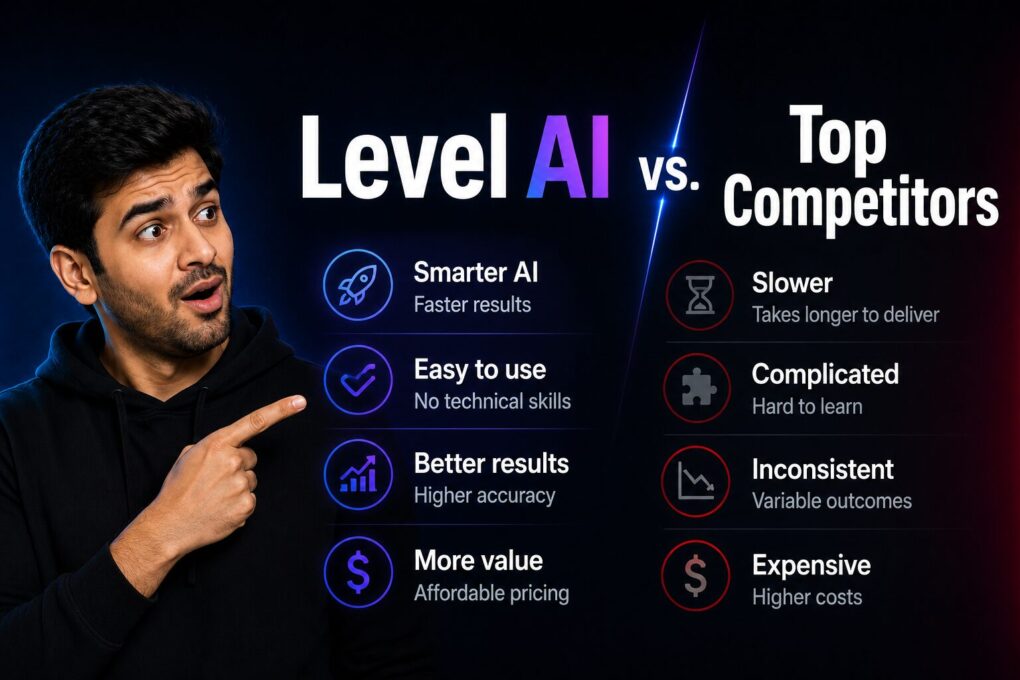
It is a tough market. Level AI competes against established heavyweights like CallMiner, NICE, Uniphore, and Observe.AI. Let’s look at Observe.AI. Both platforms target the exact same mid-market demographic. G2 reviewers report that Observe.AI is very easy to use and has a slight edge when it comes to customer scoring mechanisms. But users praise Level AI for its straightforward implementation process.
If you look at the wider market, CallMiner captures 100 percent of interactions and emphasizes real-time guidance. NICE leverages strong automation and unified platform integration. Uniphore delivers cross-channel conversation intelligence.
So how does Level AI stand out from the rest of the pack? It comes down to architecture. Competitors often focus heavily on post-call analytics. They review the recording after the fact. Level AI is built for real-time intelligence. It analyzes sentiment and intent while the customer is still on the line. Plus, the proprietary generative models are purpose-built for contact centers, rather than just being generic AI tools shoved into a customer service role.
Level AI Pros and Cons (Customer Reviews)
You have to look at the hard data. On G2, Level AI holds a massive 4.7 out of 5-star rating. That is based on around 200 verified reviews.
The pros are obvious. People love the high accuracy of the sentiment analysis. QA teams report huge productivity gains because the automation eliminates hours of manual call listening. Users also appreciate the measurable improvements they see from real-time agent coaching. The system keeps everyone compliant and on script.
But no software is flawless. Let’s be honest about the cons. Some G2 reviewers have reported instances of inaccuracy, noting it 23 times. Others complained about slow performance 17 times. Because the platform is so incredibly deep, there is a serious learning curve. Connecting it to legacy CRMs and phone systems can cause initial integration challenges.
It takes work. Change always does. But for an enterprise looking to truly modernize their operations, it pays off.
Read about – Startup business models
Read in – Startup Directory
Read about Solo businesses

Hi Friends, This is Swapnil; I love reading and sharing knowledge. Currently working as a content writer at startupsunion.com. You all can hang out with me here.