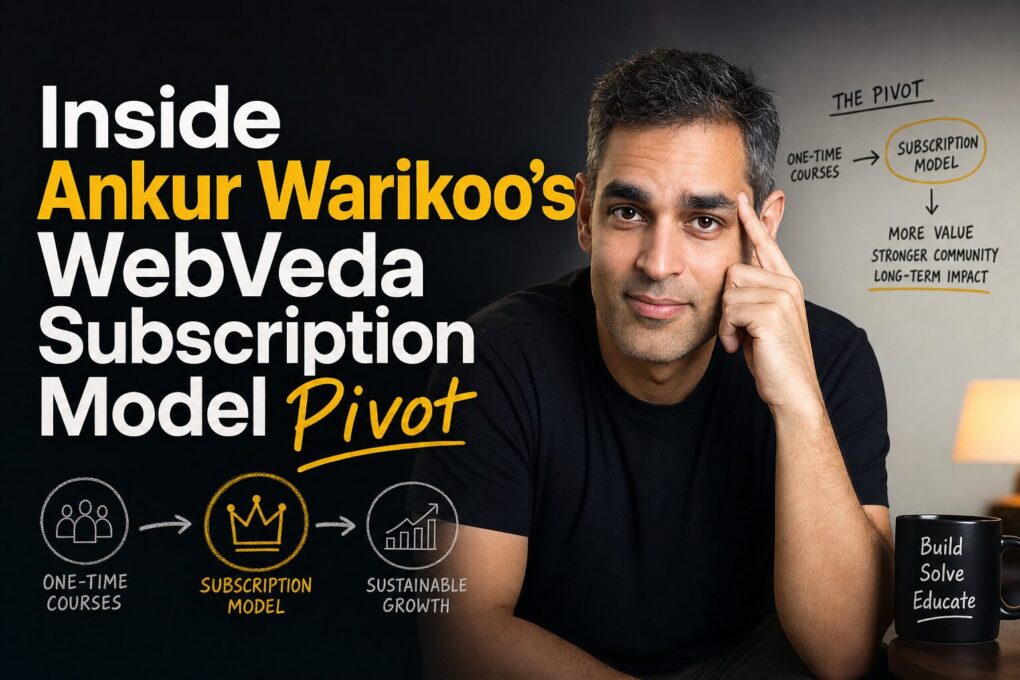
Let’s sit down and talk about the creator economy for a minute. You pour your heart into building a business, and sometimes you have to burn it down to keep growing. When Ankur Warikoo posted on social media that he was shutting down his massive courses business, the internet went crazy. He had built an absolute beast. Five lakh students. Total sales hitting 100 crore rupees with 25 crore in profits. Most founders would ride those numbers to the beach. But then he pulled the plug on the old way of doing things. Having Ankur Warikoo’s WebVeda Subscription Model Explained is crucial if you want to understand how online businesses actually survive when the market turns upside down. It is brutal. It is necessary. But it works. Warikoo started this journey back in 2020 during the Covid lockdowns. He began by running webinars where people could pay whatever they wanted. That humble experiment snowballed into WebVeda. But what got you here will not get you there. The rules of the game changed entirely.
What is Ankur Warikoo’s WebVeda subscription model?
So how does this new machine actually operate? To get Ankur Warikoo’s WebVeda Subscription Model Explained properly, we have to look at the raw numbers and the product delivery. Under the old system, people bought standalone courses. Those individual learning modules cost an average of 2,175 rupees each. The reality is that selling one off courses is an exhausting grind. You are always hunting for the next buyer. Now the platform has completely killed that standalone model.
They moved to a flat yearly fee of 1,999 rupees. That gives the user access to absolutely everything in the catalog. Warikoo calls this concept growth as a subscription. By lowering the financial barrier to entry, he is betting on volume and retention.
And they split the content into three very specific buckets to fit how busy professionals actually consume information today. First, you have daily short videos under ten minutes dropping every single day at 2:00 p.m. to catch people commuting. Second, you have medium length technical skills courses taking one to three hours, launching every Friday evening at 7:00 p.m.. Finally, they push out massive, exhaustive deep dives over three hours long on the fourth Saturday of every month at 9:00 a.m.. It is a massive content engine.
But what happens to the early adopters who bought the old courses? The transition was handled cleanly. Existing buyers kept their lifetime access to their specific content without paying an extra dime. Plus, the company gave all five lakh historical students a free one year upgrade to this new premium tier. It builds massive goodwill. And if new users hate the platform, they have a standard 14 day refund policy to fall back on, no questions asked. The whole operation is backed by a dedicated mobile application.
The Core Reasons Behind the Pivot: Ankur Warikoo’s WebVeda Subscription Model

Let’s be honest. You do not tear down a highly profitable system unless something is fundamentally broken beneath the surface. Uncovering the true motivations to get Ankur Warikoo’s WebVeda Subscription Model Explained requires reading between the lines of his announcements.
Warikoo went on a 36 minute YouTube livestream and laid out his thought process. The traditional education system was flawed. People would buy a course, watch two videos, and their life stayed exactly the same. He openly admitted that the problem was not the course itself, but the entire transactional system. He also hit a hard wall with his own expertise. A creator can only teach so much from personal experience. He knew he could not effectively teach hard technical skills like coding, digital marketing, or data analytics.
Then there was the sales fatigue. Constantly telling your loyal audience to buy the next course and the next course feels terrible. Warikoo literally stated he did not want to keep asking students to buy again and again.
Here is the kicker. Artificial intelligence changed the math for everyone. The backend costs to produce and deliver digital content collapsed over the past three years thanks to new technologies. Because it got so cheap to run the tech infrastructure, they could suddenly afford to offer the entire catalog for the price of just one old course. AI forced their hand. But it also gave them the financial margin to make this massive pivot work.
Community, Jobs, and Creator Studio in Ankur Warikoo’s WebVeda
A standalone course is a commodity. A network is a moat. To really have Ankur Warikoo’s WebVeda Subscription Model, you have to look way past the video content. They are building an entire career ecosystem.
Since Warikoo cannot teach everything, the company launched the WebVeda Courses Studio. They are actively hunting for capable teachers from smaller tier two and tier three Indian cities. They are specifically avoiding creators with a million followers. They just want people who have a genuine talent for teaching. That is a massive shift from the influencer driven model.
The community piece is also a major retention tool. The platform connects over five lakh learners across 700 cities in more than 10 countries. It is heavily gamified with leaderboards, daily tasks, and monthly challenges to keep people logging in. Members get access to exclusive chat groups and invite only offline and virtual events. Through active participation, members can even find freelancing gigs and collaboration opportunities straight from their peers.
And then they added a dedicated jobs portal. WebVeda Jobs aggregates over 10,000 professional listings from different public platforms. Users can upload their resumes or add their skills to get highly relevant job matches. The platform does not take a commission or conduct the interviews. It just curates the opportunities and connects the dots directly between the learner and the employer. This transforms a simple learning site into a powerful career engine.
Market Realities and Public Reaction to Ankur Warikoo’s WebVeda Subscription Model
Now we need to look at the cold hard facts. The story on the street is very different from the polished official press release. Looking at the market data gets the gritty side of Ankur Warikoo’s WebVeda Subscription Model. The reality is that the Indian edtech market has been bleeding heavily. Investment money dried up fast. Edtech funding crashed from a massive 4.3 billion dollars in 2021 down to a meager 156.7 million dollars by 2025. That is a more than 20X crash in just four years. The glory days are over.
And the public reaction on platforms like Reddit was extremely skeptical. Users pointed out that while lifetime sales were touted at 100 crore, the business only did 9.56 crore in sales in 2024. If you look at those numbers, the standalone course business was clearly in steep decline.
People also realized that AI has completely commoditized basic upskilling. The kind of generic advice that used to sell for anywhere between 1,799 and 5,000 rupees is now freely available through a quick conversation with Claude or ChatGPT. And AI often gives better, more personalized answers.
Critics argued that his entire business rested heavily on one single asset. His face and his presentation skills. That is a brilliant distribution channel until it suddenly stops working. Influencers inevitably have a shelf life. When AI can give you the same information without the premium attachment, conversion rates on courses are going to drop hard. So moving to a low cost subscription model and bringing in outside teachers was a brilliant survival tactic. It shifts the heavy pressure off his personal brand and creates a recurring revenue stream that is much harder for AI to break. It is smart. It is calculated. And it is exactly what you have to do to survive in business today.
Why Ankur Warikoo Shut Down His ₹100Cr Course Empire
Read about – Startup business models.
Read in – Startup Directory
Read about Solo businesses

Hi Friends, This is Swapnil; I love reading and sharing knowledge. Currently working as a content writer at startupsunion.com. You all can hang out with me here.