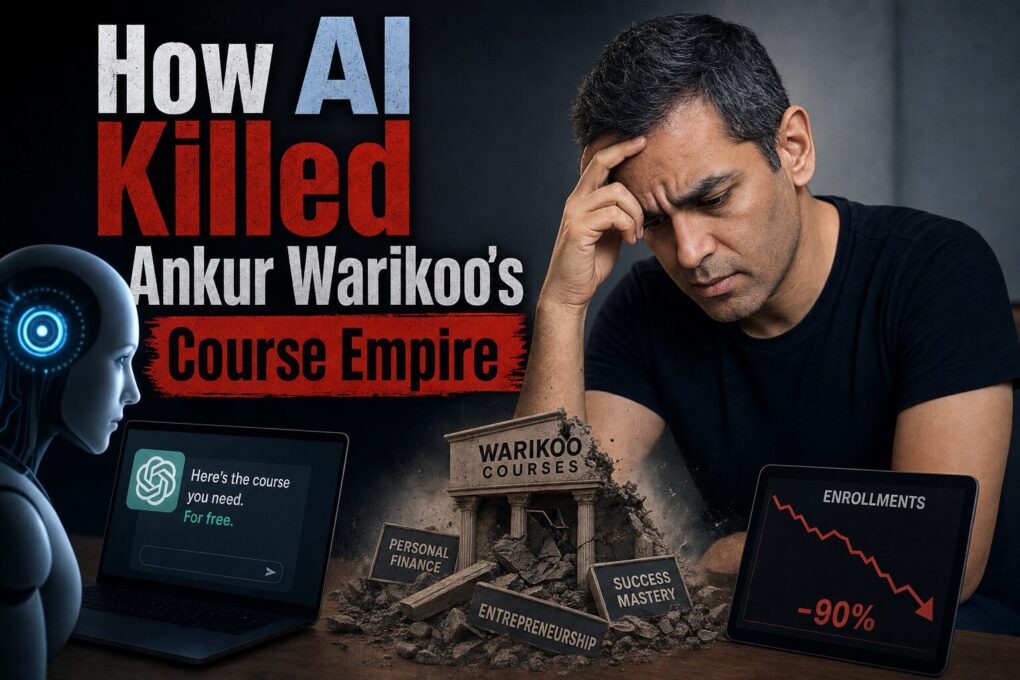
Let’s be honest. When a founder kills a profitable business, everyone whispers. Ankur Warikoo just did exactly that. He shut down his online courses venture after five years of running it. It was making money. Serious money. We are talking about 5 lakh students and ₹100 crore in sales since 2020, pulling in ₹25 crore in pure profits. But he pulled the plug. Why? Because the ground beneath us is shifting. The reality is, the creator economy is crashing into artificial intelligence. And the collision is not pretty for everyone.
AI’s “Huge” Impact on Warikoo’s Course Business
Warikoo posted a video on X announcing the closure of his highly lucrative courses business. He admitted the brand had grown beyond what he could have imagined. But he flat out said it makes no sense to continue it. The internet went wild trying to figure out why a founder would kill a cash cow. Usually, only the failed ones get shut down. Here is the kicker. A user in the comments simply asked him if it was an “AI Impact”. Warikoo replied with just one word. “Huge”.
It takes guts to see the writing on the wall while the bank account is still growing. He recognized that scaling a business based purely on static video courses was a dying model. He chose to voluntarily shut it down before market forces made the choice for him.
How ChatGPT Made Paid Courses Free
Let’s look at the actual product. For years, the creator economy ran on a simple model of information arbitrage. Founders packaged standard productivity, finance, and career advice into pre-recorded modules. People paid anywhere from ₹1,799 to ₹5,000 for these WebVeda courses. It worked beautifully.
But things changed almost overnight. Large language models like ChatGPT and Claude absolutely commoditized this exact tier of generalized knowledge. The basic upskilling content that creators used to charge a premium for is now available through a quick conversation with an AI agent. And it is completely free. You can even get it highly personalized.
The reality is, selling basic information is a terrible business model today. You can see this reflected in the broader market. Indian EdTech investment crashed from a massive $4.3 billion in 2021 to just around $156.7 million by 2025. That is a brutal 20X drop in four years. Meanwhile, AI video production is growing at a massive 35 percent rate. When consumers have limitless free AI assistants, paying for static information feels entirely obsolete.
The Shift from Courses to Subscriptions
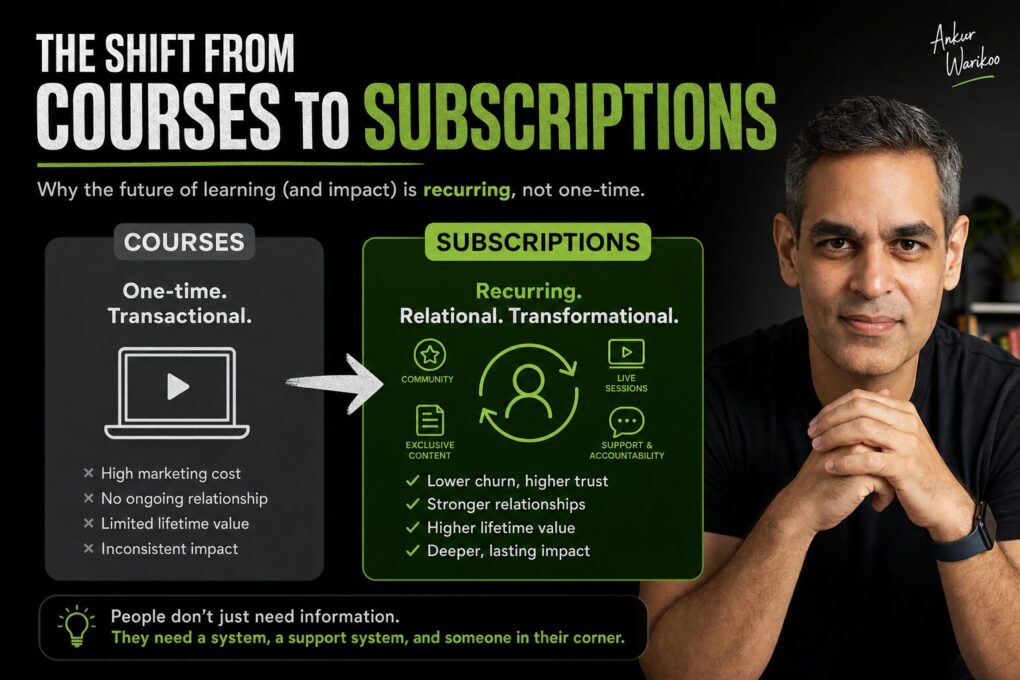
So what do you do when your core product loses its value? You pivot. Fast. Warikoo did not abandon the education space. Instead, he converted WebVeda into a subscription based platform. He called it “Growth as a subscription”. Under this new setup, users pay a single membership fee equivalent to the price of one course, and they get access to all present and future courses.
He also made a massive goodwill play. All 5 lakh existing WebVeda students were upgraded to this new membership model for free. There were no additional charges. Warikoo stated the choice was super clear between making more money and helping more people. His larger vision is to democratize education. He wants every person with a phone and internet connection to have the exact same learning and job opportunities, regardless of their background or privilege. It is a smart move. He is shifting away from individual transactions to an accessible bundle that AI simply cannot offer.
Why Community is the Future of Education
Here is a hard truth about the creator space today. Having a big audience is no longer enough to protect you. Around 40 percent of the video content on major social media platforms is already being generated by AI. We are drowning in “AI slop” and high volume automated material.
Because AI has dropped the barrier to content creation to zero, information itself has no premium. To survive, you must offer something a bot cannot replicate. Warikoo understands this deeply. WebVeda’s new subscription model heavily features an exclusive members only community. It also includes personalized jobs based on your exact skills.
People crave authentic human connection. Warikoo believes that authenticity will remain the ultimate currency because it attracts the maximum eyeballs. A generative AI bot cannot simulate a real community or provide verified credentialed outcomes. That is where the actual enterprise value lies now.
Adapting to AI for Future Success
We are standing at a major crossroads. In the past, hard work was the ultimate separator between winners and losers. But Ankur has a very different prediction for the future. He argues that five years from now, the gap will not be between people who worked hard and people who did not. The real divide will be between those who adapted to new tools early and those who delayed.
Let’s be honest. A lot of people are using AI the wrong way right now. One out of three Indians uses AI for basic everyday decisions. We are becoming tech dependent instead of tech driven. We use it to do our homework or draft basic emails, completely outsourcing our core thinking. It makes us feel smart, but we are just sitting in the passenger seat. We lose our individuality because we are all pulling from the exact same global data.
Warikoo suggests a totally different approach. Use AI to elevate your work, not create it. Start with your own original thought, then give it to the AI. Give the bot strict instructions to act like a high performance coach. Tell it not to sugarcoat things, and tell it to push you to become better. He even suggests a monthly self reflection prompt. On the first of every month, you ask the AI to review your past 30 days of queries and tell you how your thinking has evolved. It helps you spot new dimensions of your personality and gives you guidance for the future.
To push this adaptation, he launched the “2 Weeks of AI” challenge to help professionals bridge the gap and learn these essential skills. It is about staying relevant. It is about understanding that the game has fundamentally changed, and you either evolve your model or close your doors.
Read about – Startup business models.
Read in – Startup Directory
Read about Solo businesses

Hi Friends, This is Swapnil; I love reading and sharing knowledge. Currently working as a content writer at startupsunion.com. You all can hang out with me here.