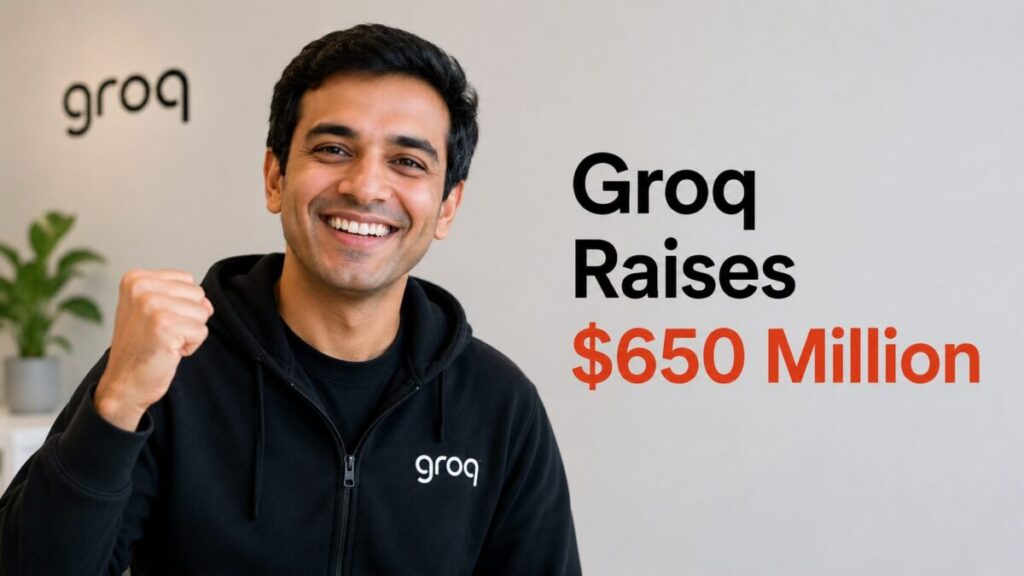
Groq raises $650 million. And if you are following AI infrastructure closely, that headline should stop you mid-scroll. This is not a typical Series A announcement from a three-person team with a deck and a dream. This is a company that has already been through the fire, lost its founder to Nvidia, handed shareholders a massive payout, and is now coming back for round two. On June 22, 2026, Groq officially announced $650 million in new growth capital to accelerate its AI inference cloud expansion. The round was led by Disruptive and Infinitum, with existing investors choosing to reinvest.
That last part matters more than most people realize.
What Is Groq and Why Is It Raising $650 Million?
Founded in 2016 by Jonathan Ross and Doug Wightman, two engineers who left Google, Groq was built around a single obsession: making AI inference faster. Ross had previously helped create Google’s Tensor Processing Unit. He knew the bottleneck was not training. It was inference. So Groq built the Language Processing Unit, or LPU, a chip architecture designed from scratch for the sequential, real-time processing that happens every time an AI model generates a response.
That bet worked. GroqCloud scaled to over five million developers. Thousands of AI-native companies started running workloads on it. The platform now processes trillions of AI tokens every single week.
So why does a company doing all of that need $650 million more? Because Groq is not the same company it was 18 months ago. The Nvidia deal changed everything. This raise is the opening move in Groq’s second chapter.
How Nvidia’s $20 Billion Deal Changed Everything for Groq
In December 2025, Nvidia signed a non-exclusive licensing agreement for Groq’s LPU technology, a chip designed specifically for running AI models. As part of that arrangement, Nvidia hired away Groq co-founder and CEO Jonathan Ross, president Sunny Madra, and other staff.
Let that sink in. The founder left. The president left. Most of the senior engineering team went with them.
The transaction produced the Nvidia Grok LPU 3, an inference processor that the chip giant debuted in March. It ships as part of a rack-size, liquid-cooled appliance called the LPQ. Groq’s own technology, now powering Nvidia’s next-generation hardware. That is either the ultimate validation or the ultimate irony, depending on how you look at it.
Senators Elizabeth Warren and Richard Blumenthal opened a formal inquiry in March 2026, arguing the transaction was designed to avoid triggering Hart-Scott-Rodino antitrust filing thresholds, essentially a full acquisition disguised as a licensing deal. Groq pushed back on that framing and continued operating independently throughout.
But here is what the critics missed. The deal was also a windfall. Investors who had backed Groq received substantial distributions. And now those same investors are being offered another seat at the table. That is not a distress signal. That is conviction.
What Is an AI Inference Cloud and Why Is Groq Betting on It?
Every time you type a prompt and get an answer, that is inference. It is the live, real-time process of running a trained AI model to generate output. Training happens once. Inference happens billions of times a day, across millions of users and applications.
Groq is wagering that running AI models in production will become a far larger market than training them. Inference requires an estimated 15 to 20 times more compute than training over time, according to the company.
And no one has clearly won this market yet. That is the whole point.
The company is positioning GroqCloud as a neocloud, a specialized infrastructure provider optimized for inference workloads rather than the general-purpose GPU clouds offered by hyperscalers. Not trying to out-Amazon AWS. Not trying to out-Google Google Cloud. Carving out a specific lane where its LPU architecture gives it a measurable speed advantage for inference-heavy workloads.
“We believe inference will become the largest infrastructure market in technology,” said John Yetimoglu, Groq board member and founder of Infinitum.
That is a bold call. But the math behind it is hard to argue with.
Who Is Funding Groq 2.0 and How Is the Round Structured?
The structure of this round is worth paying attention to. The round is structured as a pro rata opportunity for existing shareholders, with investors Disruptive and Infinitum committed to filling any unsubscribed portion, effectively guaranteeing the full $650 million will be raised.
So this is not a situation where Groq shopped the term sheet around and got lucky. The lead investors guaranteed the whole thing. That is not charity. That is a calculated bet from people who know this company better than anyone outside it.
The round was led by Disruptive, a Dallas-based late-stage investment firm founded by Alex Davis, who also serves as Groq’s chairman, and Infinitum, a Fort Lauderdale hedge fund.
Alex Davis said, “Groq has spent years building the technology, infrastructure, and operational expertise required for the next phase of AI. Today, the company has a proven global platform, a world-class leadership team, and a clear strategy focused on one of the most important opportunities in technology: AI inference at scale.”
Groq did not disclose a new valuation. Its last known valuation was $6.9 billion following the $750 million round in September 2025. Read into that silence what you will.
What Happened to Groq’s Founders and Leadership Team?
Ross, who came from Google, was known in the AI chip world for helping create Google’s Tensor Processing Unit. He teamed up with another Google engineer, Doug Wightman, to launch Groq a decade ago. Wightman stayed on after the Nvidia deal.
So not everyone left. But the leadership void was real, and Groq has been methodically filling it.
Alan Rice joined as Chief Operating Officer, previously at xAI (now SpaceXAI) and Meta Datacenters, after an earlier career in U.S. Navy nuclear submarine operations. That background matters. Running nuclear submarines and running hyperscale data centers both require the same thing: zero tolerance for failure.
Starting in July, the company is also appointing Chief Technology Officer Sinclair Schuller and Chief Product Officer Rakesh Malhotra, longtime partners who worked together at Apprenda, the enterprise cloud platform Schuller founded and later sold to Atos. The pair then co-founded Nuvalence, a software-engineering and digital-transformation firm acquired by EY in 2024. Earlier, Malhotra spent roughly a decade at Microsoft leading cloud, data-center-management, and enterprise-storage products.
None of these are accidental hires. This is a team built specifically to run infrastructure at scale, not to design chips.
How Big Is Groq’s Current Business: Data Centers, Developers, and Token Volume
Strip away the drama and look at what Groq actually operates today.
The company currently operates 13 data centers across North America, Europe, the Middle East, and Asia-Pacific. Groq’s platform serves more than five million developers and thousands of AI-native companies that process trillions of tokens weekly.
Five million developers do not stick around by accident. They stay because the product works.
The new capital accelerates the fit-out of its existing footprint with Groq’s latest inference technology, including systems based on NVIDIA’s LPX platform, which incorporates Groq inference technology under a licensing agreement announced in late 2025. Groq expects to scale toward 200 megawatts of capacity by the end of 2027.
The reality is, 200 megawatts is a serious infrastructure target. That is not startup territory. That is enterprise-grade, hyperscale-competing infrastructure buildout. And the $650 million is the fuel to get there.
Who Are Groq’s Biggest Competitors in the AI Cloud Space?
Let’s be honest. Groq raises $650 million into a market that is getting more crowded by the quarter. CoreWeave has already gone public and is scaling GPU capacity aggressively. Lambda Labs, Together AI, and Fireworks AI are all competing for the same enterprise inference contracts. Cerebras and SambaNova are building their own chip-and-cloud plays targeting similar workloads.
And then there are the hyperscalers. AWS, Google Cloud, and Microsoft Azure are each investing tens of billions into AI infrastructure, with inference squarely in their sights. These are not opponents you beat by doing the same thing slightly better.
If Nvidia ships commercial products using licensed LPU technology within 12 to 18 months, Groq’s cloud service competes directly against Nvidia’s own distribution network and sales force. That is the uncomfortable truth sitting at the center of this whole story.
But Groq’s edge is still the LPU architecture. Purpose-built for inference speed. Faster token generation than GPU alternatives on real-world AI workloads. And now paired with a leadership team that knows how to sell infrastructure to enterprises, not just developers.
One way Groq could set itself apart from rivals is by extending its platform with new services such as managed databases.
So the $650 million is not a rescue round. It is a growth bet. And the people writing the checks are the same ones who believed in Groq before anyone knew what an LPU was. That is worth something.
Read about – Startup business models
Read in – Startup Directory
Read about Solo businesses

Hi Friends, This is Swapnil; I love reading and sharing knowledge. Currently working as a content writer at startupsunion.com. You all can hang out with me here.