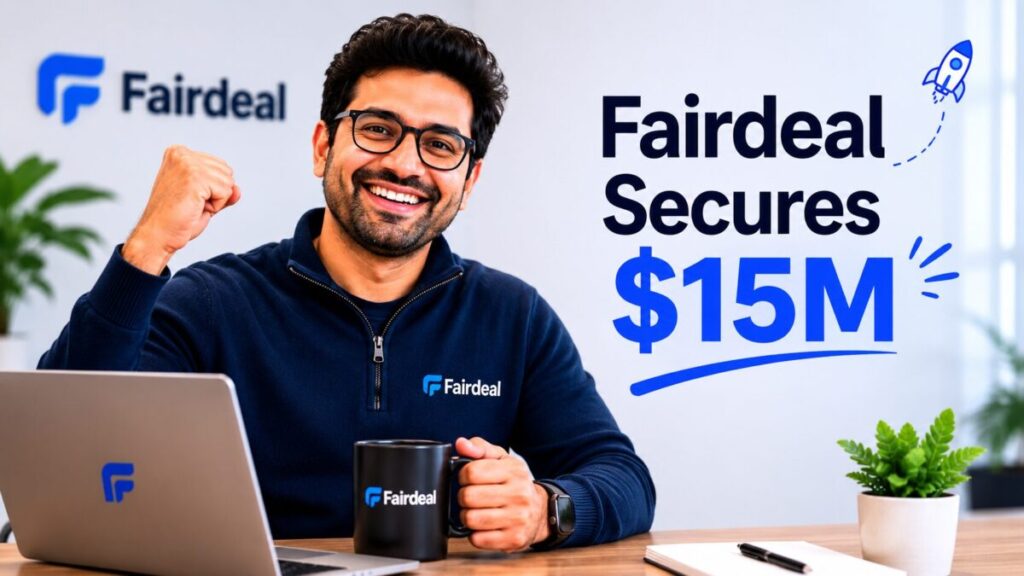
Let’s be honest. Building a supply chain startup in India is an absolute grind. It is messy. It is loud. It requires a lot of grit while navigating choked city streets and razor-thin margins. But every now and then, a company figures out a real operational hack. That is exactly what brothers Prateek and Yash Bansal have done. They just closed a massive funding round, and the entire industry is talking about how Fairdeal raised $15M by flipping the B2B wholesale script completely upside down.
When you sit down and look at the numbers, you realize this is not just another tech company burning through venture capital. They are actually changing how local shops buy their daily goods.
Here is my take on exactly how Fairdeal raised $15M, who wrote the checks, and what they are up against next.
Fairdeal Secures $15M in Series A Funding
Raising capital right now is not for the faint of heart. But Fairdeal.Market just locked down $15 million in a Series A funding round. This translates to about Rs 142.8 crore. Bertelsmann India Investments led the charge. WaterBridge Ventures and Incubate Asia Fund came back to the table to participate as well.
This is serious money. But here is the kicker. They earned it by proving their model actually makes financial sense.
Just last August, they picked up $3 million in a pre-Series A round. That early round was led by Incubate Fund Asia and WaterBridge Ventures, alongside some angel investors. Instead of throwing that cash at unsustainable growth, they built a highly capital-efficient machine. They achieved positive unit economics. Within just their first year of operations, they approached an impressive $10 million in annual recurring revenue.
Now that Fairdeal raised $15M, they are staring down a massive goal. They want to hit $150 million in annual recurring revenue over the next three years. It is aggressive. It is risky. But based on their current trajectory, it works.
What is Fairdeal.Market?
To understand why investors are backing them, you have to understand the problem they are fixing. Fairdeal.Market, co-founded in 2022 by Prateek and Yash Bansal, is India’s first B2B quick commerce platform built specifically for kirana stores.
The reality is that India is home to over 13 million of these local neighborhood shops. In the Delhi NCR region alone, there are roughly 260,000 to 280,000 small retailers. They are the absolute backbone of household consumption. Yet, the way they buy their inventory is stuck in the past.
For decades, these shop owners have relied on heavily fragmented offline wholesale markets and traditional distributor networks. Those old systems were never designed for the fast, small-format reality of neighborhood retail. It is slow. It is frustrating. It leaves money on the table. Prateek Bansal noted that the inefficiency in this procurement infrastructure is not incidental; it is structural.
Fairdeal steps in and gives these store owners a completely digital platform. It gives them real-time inventory visibility and transparent pricing. So, instead of making blind bets on what they might need next week, shop owners can stock smarter and improve their profit margins today.
60-Minute Delivery for Kirana Stores
This is where the magic happens. Fairdeal uses a dark store fulfillment model. These are tight, highly efficient micro-warehouses hidden in dense urban clusters. Using this network, they deliver a cloud inventory of over 1,000 distinct products to kirana retailers in under 60 minutes.
Co-founder Prateek Bansal hit the nail on the head when he talked about the fill rate. The fill rate is the biggest headache for any shop owner. If a customer walks in for a specific brand of soap and the shelf is empty, that customer walks out. They go to the shop down the street with a better fill rate. That is a direct revenue loss.
By guaranteeing 60-minute delivery, Fairdeal completely eliminates the fill rate problem. Shop owners no longer have to guess what will sell. They do not have to tie up their limited working capital in massive orders of slow-moving stock just to be safe. They can use intelligent demand sensing. When a product starts flying off the shelf, they order more and get it in an hour. They are operating with real-time supply chains, just like modern asset-light businesses.
Top Investors Behind the Deal
You can tell a lot about a startup by the people backing it. The fact that Fairdeal raised $15M shows serious institutional confidence. Rohit Sood, a partner at Bertelsmann India Investments, saw the potential immediately. He pointed out that Fairdeal is building a completely new operating model for wholesale procurement. He understands that this is not just about the 60-minute delivery promise. It is about bringing necessary innovation to a space that has seen zero innovation in past decades.
And Ashish Jain, a partner at WaterBridge Ventures, sees the hidden goldmine here. Data.
When you process millions of real-time transactions with precise cart-level visibility, you build a massive, incredibly valuable dataset. It gives fast-moving consumer goods and D2C brands live, actionable insights. They get to see exactly what is selling, exactly where it is selling, and exactly why.
Incubate Asia Fund also came back for this round. When early investors double down, it tells you the founders are executing their vision ruthlessly.
Expansion Plans: Reaching 100,000 Stores
So, what do they do with the capital now that Fairdeal raised $15M? They scale. Right now, Fairdeal is operating strictly within the Delhi NCR region. In just the last six months, they have grown their network to over 20,000 active retailers. The platform handles 50,000 orders every single month, with an average order value of Rs 3,500.
But here is the metric that matters most. Their customer retention rate is over 80 percent. Once a kirana owner tries the platform, they do not leave. They become dependent on that fast replenishment infrastructure.
With the new capital, Fairdeal is taking this model on the road. They are planning to expand their dark store footprint and enter massive new markets like Mumbai and Bangalore. Their target is to scale the network to over 100,000 retailers within the current financial year.
Co-founder Yash Bansal noted that this aggressive expansion does not just help the local shops. It also helps emerging brands who create great products but struggle to find efficient offline distribution. Fairdeal provides them with a direct, high-speed pipeline to the consumer.
Fairdeal vs. Udaan and Jumbotail
Make no mistake, the B2B grocery and wholesale market in India is a knife fight. With the news that Fairdeal raised $15M, they are going head-to-head with heavyweights. They are competing against well-funded companies like Udaan and Jumbotail. Other players like ElasticRun, ApnaKlub, and ShopKirana operate in this space too.
But their strategy is completely different. The traditional B2B giants try to win by offering massive, endless catalogs of products. The trade-off is time. Their fulfillment cycles are long, often taking days to restock a store.
Fairdeal is betting everything on speed. They use their sub-60-minute delivery as their main wedge into the market. They keep their product list curated to around 1,000 highly popular items. For a busy kirana owner, the choice is simple. Do you want to juggle multiple slow-moving distributors, or do you want guaranteed, lightning-fast restocking? Fairdeal wins by ensuring the shop owner never misses a daily sale.
Dark Store Risks and FDI Challenges
I will not sugarcoat it. The road to $150 million in revenue is full of landmines. Even though Fairdeal raised $15M, they face brutal logistics. Running dark stores in places like Mumbai and Delhi is incredibly expensive. Real estate costs are astronomical. And trying to guarantee a 60-minute delivery window through dense, unpredictable urban traffic is a constant operational nightmare. The economics of rapid fulfillment are unforgiving.
Then, there is the regulatory dark cloud. Trade groups like the Confederation of All India Traders are pushing back hard against dark stores. There is serious legal uncertainty regarding how these micro-fulfillment centers are classified by the government.
Regulators are watching closely. They want to know if tech platforms managing these facilities are simply acting as B2B intermediaries. If the government decides these companies are actually engaging in prohibited inventory-led retail, it could violate strict Foreign Direct Investment rules. That kind of regulatory action could blow up the entire business model overnight.
Finally, they are fighting human nature. Changing deeply ingrained retail habits is tough. Many kirana owners still prefer manual processes and old-school offline purchasing. Getting them to trust a digital platform takes time and boots on the ground.
Prateek and Yash Bansal have built an incredible machine so far. They have the capital. They have the momentum. But surviving the next phase will require flawless execution.
Read about – Startup business models
Read about – Startup business models
Read about Solo businesses

Hi Friends, This is Swapnil; I love reading and sharing knowledge. Currently working as a content writer at startupsunion.com. You all can hang out with me here.