What Is Etched and What Does It Do?
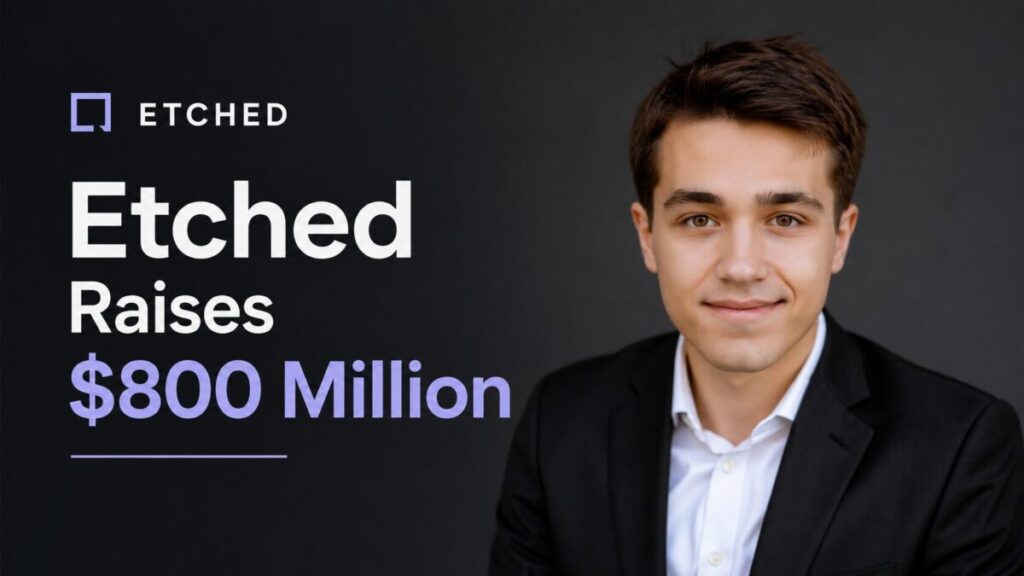
Let’s be honest, most chip startups talk a big game and then disappear. Etched didn’t disappear. It just went quiet for a while, and now it’s back with receipts: a working chip, more than $1 billion in signed customer contracts, and $800 million raised across financing rounds nobody outside the company knew about until now.
Founded in 2022, Etched builds chips for one specific job. Running AI models, not training them. That’s the whole bet. And it’s a bet that separates them from Nvidia, which makes chips for everything.
The chip is called Sohu. It’s built for transformer inference, which is just a fancy way of saying it runs large language models when they’re actually answering your questions in real time. The founders’ argument is simple: general-purpose GPUs running CUDA are the wrong tool for this job. You don’t need a Swiss Army knife. You need a scalpel.
Here’s the part that impressed me. Etched didn’t just build a chip and call it done. They designed the entire server rack. Circuit boards, cooling plates, networking, all of it. Co-founder Robert Wachen says no other chip startup has gone this deep. That’s not a small claim. And the team backs it up: over 400 employees, most of them pulled from Nvidia, Broadcom, Google TPU, SK Hynix, and quant trading firms that live and die by speed.
Etched’s $800 Million Funding Round Explained
The number everyone’s talking about is $800 million. But here’s the thing, that’s not one big check. It’s a stack of rounds, some of them raised quietly and only now coming to light.
The biggest piece was $500 million, closed in December, valuing the company at $5 billion post-money. That round alone pulled in VentureTech Alliance, Peter Thiel, Jane Street, Hudson River Trading, Jump Trading, Two Sigma, Stripes, Ribbit Capital, Radical Ventures, Primary VC, and Positive Sum. That’s a lot of names on one cap table.
Then there’s Jane Street. They led a separate round that was never announced, and according to co-founder Robert Wachen, they’ve kept writing checks since. Total investment from Jane Street alone now sits above $100 million.
This is the first time in about two years Etched has said anything publicly about its funding or its chip roadmap. Two years of silence, then this. And the backstory makes it hit different. By 2024 they’d raised just over $125 million, but rewind further and the picture gets rough. In 2023, the founders say every major investor they pitched passed, even with a 30-page memo laying out why AI would need specialized silicon. The company was reportedly running month to month, close to broke. So yeah, this $800 million didn’t come easy.
Who Are Etched’s Investors?
You don’t usually see venture capital, high-frequency trading firms, and Nobel laureates on the same cap table. Etched pulled it off.
Backers include VentureTech Alliance, Jane Street, Hudson River Trading, Two Sigma, Ribbit Capital, and Stripes, who led the big round. On the angel side, you’ve got Andrej Karpathy, Geoffrey Hinton, Fei-Fei Li, Arthur Mensch, and Scott Wu. Add Stanley Druckenmiller and Peter Thiel to the mix and you’ve got a genuinely strange, genuinely impressive group of people betting on the same outcome.
Geoffrey Hinton’s name carries weight here. The man won a Nobel Prize for the deep learning work that basically started this whole AI wave. When he puts money into your chip company, people notice.
But if you’re looking for the investor that matters most strategically, it’s VentureTech Alliance. They’re tied directly to TSMC. That’s not just capital, that’s a relationship. And in the chip business, relationships with the foundry are everything. Manufacturing capacity is the real bottleneck right now, not ideas.
What Is the Sohu Chip?
Sohu is built for one thing: transformer inference. Not training, not general compute. Just running the models people already built, as fast and cheap as possible.
Two ideas make it different. First, working with TSMC, Etched developed something they call low-voltage inference. It runs the chip at lower voltage so it doesn’t overheat under load. Specifically, the compute arrays run at less than half the voltage of typical AI accelerators, which lets the chip stay above 80% peak FLOP utilization without thermal throttling, even on massive mixture-of-experts models.
Second is the memory system. They call it Cluster Scale Memory, and it combines High-Bandwidth Memory with a shared low-latency architecture connected through a proprietary interconnect. The goal is less latency, more throughput. Sounds simple when you say it fast. It’s not simple to build.
On the manufacturing side, Etched hit first-pass silicon success, known as A0, on TSMC’s N4P process. That matters more than it sounds like it should. First-pass success means you skip an expensive, time-consuming re-spin. The chips are already running production models too, including DeepSeek, Qwen, Mamba, and Llama, across both dense architectures and large mixture-of-experts systems.
How Does Etched Compare to Nvidia?
Etched isn’t shy about who they’re aiming at. They want to be the next real challenger to Nvidia in inference. Not training. Inference specifically, which is where the money is shifting as AI moves from being built to being used at scale.
The claim on the table is bold. Sohu reportedly delivers around 20 times the throughput of Nvidia’s H100, using fixed-function attention circuits paired with that low-voltage design. Big number. We’ll see if it holds once real customers put it through real workloads.
And Etched isn’t fighting this battle alone. The whole inference chip space is heating up fast. Nvidia itself paid Groq $20 billion in December just to license their tech and bring most of their engineers in-house. Google said in April that part of its own chip lineup will focus purely on inference. A London startup called Fractile raised $220 million putting compute and memory on the same die. Cerebras had the year’s first breakout IPO. Groq separately raised $650 million. Everyone’s chasing the same prize, and Etched now sits in that crowd alongside Cerebras, SambaNova, and d-Matrix, plus Nvidia looming over all of it.
Etched’s Revenue and Customer Contracts
Numbers are one thing. Contracts are another. And Etched has $1 billion of the latter already signed, though they won’t say who’s buying. Fair enough, that’s how this game is often played early on.
Products are still being tested, but the timeline is real. Etched plans to ship chips to customers this summer, with the first rack-scale systems expected in the same window. More performance data is expected to come out later in the season, once real deployments start proving (or disproving) the claims.
They’re not just designing chips in a garage either. Etched stood up a factory in Taiwan and built a data center, test house, and prototyping lab at their San Jose headquarters. That San Jose site alone runs a 2 megawatt data center. The stated goal, and it’s an ambitious one, is gigawatt-scale deployment starting in 2027.
What’s Next for Etched?
Co-founder Rob Wachen put it plainly: the company was built from day one for gigawatt scale. His words were that production is the product, and that we’re living through one of the largest infrastructure buildouts in history. He’s not wrong about the scale of what’s happening across the industry right now.
CEO Gavin Uberti frames it differently, more from the mission side. He’s said the team recognized early that frontier AI would become one of the most economically significant technologies ever built but that the infrastructure to actually serve it sustainably just didn’t exist yet. So they built it.
The reality is, none of this is proven yet. Not really. The real test comes over the next six to twelve months as chips ship and customers start running them at scale. Until then, every number here, the 20x throughput, the $1 billion in contracts, and the gigawatt ambitions, is a claim waiting on results. Etched has the money, the foundry partnership, and the team. What they don’t have yet is the track record. That part’s still being written.
Sources used for this article:
- Investing.com – Etched raises $800 million from Jane Street, TSMC-linked VC (via Bloomberg)
- Yahoo Finance UK – Etched Raises $800 Million as AI Chip Race Intensifies
- TechCrunch – Nvidia competitor Etched hits $5B valuation, $1B in sales for AI chip
- Yahoo Finance – Etched Emerges From Stealth With Working Chip, $800M Raised, and Over $1B in Customer Contracts
Read about – Startup business models
Read in – Startup Directory
Read about Solo businesses

Hi Friends, This is Swapnil; I love reading and sharing knowledge. Currently working as a content writer at startupsunion.com. You all can hang out with me here.