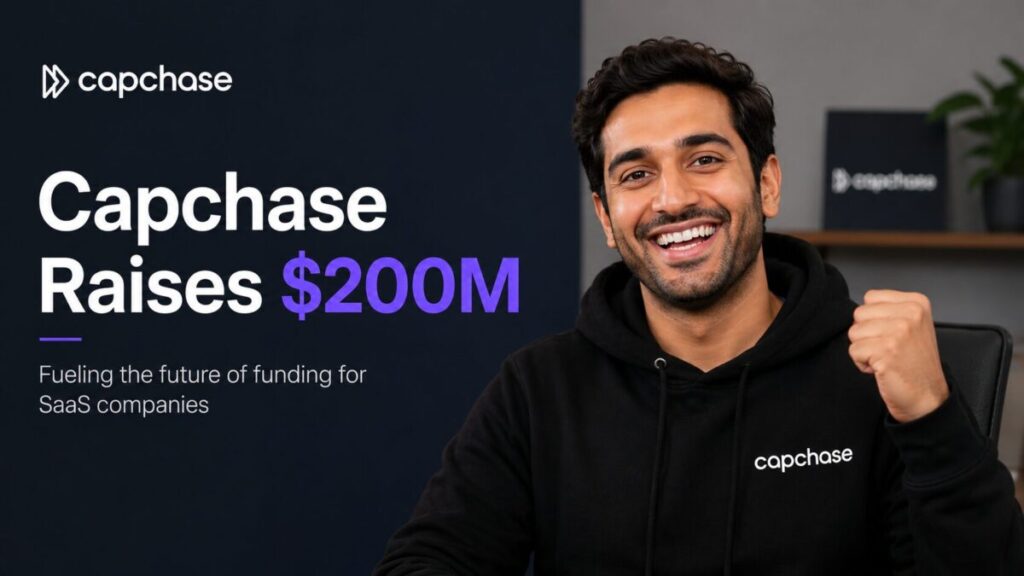
Closing enterprise tech deals right now feels like pulling teeth. We are all feeling it. Budgets are frozen. CFOs are hoarding cash. Customer acquisition costs are climbing higher every single quarter. Sellers desperately need money upfront to survive and fund their own operations. Buyers, constrained by high interest rates, want to pay in installments to preserve their capital. It is a massive friction point that slows everything down and kills deals at the finish line. But there is a fix.
You might have seen the headlines recently. The news that Capchase raised the $200M has been everywhere. As a founder who has been through the wringer of capital allocation and cash flow nightmares, I look at a round like this and see more than just numbers. I see a massive shift in how B2B sales actually happen. We are not just talking about another generic software tool. We are talking about fundamental financial infrastructure. Let’s break down exactly what happened here, who was involved, and why it matters to anyone building a serious company today.
Capchase Secures $200M in Funding
Raising money is never easy. So when you hear that Capchase secures $200M in funding, you have to look closely at the mechanics of the deal. It is a beast of a round. Specifically, this cash injection consisted of $26 million in fresh equity alongside a massive $174 million credit facility.
They structured it as a mix of debt warehouse facilities and equity. That is incredibly smart. Experienced founders know that equity is the most expensive money you can take. By leaning heavily on debt facilities backed by institutional investors, Capchase minimizes dilution for its leadership team while securing the actual lending power needed to fund their enterprise tech vendors.
And this is not their first rodeo. Since launching in 2020, the company has successfully pulled in over $949.6 million across six previous funding rounds. That massive figure includes a $400 million debt financing round back in 2022. All of this capital validates the impressive $2 billion valuation they originally set during their 2021 venture round. The fact that Capchase raised the $200M today just proves that institutional trust in their model is rock solid.
Who Invested in Capchase?
When a company pulls in this kind of money, the cap table tells a very specific story. The recent funding round was officially led by 01 Advisors. You also had major players like Caffeinated Capital, Thomvest Ventures, Scifi VC, Bling Capital, and Invesco jumping into the mix. They join early backers like QED Investors who led previous equity portions.
Here is the kicker. Adam Bain is the co-founder and managing partner of 01 Advisors. He previously ran the sales team at Twitter. He intimately understands the friction of enterprise sales. He noted that legacy incumbents in the financing space possess plenty of capital. But they completely lack modern technology. They never bothered to build a smooth software experience because, frankly, customers had nowhere else to turn.
That dynamic is dead. Investors rallied behind Capchase because they saw a team ready to drag an outdated industry into the present. This comes at a time when global funding to VC-backed financial technology startups totaled $53.8 billion in 2025. Capital is flowing, but it is flowing specifically to companies that solve real problems.
How Capchase Will Use the $200M
Raising capital is only half the battle. Deploying it correctly is where companies live or die. So how will they use the cash? The executive team has stated they intend to use the funds to scale their embedded vendor financing infrastructure globally. They also plan to deploy more proprietary artificial intelligence features.
In the past two years, Capchase was serving vendors doing tens of millions in revenue. Now? They are underwriting tech giants pulling in hundreds of millions, and even billions, in annual revenue. Because Capchase raised the $200M, they have the firepower to underwrite much more stable and established borrowers. The average enterprise buyer using their infrastructure today boasts roughly $80 million in annual revenue. They have been operating for over 20 years. They are highly profitable. By targeting this specific demographic, Capchase maintains a highly controlled risk environment. It keeps their default rates spectacularly low.
The Pivot to B2B Buy Now, Pay Later
Pivoting your core product is terrifying. It is lonely. It is hard. But it works if you read the market right. Capchase originally made its name with a product called Capchase Grow. It was a pure revenue-based financing play specifically for SaaS startups. The reality is, macroeconomic winds shifted. Startups were tired of short 24-month repayment caps and strict cash runway covenants. Interest rates spiked.
So they killed the old model. They officially discontinued their legacy revenue-based financing product.
They leaned entirely into vendor financing. Today, the market views them as the “Affirm for B2B.” They offer B2B Buy Now, Pay Later tools via their flagship product, Capchase Pay. It solves that classic standoff I mentioned earlier. When an enterprise deal is signed, Capchase allows the sales representative to offer flexible, multi-year payment terms to the buyer. Meanwhile, Capchase steps in to pay the vendor the full contract amount upfront, minus a small financing fee. In June 2025, they acquired a vendor financing platform called Vartana. That move sealed the deal. The reason Capchase secures $200M in funding is to dominate this exact space.
Using AI for Instant Loan Approvals
The legacy equipment financing market is worth $1.3 trillion. And yet, traditional banks are still underwriting deals using messy email chains and manual document reviews. Approvals used to take anywhere from four to 17 days. That kills sales momentum. It gives the buyer time to second-guess the purchase.
Capchase knew this was a massive vulnerability for incumbents. They introduced an artificial intelligence tool called the Agentic Lending Coordinator. It collects quotes, purchase orders, emails, and financial documents. Then it converts them into an executable loan package. Instantly.
Because they act as both the direct lender and the lending software natively integrated into CRMs like Salesforce, they can automatically vet and approve 97 percent of lending applications in under 30 seconds. Let that sink in. An underwriting process that used to take eight agonizing hours is now a 60-second automation. Quotes turn into actionable approvals in minutes. It turns financing from a severe bottleneck into a massive growth driver for sales teams. This specific technology is exactly why Capchase raised the $200M.
Global Expansion and UK Market Focus
Enterprise partners operate globally. If you want to serve them, you have to follow them. Driven by direct demand from these multinational vendors, Capchase is actively using its fresh capital to scale operations far beyond North America. A major piece of this strategy involves opening a brand-new European headquarters located in London. This hub is built specifically to support UK tech startups and anchor the company’s broader European footprint.
They brought in heavy hitters to lead the charge. Alex McCracken joined the team as Head of Venture Relationships in the UK. He spent over a decade as a managing director at Silicon Valley Bank. Add in a massive 105 million euro credit facility previously secured from Deutsche Bank, and they are armed for serious growth. They are pushing into Ireland, Belgium, the Netherlands, Spain, the Nordics, and Australia.
And here is something that really stands out. Fifteen percent of their deployed funding has proudly gone to female and minority-led firms. That blows traditional venture capital averages completely out of the water.
Capchase’s Massive Revenue Growth
Investors do not write checks of this size just for fun. They do it because the traction is undeniable. The fact that Capchase secures $200M in funding comes down to spectacular financial performance. They reported a 400 percent growth rate over the previous 12 months. They are aggressively forecasting an additional 200 percent growth in the upcoming year.
Look at the annual recurring revenue milestones. They went from four million dollars in 2020 to sixteen million in 2021. By 2022, they hit thirty million. They reached $40.5 million in 2023 and eventually scaled to an impressive $62.5 million by late 2024. That is wild.
Elite Fortune 500 tech companies and massive distributors run on this financing infrastructure today. We are talking about industry titans like Barracuda Networks, Verkada, Okta, Datarails, CDW, and Insight. To keep up with this massive surge in enterprise demand across their network of 3,000 customers, the company expanded its internal workforce. They grew to 145 dedicated employees. They saw a glaring problem in the market. They built a solution. They backed it with real automation. And they scaled it relentlessly. That is how you build a lasting business.
Read about – Startup business models
Read in – Startup Directory
Read about Solo businesses

Hi Friends, This is Swapnil; I love reading and sharing knowledge. Currently working as a content writer at startupsunion.com. You all can hang out with me here.