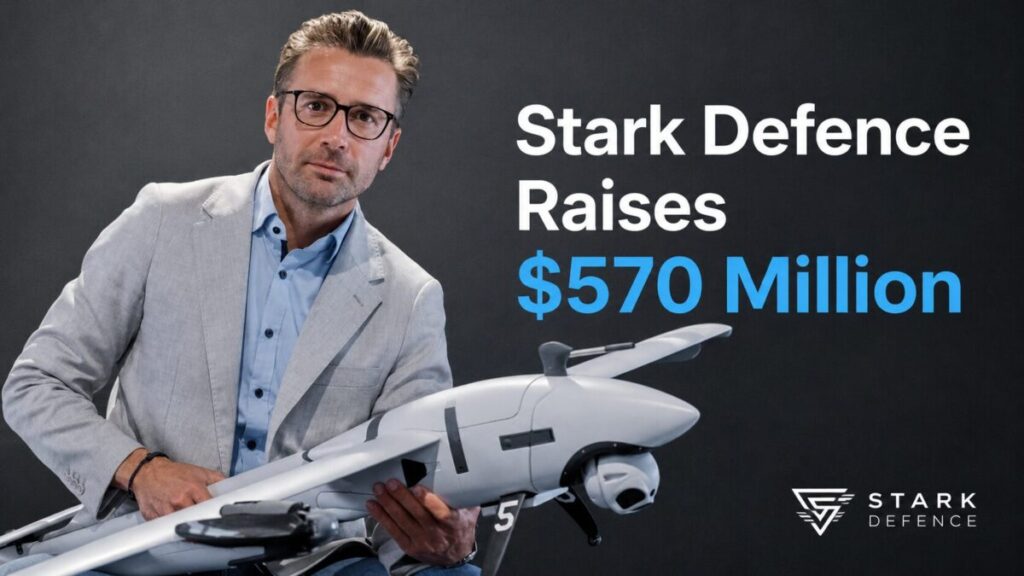
Europe’s defence sector just had a moment. A big one. Stark Defence, a Berlin-based startup making kamikaze drones, raised €500 million ($570 million) in a fundraising round led by Sequoia Capital and Peter Thiel’s Founders Fund. And the company is barely two years old.
Let’s be honest. That kind of money, at that kind of speed, doesn’t happen often. It happens when the timing is right, the product is real, and the world suddenly needs what you’re building.
What Is Stark Defence and What Does It Do?
So, what exactly is Stark Defence?
Stark was established in 2024 by Florian Seibel, Uwe Horstmann, and Johannes Schaback. The company was formed to address urgent operational demands highlighted by the Russian invasion of Ukraine. That’s the origin story in one sentence. A war changed the calculation, and these founders moved fast.
Stark’s flagship product is the Virtus loitering munition, a software-defined one-way effector with vertical launch and AI-assisted navigation. The company also produces the Vanta unmanned surface vessel and the Minerva multi-domain command and control software.
Here’s the kicker. Virtus features a 1.8-meter wingspan, a cruising speed above 120 km/h, a terminal dive speed above 250 km/h, carries a modular payload of up to 5 kg, can penetrate 800 mm of high-hardness armor, and has a flight range above 130 km with up to 1.5 hours of endurance.
That’s not a prototype. That’s a deployed weapon system. And it’s already in the field.
When people hear “drone startup,” they picture a garage and a quadcopter. Stark Defence is something else entirely. It’s an integrated battlefield platform. That’s what the $570 million is really backing.
Stark Defence Raises $570 Million Led by Sequoia and Founders Fund
The numbers deserve a second look.
Stark Defence raised €500 million ($570 million) in a fundraising round led by Sequoia Capital and Peter Thiel’s Founders Fund, as private capital pours into European military technology. This brings the total raised by the company to €640 million. Before this round, the company had raised €140 million in total. So they more than tripled their lifetime funding in a single raise.
But here’s what people miss when they read the headline number. More than 80% of the capital is earmarked for R&D and manufacturing, which is exactly the opposite of the asset-light software playbook that dominated the last cycle.
This isn’t a growth-hacking round. This is a build-a-factory round. Stark Defence is spending serious money on serious infrastructure. And that matters, because governments don’t buy software promises. They buy things that work and can be made at scale.
Stark Defence Valuation Hits €3.2 Billion After Latest Round
Two years. €3.2 billion. Wrap your head around that.
Sequoia Capital led both the initial $15 million investment, which valued Stark at approximately €90 million in October 2024, and the recent growth round. That’s a 35x jump in valuation in under two years. For a hardware company building weapons systems. Not a consumer app. Not a SaaS tool.
The pace of valuation growth is extraordinary even by defence-tech standards. Stark reportedly crossed the unicorn threshold earlier in 2026.
The reality is, Europe hasn’t produced many defence tech unicorns. The ones that exist took a decade to get there. Stark did it in 18 months. Some people will call that overvalued. Others will call it recognition that the world changed and the market is repricing accordingly. Both things can be true at once.
Who Are the Investors Behind Stark’s $570M Funding Round?
Look at the cap table and you’ll understand why this round is different from a typical VC bet.
Participants in the round include the NATO Innovation Fund, Döpfner Capital, Air Street Capital, 201 Ventures, and Project A, where Stark co-founder and CEO Uwe Horstmann works as a founding partner. Also in the round: Advent, with Sequoia and Founders Fund co-leading.
And then there’s the NATO Innovation Fund. That’s not a regular LP. That’s a fund created by NATO member states to back exactly this kind of dual-use technology. When NATO backs your company directly, the message to procurement departments across 31 member nations is hard to ignore.
Luciana Lixandru, the Sequoia partner leading the deal, noted that Stark went from an idea to delivering systems across multiple domains, winning major programmes and building industrial capacity across Europe in less than two years, calling it rare execution speed.
Patrick Schneider-Sikorsky of the NATO Innovation Fund, returning as a backer, said the company has demonstrated an exceptional ability to move from concept to deployment, delivering technology that NATO nations actually need.
So. You’ve got Silicon Valley’s most respected growth investor. You’ve got Peter Thiel’s fund. You’ve got NATO’s own investment arm. That combination is not accidental. It’s deliberate, and it’s strategic.
How Will Stark Use the $570 Million in Funding?
Big rounds need big plans. Stark’s is specific.
The funding will go toward new electronic warfare research facilities, scaling production output, and accelerating the development of sovereign defence capabilities. More than 80% of the capital raised will be invested directly into R&D and manufacturing. That’s over $456 million into physical infrastructure and engineering.
The company operates a 40,000-square-foot production facility in Swindon, England, and has offices across Germany, Ukraine, Sweden, and Greece.
But here’s what stands out most. In recent months, Stark has secured a €268 million contract with the German armed forces for its kamikaze drones, expanded into the UK and Sweden, acquired Berlin-based autonomous navigation software startup Pleno, and launched new maritime drone systems.
They’re not raising to survive. They’re raising to scale something already working. That’s a very different kind of round.
CEO Uwe Horstmann put it plainly: the challenge facing Europe is no longer whether it can innovate. It’s whether it can scale. This $570 million raise is how Stark Defence is answering that question.
Why Europe’s Defence Tech Startups Are Attracting Big Money
None of this happens in isolation. The money flowing into Stark Defence is part of something much larger.
The EU’s ReArm Europe plan aims to mobilise up to €800 billion in defence spending over four years. Germany’s special defence fund, created after Russia’s invasion of Ukraine, has accelerated procurement of autonomous systems. The European Defence Industry Programme, adopted in March 2026 with a budget of nearly €1.5 billion, earmarks specific funding for counter-drone and autonomous strike capabilities.
That is a staggering amount of government money chasing exactly the category Stark Defence operates in.
And the wars in Ukraine and the Middle East have removed every remaining doubt about the direction of modern conflict. AI-driven, low-cost autonomous weapons are not the future. They’re the present. Governments know it. Investors know it. And startups that figured it out early are now sitting on an extraordinary runway.
Investors care because Stark sits at the intersection of three forces: Europe’s defence rearmament, venture capital’s renewed comfort with dual-use technology, and the realization that “sovereign tech” now includes factories as much as code.
Let’s be honest. Five years ago, most top-tier VCs wouldn’t touch weapons tech. That changed fast. Very fast.
Stark Defence vs. Competitors: How It Stacks Up in the Drone Market
The competition is real. Let’s not sugarcoat it.
Anduril Industries presents a direct competitive challenge through its integration of autonomous drones, counter-unmanned systems, and the Lattice OS command platform. Shield AI also offers a full-stack alternative with its Hivemind AI pilot software and V-BAT drone teams, deploying swarms in GPS-denied environments, which overlaps directly with Stark’s operational focus.
But Stark has home-field advantage in Europe. And that matters enormously for procurement.
Stark recently revealed two new loitering munitions: the tube-launched Cascade and the man-portable quadcopter Gambit. Cascade flies 40 to 100 kilometres depending on battery configuration and launches from a tube in under a minute. Gambit comes in strike and reconnaissance variants light enough for a single soldier to carry. Both navigate without GPS and plug into Minerva, Stark’s command-and-control software.
In November 2025, Germany announced plans to award Stark, Helsing, and Rheinmetall contracts worth up to €900 million collectively, approximately €300 million per company, for 12,000 kamikaze drones in total.
So they’re already winning contracts. They’re already in production. They’re already deployed in Ukraine. And now they have €640 million in total raised and a valuation above €3 billion.
The reality is, the race to be Europe’s defining defence tech company is wide open. But right now, Stark Defence is running hard at the front.
Here are all the sources used to research and write this article:
Resources Used to write this Article
Read about – Startup business models
Read in – Startup Directory
Read about Solo businesses

Hi Friends, This is Swapnil; I love reading and sharing knowledge. Currently working as a content writer at startupsunion.com. You all can hang out with me here.