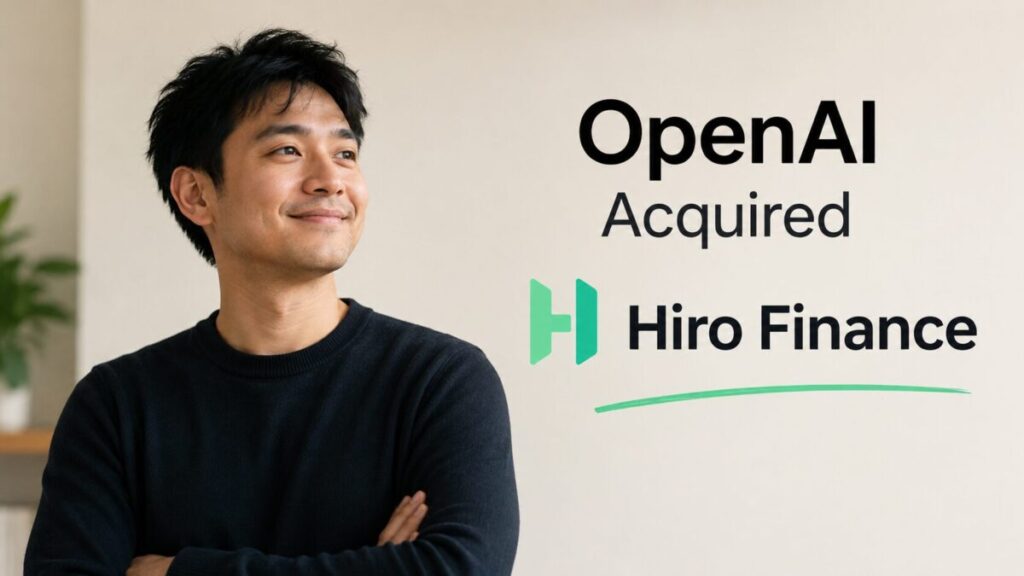
In April 2026, OpenAI acquired Hiro Finance. Simple headline. Big implications.
The deal was first announced by Hiro’s founder Ethan Bloch on LinkedIn, and OpenAI confirmed it to TechCrunch shortly after. No fanfare. No press conference. Just a quiet post that sent ripples through the fintech world. The financial terms were never disclosed. But here is the thing, the money was never really the point of this story.
This is about where AI and personal finance are heading. And why OpenAI is moving fast to get there first.
What Is Hiro Finance and What Did It Do?
Let’s be honest, most people had never heard of Hiro Finance before this deal. And that’s fair. It was a young company.
Hiro Finance was founded in 2023. It was backed by some serious fintech money, Ribbit Capital, General Catalyst, and Restive. The product itself had only launched about five months before the acquisition was announced. By startup standards, that is practically brand new.
So what did it actually do? The idea was straightforward. Users would enter their salary, their debts, their monthly expenses. Then the platform would model out different financial scenarios to help them make better decisions. Think of it less like a budgeting app and more like having a financially literate friend who could run the numbers for you in real time.
One feature stood out in particular. Hiro built in a verification option that let users check the accuracy of the AI’s financial math. That was deliberate. At the time, most large language models were still notoriously bad at precise numerical reasoning. Bloch knew that, and he built around it.
By the time the acquisition happened, Hiro had reportedly helped users plan for and manage over $1 billion in assets. For a five-month-old product. That number is worth sitting with for a second.
Why Did OpenAI Buy Hiro Finance?
Here is the kicker. OpenAI did not buy Hiro Finance because they needed the app.
The reality is, Hiro’s product was shut down almost immediately after the deal closed. So this was never about keeping the platform alive. It was about pulling the right people into the building and letting them build something much larger from the inside.
OpenAI has been marketing ChatGPT to financial institutions for a while now. Morgan Stanley and Bank of New York were among its earliest serious partners. But those are enterprise plays. Big firms with legal teams and compliance departments figuring out how to plug AI into existing workflows.
What OpenAI did not have was deep experience building consumer finance tools. The kind that regular people actually use. That is the gap Hiro fills.
And there is another angle here. Some observers pointed out that the talent acquisition may also connect to competition around automated stock trading agents, where a rival AI model currently holds a strong lead. Bloch himself had mentioned interest in building his own automated trading tool. So the strategic picture, if you zoom out, is pretty clear.
PitchBook analyst Rudy Yang put it plainly: “Personal finance has been one of the most talked-about use cases for generative AI since the beginning, and this deal reinforces that.”
Who Is Hiro Finance Founder Ethan Bloch?
You cannot really understand why OpenAI acquired Hiro Finance without understanding who Ethan Bloch is.
He started building products at 13. His first thirteen ventures failed. He counts that openly. There is something refreshing about a founder who does not airbrush the origin story. Hiro was his fifteenth project. And his third exit.
His first notable sale was Flowtown, a social media SaaS tool he launched in 2009, which sold for $5 million. Then came Digit. If you were in the fintech world in the 2010s, you know Digit. It was a digital neobank that automated savings for everyday consumers. Simple premise. Genuinely useful. Oportun acquired it in 2021 for more than $211 million.
So when Bloch started Hiro, it was not a first-time founder taking a swing. It was someone who had already figured out how to build financial products that regular people trust and actually use.
When he announced the deal, he did not dress it up. He wrote that the mission had not changed: improving people’s financial well-being. He said joining OpenAI felt like the chance to pursue that goal at a scale that Hiro simply could not reach on its own. And honestly, that reads as genuine, not like corporate PR copy.
The entire Hiro team, about ten people, moved to OpenAI as part of the deal.
What Happens to Hiro Finance After the Acquisition?
Short answer: the product is gone.
Hiro stopped accepting new signups the day the acquisition was announced. The product stopped functioning entirely on April 20, 2026. Users had until May 13, 2026 to export their data before it was permanently deleted from Hiro’s servers. No slow wind-down. No “we’re sunsetting this feature” email chain that goes on for six months. Just a clean, fast shutdown.
And look, that tells you something. When OpenAI acquired Hiro Finance, it was not buying a product to integrate. It was buying a founding team with a specific skill set. Paul Schaus from CCG Catalyst said it well: “It is bringing a team and a founder who knows how to build consumer finance tools that people use. It seems the product was a vehicle to demonstrate the capability.“
That is a very Silicon Valley way of putting it. But it is accurate. Hiro was a proof of concept. A live, working proof of concept that managed over a billion dollars in user financial planning. But a proof of concept nonetheless.
How Will OpenAI Use Hiro’s AI Financial Planning Technology?
Here is where things get interesting. And a little speculative, because OpenAI has not laid out a specific roadmap.
But the direction is not hard to read. Hiro was built from the ground up to be accurate at financial math. That is not a small thing. One of the most persistent criticisms of large language models has been their unreliability with numbers. Hiro engineered directly against that weakness. Bringing that mindset and that experience into OpenAI’s product development process is genuinely valuable.
The vision Bloch described publicly was building an “AI personal CFO.” The idea being that the kind of personalized financial guidance that used to cost thousands of dollars a year in advisor fees should be available to anyone who can access a smartphone.
ChatGPT already has hundreds of millions of users. So even a modest improvement in how the product handles financial planning questions, savings scenarios, and budgeting conversations would have real impact at enormous scale. That is the opportunity here. And it is a big one.
Is This OpenAI’s First Fintech Acquisition?
No. Not even close. Before OpenAI acquired Hiro Finance, it had already bought Roi, a personal finance and investing app, back in October 2025. Roi’s co-founder and CEO also joined OpenAI through that deal.
So this is a pattern, not a one-off. OpenAI is systematically bringing consumer fintech builders into its organization. Two deals in less than a year, both focused on personal finance, both structured as talent acquisitions. That is a deliberate strategy, not coincidence.
And it makes sense when you think about it. You can train a model on financial data all you want. But knowing how to build a product that regular people trust with their salary information and their debt numbers, that is a different skill entirely. That comes from experience. And OpenAI is clearly going out and buying that experience.
What Does This Mean for the Future of AI and Personal Finance?
The reality is, for most people, financial advice has always been out of reach.
Not because the information does not exist. But because good, personalized guidance cost money. A lot of it. And the people who needed it most were often the ones who could afford it least. AI changes that math. It already is changing it.
But here is what most coverage of this deal gets wrong. The technology, the model, the algorithm, it is not the hard part. The hard part is building something that a real person on a Tuesday night, stressed about their credit card bill, will actually open and trust. That takes a certain kind of product thinking. A certain kind of empathy in the design. Ethan Bloch has done it before. Twice.
So when OpenAI acquired Hiro Finance, it was not just buying financial AI expertise. It was buying a track record of making hard things feel simple. And that, in the long run, might be worth more than any model benchmark.
The story here is still being written. But the chapter that just opened is worth paying attention to.
Read about – Startup business models
Read in – Startup Directory
Read about Solo businesses

Hi Friends, This is Swapnil; I love reading and sharing knowledge. Currently working as a content writer at startupsunion.com. You all can hang out with me here.