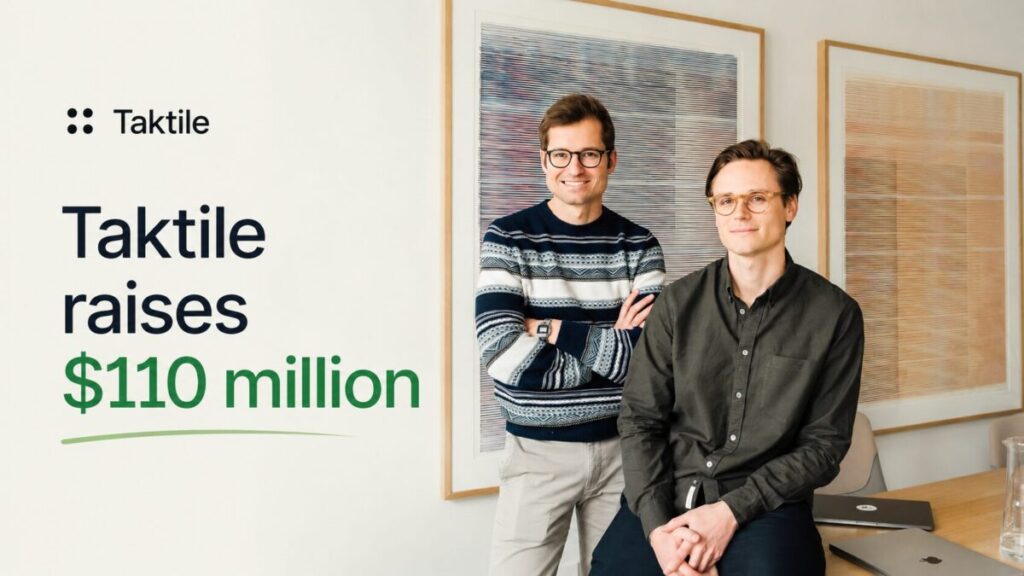
Most financial institutions are still making million-dollar decisions the same way they did twenty years ago. A human reads a file. Another human approves it. The process is slow, expensive, and honestly, full of gaps. Taktile raises $110 million because it has a very specific answer to that problem. And the biggest names in finance just put serious money behind that answer.
What Is Taktile and What Does It Do?
Taktile was founded in 2020 by Maik Taro Wehmeyer and Maximilian Eber and operates an agentic decision platform built specifically for financial service applications. Think credit underwriting, fraud detection, customer onboarding, and AML compliance. The high-stakes, error-sensitive work that banks cannot afford to get wrong.
But here is what makes Taktile different. It is not trying to be a general AI assistant. While generalist AI labs provide raw building blocks to engineers, Taktile gives financial institutions a way to operate AI-driven decisions within a system that business owners, from heads of credit to fraud officers, can understand and control. That distinction matters more than people realize.
The platform chains multiple AI agents together. One reads the document. Another interprets the data. A third makes the call. And throughout the whole process, a human can step in, review, and override. So it is not “AI instead of people.” It is AI working with people, inside a structure that regulators and compliance teams can actually audit.
Taktile Raises $110 Million in Series C Funding
On June 24, 2026, Taktile announced its $110 million Series C raise. Growth Equity at Goldman Sachs Alternatives led the round, with participation from Balderton Capital, Index Ventures, Tiger Global, Y Combinator, and Dig Ventures.
That is a heavy lineup. And the timing tells you something.
Demand for Taktile accelerated in 2025, as AI models became capable of automating high-stakes decisions that previously required hours of manual work, from underwriting business loans and assessing claims to catching financial crime. The company was not chasing a trend. The market caught up to what Taktile had already been building.
CEO Maik Taro Wehmeyer said it directly: “AI has been around for a couple of years, but 2026 is the year where AI comes to financial services. The models have now increased to such a strong level that they finally allow for agents to perform better than humans at many complex tasks.”
And the research backs it up. In December 2025, Taktile Labs, the company’s applied AI research institute, found that frontier models had crossed a critical threshold. AI could now handle the kind of high-stakes decisions that financial institutions had long reserved for human experts. That is not marketing copy. That is the actual inflection point this raise is built on.
Who Invested in Taktile’s $110M Round?
Let’s be honest. Investor names do not always tell you much. But this group is worth reading carefully.
Christian Resch, Partner in Growth Equity at Goldman Sachs Alternatives, said Taktile stands out for combining deep technical sophistication with a clear understanding of how regulated financial institutions actually operate and that banks and insurers consistently report that Taktile has helped them transform how their teams make decisions with AI.
Goldman Sachs does not lead a fintech infrastructure round to make a statement. They lead it because they have seen the product work inside the institutions they know best.
Beyond Goldman, the round includes Index Ventures and Tiger Global, both returning investors who have backed Taktile through earlier stages. Y Combinator participated too. So did Balderton Capital and Dig Ventures. The reality is, when you have early-stage credibility from YC sitting alongside growth-stage conviction from Goldman and Tiger, you have a company that has earned its way through every phase of growth.
How Taktile Uses AI to Automate Bank and Insurance Decisions
Here is a real example. Picture an insurance claim filed after a tornado damages a house. Normally, an examiner visits the site, reviews the damage, checks the policy, and makes a decision. That whole loop can take weeks. Then the homeowner waits even longer for a check.
With Taktile, there is first an agent that reads the document, then another that interprets what the data means and matches it to the coverage in the insurance policy, and then another agent that decides whether the claim should be paid out. Weeks become hours. Or less.
But it is not just about speed. The cost of doing this manually is crushing. Moody’s reports that financial institutions spend an average of $72.9 million annually on KYC and AML operations alone. That is just compliance. Not growth. Not product. Just the baseline cost of staying legal.
And the returns from switching to Taktile are not theoretical. One of the world’s largest insurers is running multiple use cases on the platform, with projected cost efficiencies of over $90 million in claims processing alone.
So we are talking about real money, at real institutions, producing real results. Not a pilot. Not a proof of concept.
Which Banks and Companies Use Taktile?
Taktile already has a client list that most fintech startups spend a decade chasing.
The platform powers millions of decisions daily for institutions including Mercury, Monzo, Faire, and Pleo. These are not experimental deployments. These are live production systems handling real customer outcomes every single day.
And the breadth goes further. The customer base spans 24 markets, encompassing sophisticated fintech companies such as Mercury, Kueski, and Zilch, as well as some of the world’s largest financial institutions, including Allianz and Rakuten Bank.
That mix of nimble fintechs and heavyweight traditional institutions is actually the hardest thing to pull off. Fintechs want speed and flexibility. Traditional banks want compliance, auditability, and rock-solid reliability. Building one product that satisfies both? That is genuinely difficult.
But the proof is in the ratings. Taktile has been named a G2 Decision Management Platform Leader for the seventh consecutive quarter, earning eleven badges across results, usability, and support. Seventh consecutive quarter. That does not happen by accident.
What Will Taktile Do With the $110 Million?
Two priorities. Clear, concrete, no fluff.
First, the product. As Wehmeyer put it, general-purpose AI tooling is fine for simple automations, but it is not sufficient for operating mission-critical financial decisions where errors can cost millions. Today, thousands of employees process these decisions manually, and leaders want to redeploy that capacity to higher-value work while ensuring every outcome, whether human or AI-driven, remains the best for the business and its customers. The new capital goes toward making the platform sharper, faster, and more accessible to non-engineering teams inside institutions.
Second, geography. Wehmeyer confirmed that the new funding will be used to continue building out the company’s software and to open a new office in Sao Paulo. Latin America is a smart next move. The region has a fast-growing fintech ecosystem, a massive underbanked population, and financial institutions that are actively looking for modern infrastructure.
With offices already in New York, Berlin, London, Sao Paulo, and Iasi, Taktile now has a genuinely global footprint to support the kind of enterprise deals that require boots on the ground.
Taktile’s Total Funding and Growth So Far
Step back and look at the full picture.
With this Series C, Taktile has now raised $184 million in total from Goldman Sachs Alternatives, Index Ventures, Tiger Global, Balderton Capital, and Y Combinator. That is a deliberate, disciplined capital stack built over six years.
The journey started with a $20 million Series A led by Index Ventures and Tiger Global. Then came a $54 million Series B led by Balderton Capital. By the time of that Series B, the company had quadrupled its customer base and grown over 3.5x in ARR. Not projected. Actual.
And now Taktile raises $110 million to press that advantage further.
The broader point is this. Banks and insurers are not automating because it sounds exciting. They are doing it because the cost of not automating is rising every single year. Compliance budgets are growing. Fraud is getting harder to catch manually. Customer expectations keep accelerating. Taktile has spent six years building exactly for this moment. The funding just means they get to move faster.
Sources used in this article:
Read about – Startup business models
Read in – Startup Directory
Read about Solo businesses

Hi Friends, This is Swapnil; I love reading and sharing knowledge. Currently working as a content writer at startupsunion.com. You all can hang out with me here.