Most people assume the AI search problem is already solved. Google exists. Bing exists. Perplexity exists. So what could possibly be missing?
Quite a lot, as it turns out.
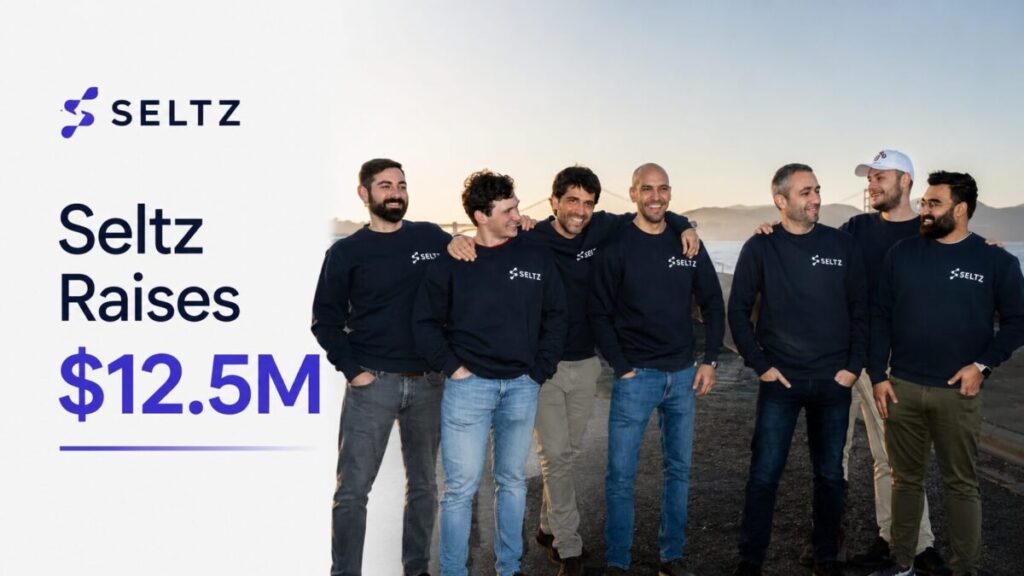
A lean, sharp startup called Seltz just raised $12.5 million to prove exactly that. The round was led by Speedinvest and B Capital, and the bet behind it is simple but important: the web was built for humans. AI agents are not humans. And plugging a machine into infrastructure designed for people clicking links produces bad results, slow responses, and a lot of noise in between.
That is the problem the Seltz $12.5M raise is built to fix.
What Is Seltz and What Does It Do?
Seltz is a San Francisco-based company that develops web retrieval technology specifically for large language models and AI agents. Not for people. For machines.
Let’s be honest about why that distinction matters. For decades, search was optimized around one kind of user: a human typing a short query, skimming a ranked list of links, and clicking through to a page. That model worked well. It still works well, for people.
But AI agents operate completely differently. They do not skim. They do not click. They fire off long, precise queries, sometimes dozens or hundreds of them in parallel, and they need structured, citable information they can immediately act on. Not a snippet designed to pull a human deeper into a website.
The challenge compounds fast. When an agent performs multiple searches during a single reasoning task, latency stacks up and retrieval quality directly shapes the final output. Feed an agent junk, you get junk back. Feed it ads, redirects, and HTML clutter, and the whole reasoning loop starts to break down.
Seltz was founded to fix the input layer. That is the whole company in a sentence.
The initial focus is on enterprise and AI-native clients building agents that depend on accurate, up-to-date information to do real work.
Seltz Raises $12.5M in New Funding Round
The Seltz $12.5M seed round was led by Speedinvest and B Capital. Additional participation came from Italian Founders Fund, United Ventures, Future Back Ventures (the venture arm of Bain and Company), futurepresent, Arc Investors, Vento Ventures, Mango Capital, and 2100 Ventures.
And then there is the angel and advisory layer, which tells its own story. Investors and advisors include figures from Amazon, Google, Cohere, Databricks, Ramp, and Synthesia, alongside academics from leading information retrieval labs at New York University and the University of Glasgow.
That is not a random list. When people who built retrieval systems at Amazon and Google are putting money into a seed-stage search infrastructure startup, they are signaling something specific about where the real gaps are. These are people who have lived inside the problem. They know what broken looks like.
Will Wells, deeptech partner at Speedinvest, described Seltz as one of the few companies rebuilding the retrieval layer in the right way for AI agents, and made clear the team was not building another wrapper-based product.
Gabe Greenbaum, general partner at B Capital, pointed to latency, reliability, and control over web retrieval as the critical infrastructure issues for AI development right now.
So the backers are not just writing checks. They are making a specific thesis call on where the AI stack is most broken.
Who Are the Investors Behind Seltz’s $12.5M Round?
Speedinvest and B Capital leading this Seltz $12.5M round is a deliberate combination.
Speedinvest is one of Europe’s most active early-stage firms with a strong track record in deep tech and infrastructure bets. B Capital brings global reach across the US and Asia, with serious operational weight behind it. Together they give Seltz European credibility and global distribution firepower at the earliest stage. That pairing matters.
The Italian presence in this round is also notable. United Ventures, Italian Founders Fund, 2100 Ventures, and Vento Ventures all participated. That reflects the founding DNA of the company more than just geography, which becomes clearer when you understand the founder’s background.
Future Back Ventures, the venture arm of Bain and Company, also joined. A major management consulting firm placing a seed bet on AI search infrastructure is not a casual move. These people study markets for a living.
And the angel board is genuinely useful, not decorative. Having active advisors from Amazon, Google, Cohere, and Databricks means the team has access to people who have run retrieval systems at scale, in production, under real enterprise load. That kind of practical knowledge is hard to hire for. Having it in the room from day one is an actual advantage.
How Seltz’s Platform Works
Here is the kicker. Most AI search products you have heard of are wrappers.
They take your query, run it through Google, Bing, or Brave’s APIs, clean up the output a little, and hand it back. That works for some use cases. But it means you are inheriting all the assumptions baked into those systems: ranked links, ad-shaped snippets, human-navigation structure.
Seltz does not do that. The company built its entire search stack from scratch. Its own web crawler. Its own search index. Its own retrieval models and ranking systems. All of it, end to end, written in Rust.
The system crawls hundreds of millions of pages a day and returns results in under 200 milliseconds. But speed is only part of it. Rather than returning a full page or a generic summary, Seltz scores individual passages and extracts the specific table, text, or image that an agent actually needs. CEO Antonio Mallia calls this context engineering.
The company also built the Dynamic News Search Benchmark (DNSB), a public benchmark for evaluating retrieval quality and latency across different AI search providers. By their own numbers, the platform delivers 89% accuracy and returns results in under 250 milliseconds.
Now, those figures come from Seltz itself. Worth keeping that in mind. But the underlying architecture is real and independently observable. You cannot fake a sub-200 millisecond crawl at that volume.
The Web Knowledge API is what developers actually interact with. It gives AI systems real-time access to web information that has been processed and structured for direct use, without routing through infrastructure built for a different era.
What Will Seltz Do With the $12.5 Million?
Three priorities. Clear and specific.
Seltz will use the Seltz $12.5M raise to expand crawl and indexing capabilities, grow the engineering and research team, and accelerate go-to-market efforts across frontier AI labs, AI-native startups, and enterprise companies.
The crawl expansion is the most capital-intensive of the three. Mallia has been direct about this: web-scale search is one of the most expensive problems in software to build correctly. The funding was specifically sought to scale the platform toward tens of billions of documents. That requires serious infrastructure investment, not incremental patches.
On the go-to-market side, the company is not starting from zero. Seltz already has a foundational lab under contract and is running multiple pilots with companies building agentic workflows. The sales motion is real, not theoretical. There are actual customers in the pipeline being moved toward production relationships.
And developer adoption is moving. Since the public API launch, Seltz has seen a six-fold increase in developer sign-ups and has entered into its first infrastructure and data partnerships with AI companies.
Six-fold sign-up growth at the seed stage is a number that earns attention. Enterprise AI teams do not casually adopt new retrieval infrastructure. When they do start signing up, it means the product is doing something the alternatives are not.
Seltz’s Growth: Key Numbers and Milestones
Let’s be clear about where Seltz actually stands right now. It is early. Very early.
Seltz was founded in October 2025 and currently employs 15 people. Only about half of them are full-time. The company operates across San Francisco, New York, Los Angeles, Paris, Berlin, Pisa, and Leipzig, with roughly half the team in the US and the other half in Europe.
But what they have shipped in under a year deserves credit. Mallia started with a news index and shipped a live platform within eight months of starting to build. Eight months from scratch to a functioning API crawling hundreds of millions of pages a day is not a typical early-stage pace. That is aggressive execution from a tiny team.
And the market recognition is building. Seltz was selected for the AWS and NVIDIA Startup Village at VivaTech 2026 in Paris as one of only seven European AI startups featured in that showcase. That does not guarantee anything. But when the cloud and chip companies with the most to gain from agentic AI taking off are hand-picking startups to spotlight, it is worth noting.
The six-fold developer sign-up growth since public API launch is the number that matters most at this stage. It is the clearest early signal that the product is finding real demand.
What Seltz’s Funding Means for the Industry
The Seltz $12.5M raise drops into one of the most competitive corners of the AI market right now.
So let’s talk about the competition plainly. Parallel, founded by former Twitter CEO Parag Agrawal, raised $100 million at a $2 billion valuation. Exa pulled in $85 million. Tavily was acquired by Nebius for up to $400 million.
The reality is, Seltz is entering this fight significantly outgunned on capital. That is a genuine challenge. Search infrastructure at web scale is expensive to build and punishing to run. The incumbents have real resources behind them.
But here is what most people miss. The majority of those competitors are still building on top of existing indexes. They are inheriting the assumptions of search systems designed for human behavior and adding an AI layer on top.
Seltz owns the full stack. That is a harder path to walk. It is also potentially a far more defensible position once the infrastructure is proven at scale. Owning the crawler, the index, the retrieval model, and the ranking means every optimization compounds across the entire pipeline. Wrappers cannot replicate that.
And here is the thing about enterprise AI infrastructure specifically. Once a company builds its agentic workflows on a retrieval system and it works, they do not swap it out casually. The switching costs are real. Getting in early, proving reliability, and expanding from there is the classic infrastructure playbook.
Seltz is trying to run that playbook from a seed round in a market where the frontrunners have raised ten to thirty times more capital.
The web was built for people. Seltz is quietly rebuilding the part that AI agents actually depend on. Fifteen people, a Rust-built crawler, and $12.5 million to find out if that bet is right.
Sources used in this article:
Read about – Startup business models
Read in – Startup Directory
Read about Solo businesses

Hi Friends, This is Swapnil; I love reading and sharing knowledge. Currently working as a content writer at startupsunion.com. You all can hang out with me here.