There are funding rounds. And then there are funding rounds that make you stop and actually pay attention.
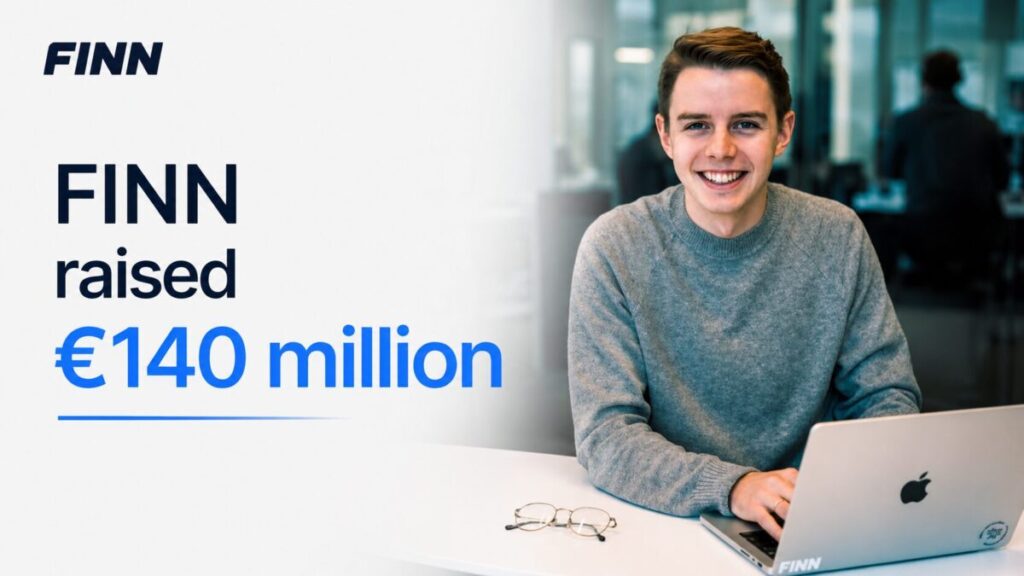
FINN just closed one of the latter. The Munich-based car subscription platform pulled in €140 million in a Series D raise, crossed the €1 billion valuation mark, and officially joined the unicorn club. But here is the kicker: this is not a company that stumbled into growth. They built something real, and the numbers back it up completely.
What Is FINN and What Does It Do?
Let’s be honest. The traditional car buying experience is broken. Dealerships, negotiations, paperwork stacks, surprise fees. Nobody actually enjoys it.
FINN was founded in Munich in 2019 by six co-founders: Maximilian Wühr, Nikolai Schröder, Andreas Stryz, Max Beyer, Hans-Peter Ringer, and Max-Josef Meier. Their core belief was simple but bold. Europeans were going to stop buying cars the way their parents did. So they built the alternative.
The model is clean. Customers go online, pick a vehicle, and get it delivered to their door within days. No showrooms. No sales pressure. The monthly subscription covers the car, insurance, registration, maintenance, and taxes. Everything bundled. One payment.
And the car selection is not limited either. FINN’s catalogue spans vehicles from over 25 brands including BMW, Mercedes-Benz, Cupra, Opel, Hyundai, MG, and BYD. Over 70% of the fleet is now electrified, covering battery-electric vehicles, hybrids, and some combustion models. So whether someone wants a fully electric daily driver or something in between, the options are there.
This is the product FINN took to €140 million. Worth understanding why investors said yes.
FINN Raises €140 Million in New Funding Round
The FINN €140 million Series D round is structured in two parts.
Nearly €100 million came in as equity. The remaining €40 million-plus came in as debt from BC Partners Credit and Runway Growth Capital. That structure matters. Debt capital is typically used to fund fleet assets directly, which means FINN is not burning equity to buy cars. Smart capital allocation.
But the most interesting piece of this FINN €140 million raise is not the size. It is one particular participant. SevenVentures, the investment arm of ProSiebenSat.1, joined through a media-for-equity deal. They received equity in exchange for advertising access across the media group’s platforms.
At a seed round, that kind of deal makes sense. At Series D, it tells you something. FINN’s leadership is not looking for more product development money. They believe the next growth lever is mass consumer awareness. And they structured the round to reflect exactly that.
The valuation now sits at over €1 billion. Unicorn status achieved. Seven years after founding.
Who Are the Investors Behind FINN’s €140M Round?
Portage leads this round. If you know the firm, you know what that signals. They have backed Wealthsimple, Marshmallow, and auxmoney. These are not flashy bets. They are recurring-revenue businesses with durable economics. FINN fits that profile precisely.
And then there are the returning investors. UVC Partners, Planet First Partners, Korelya Capital, White Star Capital, HV Capital, and Picus Capital all came back and either maintained or expanded their positions. That is the part people sometimes gloss over.
The reality is, returning investors at a higher valuation means something. It means people who had access to the internal data, the real unit economics, the hiring struggles, the operational chaos, all of that, still chose to write another check. That is the vote of confidence that actually matters.
Planet First Partners had led FINN’s €100 million Series C back in January 2024, when the valuation sat at around $600 million. Coming back for the Series D at a unicorn valuation is not a small commitment.
As of 2025, FINN had roughly 484 employees. A real company with real operational complexity, not a handful of people and a pitch deck.
How FINN’s Car Subscription Model Works
Here is what most people miss about FINN’s model. It is not just a consumer product.
Yes, the customer-facing experience is simple. Go online. Choose a car. Get it delivered. Pay one monthly fee that covers the vehicle, insurance, registration, maintenance, and taxes. Done. No hidden charges at the end.
But the B2B side of this business is equally important. At the time of FINN’s Series C in early 2024, the B2B fleet business accounted for half of annual recurring revenue. Companies that want to manage employee mobility without owning a fleet found FINN’s model genuinely useful.
So you have two customer bases feeding the same platform. That kind of dual demand is actually what makes the unit economics work over time.
And FINN built something else into the model that deserves credit. Every vehicle’s carbon footprint is offset through certified climate protection projects, run in partnership with South Pole. For a fleet that is now majority electric and growing, that sustainability layer is not just marketing. It reflects where the product is genuinely headed.
What Will FINN Do With the €140 Million?
Three things. Fleet. Technology. Operations.
The fleet expansion target is concrete. Earlier in 2026, FINN announced plans to add 11,500 vehicles, nearly doubling the fleet compared to the prior year. That kind of growth requires serious upfront capital, which is exactly what the debt portion of this FINN €140 million round is designed to cover.
The technology investment is about making the customer experience sharper. In a subscription business, the moment someone faces friction, whether in choosing a car, managing their subscription, or handling a service issue, you lose them. Keeping that experience frictionless as the platform scales is not optional. It is survival.
And then there is the longer game. FINN wants to move beyond Germany and build a genuinely pan-European platform for flexible car access. Germany is where the foundation is solid. Europe is where the real scale lives. And with a unicorn valuation and fresh capital in hand, that expansion effort now has proper fuel.
FINN’s Growth: Key Numbers and Milestones
Let’s just look at the numbers plainly.
FINN now manages over 50,000 active subscriptions. Annual recurring revenue sits at more than €300 million. That is significant scale for a company that did not exist seven years ago.
But the two-year trajectory is what really stands out. Between 2022 and 2024, FINN’s revenue grew from €3.2 million to €444 million. That is a 1,078% two-year compound annual growth rate. Read that again. Not year-over-year. Two-year CAGR of over one thousand percent.
Compare that to where the company stood at its Series C, just 18 months before this FINN €140 million round. At that point, the company had 25,000 active subscriptions and €160 million in annual recurring revenue. Both numbers have effectively doubled since then.
So the growth is not slowing down as the company scales. It is accelerating. That is the kind of thing that gets a Portage on the phone.
FINN also expanded beyond Germany, launching on the US East Coast in 2022. Proving the model could work outside its home market was a meaningful proof point for international investors.
What FINN’s Funding Means for the Car Subscription Market
The FINN €140 million raise does not happen in isolation. It arrives at a specific moment in a market that is moving fast.
The European car subscription market is currently valued at $3.91 billion in 2025. By 2035, projections put it at $35.95 billion, growing at roughly 25% annually. That is nearly a 10x expansion in a decade. The tailwind is real.
Germany alone accounts for about 34% of total European demand. FINN sits right at the center of that. The home-market advantage here is structural, not incidental.
But competition is coming. Sixt+ brings existing fleet infrastructure and brand recognition across Europe. Onto, based in the UK, is pushing an electric-only subscription model. And Free2Move, Stellantis’ mobility arm, covers Peugeot, Citroën, and Fiat customers with multi-brand subscriptions.
None of them have 50,000 active subscriptions. None of them just hit a unicorn valuation with a €140 million round behind them.
The reality is, markets like this tend to consolidate around one or two dominant platforms. FINN has positioned itself to be the one that survives that consolidation, not the one that gets absorbed into it. And with Portage leading the charge and every major prior investor doubling back down, the momentum points clearly in one direction.
The European car ownership era is not ending overnight. But it is ending. And FINN, with €140 million in fresh backing and 50,000 subscribers already on the platform, is building the infrastructure that comes next.
sources used in this article:
Read about – Startup business models
Read in – Startup Directory
Read about Solo businesses

Hi Friends, This is Swapnil; I love reading and sharing knowledge. Currently working as a content writer at startupsunion.com. You all can hang out with me here.