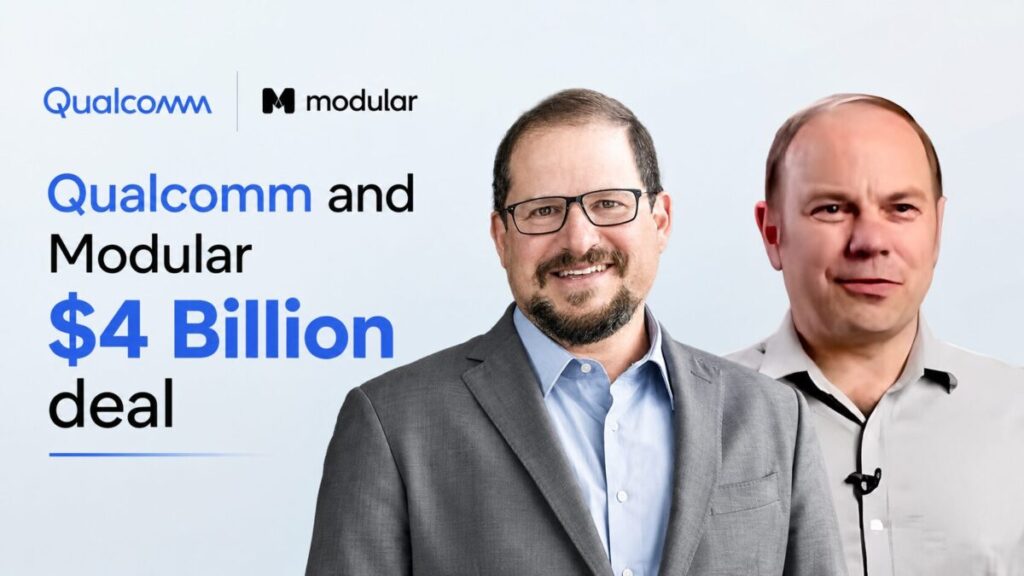
On June 24, 2026. Qualcomm confirmed it is buying AI software startup Modular in an all-stock deal worth roughly $3.9 billion. Simple announcement. Massive implications.
Here is the thing most headlines are missing. This is not really a hardware story. It is a software story. And the software in question is the kind that makes or breaks entire chip ecosystems. Qualcomm buys Modular not for a product line or a revenue stream. It is buying control over the layer that decides where AI models run and on whose silicon they land.
The reality is, that kind of control is worth far more than $4 billion if you execute on it correctly. Qualcomm knows that. And Nvidia definitely knows that.
What Is the Qualcomm-Modular Deal?
So let’s get the facts on the table first. Qualcomm is acquiring Modular through an all-stock deal structured as the issuance of up to 19.2 million shares of common stock. Based on Qualcomm’s closing share price ahead of the announcement, that works out to approximately $3.92 billion. The deal also carries a $300 million component earmarked specifically for Modular employees. That is not an afterthought tacked on at the end of negotiations. That is a deliberate retention strategy built directly into the contract structure.
The acquisition is expected to close in the second half of 2026, pending regulatory approvals.
And this is not Qualcomm’s only major move right now. The company has been in advanced talks to acquire Tenstorrent, an AI chip startup, in a separate transaction reportedly valued between $8 billion and $10 billion. Qualcomm also previously picked up Ventana Micro Systems, a startup building RISC-V server CPUs. The company is not moving slowly. It is assembling pieces at speed.
Cristiano Amon, Qualcomm’s President and CEO, said the company believes the future belongs to developer-friendly, horizontal platforms that can run across diverse compute environments and give customers real choice in how and where they deploy AI. That is a pointed statement. Not subtle at all.
Who Founded Modular and What Does It Build?
Modular was founded in 2022 by Chris Lattner and Tim Davis. They met at Google.
But Lattner’s track record stretches back much further. He created Apple’s Swift programming language and built the LLVM compiler infrastructure, which now sits underneath a massive portion of the software industry. He also led software development for Tesla’s Autopilot team before starting Modular with Davis.
Let’s be honest. That is not your average founding story. That is someone who spent decades building the tools that other builders depend on daily. He was not approaching this problem fresh. He had already seen it from the inside at multiple major companies.
The problem Modular was set up to solve is straightforward and expensive. Every time an AI developer moved from one chip to another, say from an Nvidia GPU to a custom ASIC or an ARM processor, they had to rewrite significant amounts of code from scratch. Time-consuming. Expensive. And it keeps developers permanently tethered to whichever chip ecosystem they originally built on.
Their answer is two core products. First, Mojo, a programming language designed specifically for AI, sits on top of Python’s familiar syntax but delivers performance Python cannot come close to matching. Second, the MAX inference engine, a hardware-agnostic runtime that allows AI models to run across CPUs, GPUs, NPUs, and custom ASICs without developers rewriting their code for each chip. That combination is what Qualcomm is really buying here.
How Much Did Qualcomm Pay for Modular?
Here is the kicker. Nine months before this deal was announced, Modular had just closed a $250 million funding round that valued the company at $1.6 billion. Total funding raised before the acquisition: approximately $380 million.
Qualcomm buys Modular at roughly $4 billion. A valuation jump of more than 140% in under a year.
Some people will call that overpaying. That framing is too simple. You are not buying a startup at its current revenue multiple. You are buying a strategic position in an infrastructure market where the first mover with the right software stack wins for a very long time. Whoever controls the layer between AI models and hardware can steer workloads onto their own chips. At that level of strategic value, $4 billion starts looking like a reasonable entry price.
Why Qualcomm Is Taking On Nvidia’s CUDA
The reality is, Nvidia’s grip on AI is not built on chip performance alone. It is built on CUDA. A software platform Nvidia has been developing since 2006. Millions of developers have written AI code on top of it. Moving to a different chip ecosystem means breaking all of that. Starting over. Rewriting models. Debugging a new runtime. Most engineering teams simply will not take that risk, even if a competing chip technically performs better.
That switching cost is the real moat. Not the silicon.
Competitors have attacked Nvidia on hardware for years. Results have been limited. The gap in raw chip performance is narrowing, but CUDA keeps developers in place regardless. So the smarter play is to attack the lock-in itself, not the hardware specs.
That is exactly what happens when Qualcomm buys Modular. The MAX inference engine is built so developers can run AI code across different hardware without rewriting it for each chip. No vendor dependency. No forced ecosystem.
But there is also a timing angle worth understanding. Training large AI models is still Nvidia’s stronghold. That is where CUDA is most embedded and hardest to dislodge. Inference, actually running those trained models at scale across data centers and edge devices, is where competition is far more open. That is where MAX operates. That is where this acquisition is aimed.
What Modular’s Technology Does for AI Developers
Before Qualcomm buys Modular, the startup had already secured partnerships with major chipmakers and hyperscalers. It was competing head-on against in-house software efforts built by some of the largest companies in technology. And it still grew to a $1.6 billion valuation in three years.
That does not happen unless the technology is genuinely solving something real and painful.
Mojo is accessible to any developer who already knows Python. Low learning curve. But the performance ceiling is dramatically higher for AI workloads. MAX then acts as the translation layer between the written code and whatever hardware it eventually runs on.
Think about what that means practically. An enterprise team deploying AI across a mixed hardware environment, cloud GPUs for some tasks, edge chips for others, and custom ASICs for specific inference jobs normally maintains separate codebases for each hardware type. With MAX, the code is written once. The engine handles the rest. And now, with Qualcomm’s scale and distribution behind it, this technology can reach customers no 150-person startup could have accessed independently.
What Happens to Modular’s Team After the Deal
All 150 Modular employees are joining Qualcomm. Both co-founders, Lattner and Davis, are part of the move.
Lattner responded to the acquisition publicly, saying that joining Qualcomm gives the company “the scale and platform reach to accelerate that mission.” That reads like someone who still has unfinished business on the table. Not a founder quietly walking away with a check.
The $300 million employee component built into the deal structure is Qualcomm making sure the team stays together after close. And that matters more than most press coverage acknowledges. In AI acquisitions, the engineers who built the core technology are not interchangeable. If they leave, the IP stays but the people who know how to develop and extend it are gone. Qualcomm is paying specifically to prevent that.
The all-stock structure also means the Modular team has a real financial stake in whether this works. Their interests are tied directly to Qualcomm executing on the strategy. That kind of alignment is hard to manufacture.
What This Acquisition Means for Qualcomm’s AI Strategy
Step back and look at the full picture. Qualcomm has been working to reduce its reliance on smartphones for years. Smartphones still generate most of the company’s revenue. But that market grows slowly compared to AI infrastructure, and everyone at Qualcomm is aware of that gap.
So the company has been building outward into new categories. AI-powered PCs, automotive technology, industrial systems, networking equipment, and data center processors are all part of the current expansion plan. But hardware alone does not build an ecosystem. You need the software layer on top of it. That was the missing piece.
Qualcomm buys Modular to close that gap directly. With MAX and Mojo in hand, the company can now walk into enterprise conversations and offer not just chips, but a full-stack platform that gives developers a real, working alternative to what Nvidia provides. That changes the sales conversation at a fundamental level.
Line it all up. Ventana Micro for RISC-V server CPUs. Tenstorrent negotiations for dedicated AI silicon. And now Qualcomm buys Modular for the inference software stack that runs across all of it. A data center AI platform, being built piece by piece, with serious money behind every move.
Whether developers actually adopt it is the real test. But Qualcomm is not testing the waters here. It is spending $4 billion to own the software sitting between AI models and the machines running them. That is a committed, calculated bet. And it is aimed squarely at Nvidia.
Sources used in this article:
Read about – Startup business models
Read in – Startup Directory
Read about Solo businesses

Hi Friends, This is Swapnil; I love reading and sharing knowledge. Currently working as a content writer at startupsunion.com. You all can hang out with me here.