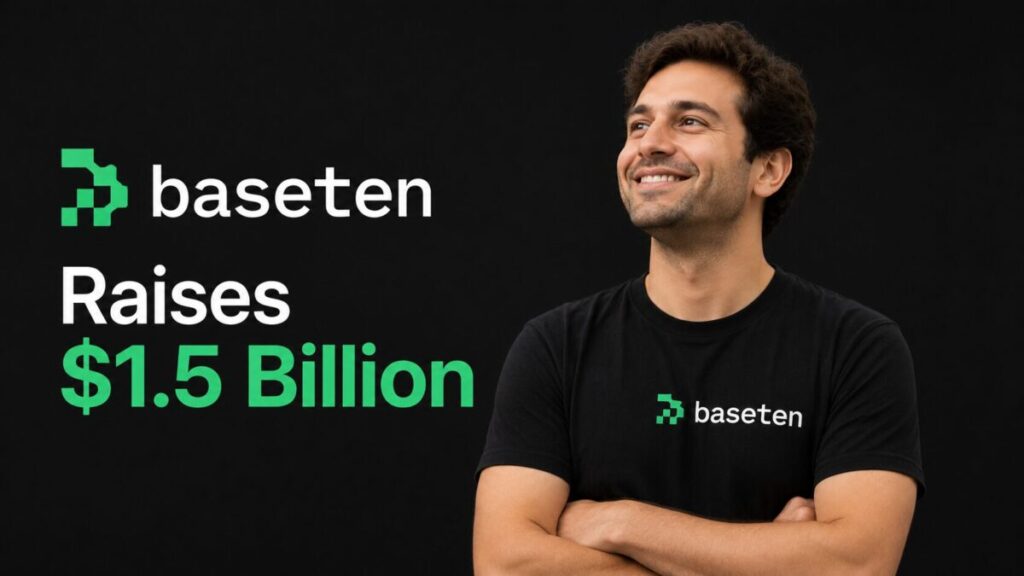
Baseten just did something most startups only dream about. The San Francisco-based company closed a $1.5 billion Series F, landing a valuation of up to $13 billion. Five months ago, that number was $5 billion. And before that, $2.15 billion.
Let’s be honest. That kind of trajectory doesn’t happen by accident.
This is not a company that stumbled into the right moment. Baseten built something real, and now the market is catching up to what they saw coming years ago.
What Is Baseten and What Does It Actually Do?
Baseten is an AI inference company. Simple as that. Founded in 2019 by Tuhin Srivastava, Amir Haghighat, Philip Howes, and Pankaj Gupta, the company builds the systems software that actually runs AI applications in the real world.
Here is the kicker. Most people hear “AI company” and think of the model itself. The flashy thing doing the talking. But someone has to run that model. At scale. In real-time. Without dropping requests. That is an inference. And that is exactly what Baseten handles.
The platform covers GPU orchestration, autoscaling, observability, billing, and developer tooling. So the engineering teams building AI products can actually focus on building, instead of babysitting infrastructure. Baseten also supports training, fine-tuning, evaluation, and embeddings inference for RAG and search workloads.
The pitch is simple. Run your AI cheaper, faster, and more reliably than you ever could on closed-source APIs. Some customers have reported running workloads on Baseten at roughly 30% of the cost of proprietary alternatives.
That is not a small number.
Baseten Raises $1.5 Billion in Series F at $13 Billion Valuation
On June 22, 2026, Baseten officially closed its $1.5 billion Series F. The round was split across two tranches. Some investors came in at an $11 billion valuation. Others paid the full $13 billion headline price. Split-priced rounds like this have become common in fast-moving AI deals, letting companies bring in different investor classes at different terms while still putting a big number on the press release.
So how fast did this all happen? Very fast.
Just five months earlier, in January 2026, Baseten raised a $300 million Series E at a $5 billion valuation, backed by IVP, CapitalG, and NVIDIA. Before that came a $150 million Series D in September 2025 at a $2.15 billion valuation. And before that, a $75 million Series C in February 2025 at an $825 million valuation.
The reality is, Baseten has now raised over $2 billion in total since founding. The Series F alone is nearly 2.5x everything they had raised across all prior rounds combined. And this is their fourth capital raise in 18 months.
That is not normal. But Baseten’s growth has not been normal either.
Who Led the Baseten Funding Round?
The $1.5 billion Series F was led by Altimeter Capital, Conviction, and Spark Capital. Conviction and Spark Capital are both returning investors. Sands Capital and Wellington Management came in as co-leads.
The rest of the cap table includes IVP, Greylock, 01A, Blackbird, Durable Capital Partners, Verified Capital, Battery Ventures, and D. E. Shaw Ventures, plus a number of existing backers.
Blackbird VC said their commitment to this round may be the firm’s biggest single investment ever. That is a meaningful statement from a firm that does not make them lightly.
Altimeter Capital partner Apoorv Agrawal noted that Baseten’s early focus on specialized AI models put the company in position to benefit from a market shift that moved faster than most people expected. He pointed out that some of the world’s most sophisticated AI companies are now standardizing on Baseten’s infrastructure for production deployments.
And here is what that investor list tells you. Wellington Management. Sands Capital. These are not your typical seed-stage venture tourists. These are institutional names that write big checks when they believe the fundamentals are real. That is a very different signal than a typical VC-heavy round.
Why Baseten’s Revenue Jumped 20x in One Year
Let’s talk numbers. Because the valuation jump from $5 billion to $13 billion in five months is a bold move. Bold enough to raise eyebrows. But the revenue story backs it up.
Baseten reported revenue growth of approximately 20x year-over-year. Research firm Sacra tracked the annualized revenue run rate going from roughly $200 million in December 2025 to approximately $600 million by March 2026. That is a tripling in a single quarter. Year-over-year growth landed at around 1,900%.
So what actually drove that?
Open-source AI models got really, really good. As models like Llama and DeepSeek closed the gap with expensive closed-source alternatives, enterprises started rerouting workloads. Why pay OpenAI or Anthropic rates when you can fine-tune an open-source model for your specific use case and run it on Baseten at a fraction of the cost?
CEO Tuhin Srivastava said it plainly: “At the highest level, what’s happening in the market is that the open-source models are getting very, very good. And as open-source gets better, we are growing with it.”
Leading app-layer companies now direct between 30% and 50% of their model spending toward custom and post-trained models, according to Baseten. That shift in where money is going is exactly why Baseten’s revenue looks the way it does.
The company also acquired Parsed, a reinforcement learning startup focused on post-training and continual learning for large models. That acquisition deepens Baseten’s grip on the full AI development loop, not just the inference piece at the end.
How Baseten Handles AI Inference Across 18 Cloud Providers
Here is where it gets genuinely interesting from a technical standpoint.
Baseten does not own its GPU hardware. Instead, it sources compute from 18 cloud environments globally, operating across 87 clusters worldwide. The Multi-Cloud Manager (MCM) module automatically distributes inference requests across all those providers, with built-in failover to handle GPU scarcity without dropping a single query.
The result? More than 1 billion inference calls are processed every day. And inference volume grew 40x over the past year.
The platform runs on an open-source framework called Truss. Developers package their models into production-ready APIs through a straightforward CLI workflow. Models are wrapped in Firecracker-style micro-VMs, weights are sharded across GPU fleets, and cold-start snapshots let models as large as 20GB come online in under 10 seconds.
So fast it almost feels wrong.
Baseten also signed a Strategic Collaboration Agreement with Amazon Web Services (AWS) this year, making its inference services available to customers already running on AWS infrastructure.
Which companies use Baseten for AI infrastructure?
The customer list here matters. A lot.
Baseten’s current customers include Abridge, Clay, Cursor, Lovable, Mercor, and OpenEvidence. These are not pilot customers running experiments. These are companies where AI is the core product, and downtime or latency is not acceptable.
Cursor runs one of the most widely used AI code editors in the world. Abridge handles clinical documentation AI in healthcare settings where accuracy is non-negotiable. Mercor powers AI-driven recruiting workflows. OpenEvidence runs medical AI where speed directly affects real-world outcomes.
The reality is these companies chose Baseten not because it was cheap, but because it could handle the load. When intelligence is the product and not just a feature, inference performance is everything. And Baseten is built around exactly that use case.
But it does not stop at AI-native startups. The platform also counts Notion among its customers, and a growing number of larger enterprises are moving in fast.
What Baseten Plans to Do With the $1.5 Billion
Baseten has been direct. The money goes toward talent, compute, and enterprise go-to-market.
The company plans to triple its headcount in 2026, scaling across engineering, research, operations, and commercial teams. That is a massive hiring push for a company at this stage. But it signals something important: Baseten knows the window to capture this market is open right now, and they intend to run through it.
On compute, the plan is to expand GPU capacity across the multi-cloud network to handle even larger inference workloads as enterprise adoption accelerates.
The enterprise push deserves attention. Most of Baseten’s current base are AI-native startups. But the bigger opportunity, and the bigger revenue, sits in established enterprises in healthcare, financial services, and legal tech. Those deals are larger, stickier, and harder to compete with.
Srivastava has been clear about the long-term ambition. “For us, inference is one part of AI infrastructure. Beyond that, there’s training, evaluation, and fine-tuning. We really want to own that entire loop. We want to build the next AWS for inference.”
That is not a small vision. And with over $2 billion raised and revenue growing at a pace that few infrastructure companies have ever seen, Baseten is not just making noise. The $1.5 billion raise puts real fuel behind a company that was already moving fast. Whether the $13 billion valuation holds at exit depends on what the next few quarters look like. But right now, the bet looks less like optimism and more like conviction.
Read about – Startup business models
Read in – Startup Directory
Read about Solo businesses

Hi Friends, This is Swapnil; I love reading and sharing knowledge. Currently working as a content writer at startupsunion.com. You all can hang out with me here.