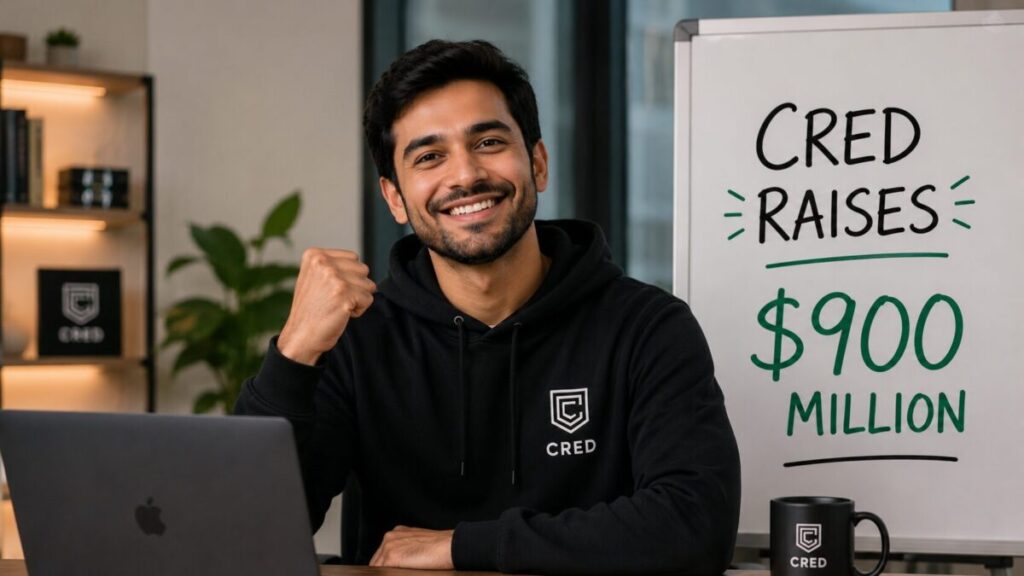
India’s startup world does not get many days like this. CRED raises $900 million in a Series H round led by Meta Platforms, landing a post-money valuation of $4.5 billion. And if you think this is just another funding announcement, you are missing what is actually going on here. The money is real. But what is happening around it, the founder exit, the leadership shuffle, the IPO signal—that is the real story.
What Is CRED and Why Did Meta Invest $900 Million in It?
Let’s be honest. When CRED launched in 2018, a lot of people scratched their heads. Pay your credit card bills on time and earn rewards. That was the pitch. Simple, almost boring. But Kunal Shah saw something nobody else did. Creditworthy Indians were being ignored by the financial system, not rewarded for their discipline. CRED was built to fix that.
Eight years later, 17 million people use CRED every month. The platform processes more than 40% of all credit card bill payments in India. It has since expanded into lending, insurance, wealth management, and lifestyle products. Annual revenue sits at roughly Rs 3,200 crore, or about $325 million, and the company is profitable.
So why does Meta care? Because WhatsApp has around 500 million users in India and still ranked ninth in UPI transaction volume as of May 2026. That is a massive user base with a relatively weak payments position. CRED’s 17 million members are not random users. They are high-credit-score individuals, exactly the people Meta needs to make WhatsApp Pay relevant. This investment is not charity. It is strategy.
CRED Raises $900 Million in Series H Round Led by Meta
Here is the kicker. This round is not just a cheque being written. The Series H is structured as a mix of primary capital and secondary share purchases. The breakdown: $500 million in fresh primary capital, $400 million from secondary share sales by existing investors, and an additional $100 million in Meta ad credits redeemable across Facebook and Instagram.
Before the round, CRED’s pre-money valuation stood at Rs 38,819 crore, or about $4.03 billion. After the round closes, the post-money figure lands at Rs 43,239 crore, roughly $4.5 billion. Meta picks up approximately 20% as a minority investor.
And here is something worth paying attention to. Meta gets no board seat. No access to CRED’s customer data. That is explicitly confirmed by the company. In India’s regulatory environment, where fintech data privacy is under constant scrutiny, CRED clearly knew that line had to be drawn from day one. Smart move.
The round is widely expected to be CRED’s last private fundraise before heading toward a public listing.
CRED Valued at $4.5 Billion After Meta’s Investment
The reality is, valuations tell a full story only when you read the whole arc. CRED peaked at $6.4 billion in 2022, got hit by the global tech correction, and had slid down to around $3.6 billion by May 2025. That is a rough two years by any measure.
But context matters. That correction happened across the board. And CRED used that time to fix its fundamentals rather than chase another flashy round.
So when CRED raises $900 million and lands back near that 2022 peak, the narrative is different. The company is profitable now. Its lending book has grown to Rs 24,000 crore in managed assets under management. PeakXV Partners, which backed CRED at the seed stage in 2018, described it as a company with a “sound economic engine. ” That is not a phrase investors use lightly. That is a phrase they use when the math actually works.
And Meta’s involvement adds a layer that money alone cannot buy. Half a billion Indians use a Meta product every day. That is distribution. That is leverage. And now CRED sits directly inside that orbit.
Kunal Shah Steps Down as CEO to Lead WhatsApp Globally
Nobody saw this part coming. As part of this deal, CRED founder Kunal Shah steps down as CEO and moves to Meta to lead WhatsApp globally. He becomes the first Indian to head the world’s most used messaging platform.
He is replacing Will Cathcart, who led WhatsApp for about seven years. Cathcart oversaw the platform growing past 3 billion monthly active users and launched products like Communities, Channels, and AI-linked features. He is staying at Meta but shifting to a new role focused on building consumer AI products from scratch.
Shah’s appointment came directly from Meta’s Chief Product Officer Chris Cox. In an internal note to employees, Cox described Shah as “one of India’s most respected entrepreneurs.” The brief was clear: find someone who understands how AI will reshape global messaging and who knows WhatsApp’s market from the inside. Shah, who built a fintech company in India’s most complex consumer environment, was the answer.
But Shah is not walking away from CRED entirely. He retains his personal shareholding. The founder exits the operator role, not the cap table.
Who Is Miten Sampat, CRED’s New Interim CEO?
When a founder leaves, the first question is always: Who keeps the engine running? At CRED, that answer is Miten Sampat, appointed interim CEO with immediate effect.
Sampat is not a parachute hire. He has been at CRED since 2020, running strategy and finance through the company’s most critical growth years. He was part of the team that expanded CRED from a single-product rewards platform into the multi-license fintech it is today. He helped steer it toward profitability.
His first public statement set a deliberate tone. Sampat said CRED has a “generational opportunity” to build on Shah’s vision and grow consistently toward becoming a public company. Short on drama, long on direction. That is exactly what you want from someone stepping into a role like this.
The board is actively working on a permanent leadership structure with the IPO timeline in mind. That process is ongoing.
What Will CRED Do With the $900 Million Funding?
Growth. Institution building. Category leadership. That is what CRED says, and it actually tracks.
CRED already owns credit card bill payments in India. The next move is scaling what is already working: lending, insurance, wealth management, and merchant solutions for its existing base of high-intent, high-credit-score members. These are not random users. They are people who have already demonstrated financial discipline. Selling them deeper financial products is a logical, defensible play.
The $100 million in Meta ad credits is easy to underestimate but genuinely valuable. CRED spent heavily on marketing for years to build its brand. Getting equivalent value in ad inventory across Facebook and Instagram without burning primary capital is a quiet win buried inside the bigger headline.
And then there is the angle everyone is thinking about but nobody is saying out loud. Kunal Shah is now leading WhatsApp. Meta owns 20% of CRED. WhatsApp Pay is trying to grow in the same payments space CRED already dominates. The strategic alignment between these two entities is visible without needing anyone to spell it out.
Is CRED Planning an IPO After This Funding Round?
Yes. Not a maybe. Not “exploring options.” The company has said directly that this Series H may be its final private round before a public listing. The board has confirmed it is working toward an IPO structure. Miten Sampat’s mandate as interim CEO includes building the institutional capabilities a listed company needs.
The foundation is there. CRED is profitable. It holds multiple financial licences. Revenue is over Rs 3,200 crore annually. Lending AUM has crossed Rs 24,000 crore. And there is now $900 million sitting on the balance sheet.
The timeline has not been shared. But the direction is not in question. CRED raises $900 million not just to fund growth but to arrive at an IPO in the strongest position possible. That is the plan. And right now, for the first time in a while, CRED has the fundamentals to pull it off.
Is CRED Worth It for You? Here’s What the Ratings, Reddit, and the Latest News
Read about – Startup business models
Read in – Startup Directory
Read about Solo businesses
Hi Friends, This is Swapnil; I love reading and sharing knowledge. Currently working as a content writer at startupsunion.com. You all can hang out with me here.