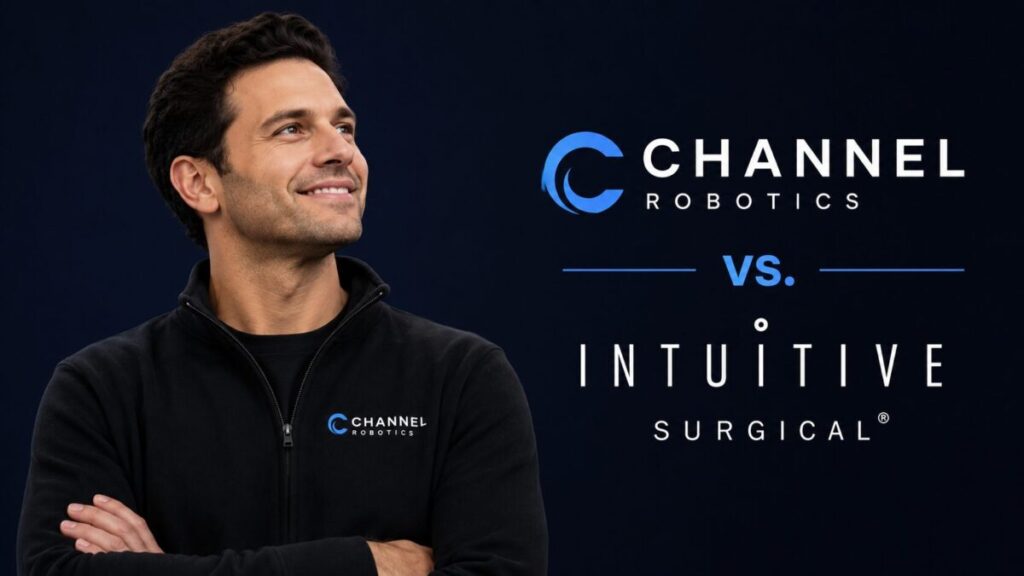
The surgical robotics industry is at an inflection point. On one side, you have Intuitive Surgical — the undisputed king of the operating room with over three decades of dominance. On the other, a scrappy San Diego startup called Channel Robotics that just raised $4.6 million and is quietly building something that could change how the entire market works. The Channel Robotics vs. Intuitive Surgical conversation is not just about two companies. It is about two completely different philosophies on where robotic surgery is headed.
What Is Channel Robotics and What Does It Do?
Channel Robotics is a San Diego-based medical technology company developing a handheld endoscopic robotic platform. Simple as that. But the implications are anything but simple.
The company was founded by physician-scientist Dr. Philip Weissbrod and roboticist Dr. Michael Yip – a rare pairing of someone who has actually held a scalpel and someone who builds the machines. That combination matters more than most people realize when you are trying to solve real clinical problems.
Channel’s patented and patent-pending technologies allow surgeons to reach further with robotic surgery. Their technology employs the latest developments in endoscopic robotics at a miniaturized scale, allowing a single surgeon to both operate the endoscope and control the robot without additional ergonomic strain.
So what does that actually mean? It means a doctor in a smaller hospital, without a million-dollar robotic suite, could one day perform complex procedures with the kind of precision previously reserved for elite academic medical centers. That is the bet.
The company recently closed a $2.5 million Seed+ financing round led by True Ventures, following an earlier $2.1 million seed round that included participation from Defined Ventures and Old Line Capital Partners, bringing the total capital raised to $4.6 million. The new funding will support product development, regulatory work, preparation for an FDA submission targeted for 2027, and commercial launch planning following regulatory clearance.
Early days. But pointed ones.
How Does Channel Robotics Compare to Intuitive Surgical’s da Vinci?
Here is the kicker. When you look at Channel Robotics vs. Intuitive Surgical side by side, you quickly realize they are not actually building the same thing. And that distinction is everything.
Intuitive Surgical’s da Vinci surgical systems are designed to help surgeons perform minimally invasive surgery and offer surgeons high-definition 3D vision, a magnified view, and robotic and computer assistance. They use specialized instrumentation, including a miniaturized surgical camera and wristed instruments designed to help with precise dissection and reconstruction deep inside the body. It is a powerful, proven, room-sized system. Built for large hospitals. Built for volume.
Channel Robotics is going the other way entirely.
Their technology leverages AI to achieve superhuman freedom of instrument movement and intuitive control. And crucially, by avoiding the need for large, capital-intensive robotic systems, Channel aims to make advanced endoscopic procedures more accessible to hospitals, ambulatory surgery centers, and community practice settings.
That is a fundamentally different bet. One company is building the flagship aircraft carrier. The other is building something fast, nimble, and deployable almost anywhere. Both have a role to play. But they are not fighting over the same ocean.
Which Robotic Surgery System Is Safer for Patients?
Let’s be honest. This is the question that matters most. And the answer, right now, is not a clean one.
Surgeons have performed nearly 17 million procedures using da Vinci technology worldwide, and nearly 90,000 surgeons have been trained to use Intuitive’s systems globally. That is an extraordinary body of clinical evidence. Decades of refinement. Thousands of edge cases worked out in real operating rooms.
The da Vinci 5 platform has already been used for 40 different procedure types by more than 2,500 surgeons, with over 32,000 procedures performed in its early phase alone.
So Intuitive carries weight. Real weight.
Channel Robotics, by contrast, is pre-FDA clearance. Still in prototype refinement. The company is currently supporting continued refinement and validation of its prototype, with an FDA submission targeted for 2027. The safety story for Channel has not been written yet. That is not a knock. That is just the truth of where they are in the journey.
But here is what you should not dismiss. Channel Robotics’ vision of democratization speaks to a fundamental shift in how and where advanced medical care is delivered. By making robotic-assisted procedures affordable and accessible for a broader range of healthcare facilities, the technology could help alleviate geographic and economic disparities in patient care.
A patient getting a safer, more precise procedure in a community hospital rather than no robotic care at all. That is a safety argument too.
Channel Robotics vs. Intuitive Surgical: Cost and Pricing Breakdown
Let’s talk money. Because in healthcare, cost is never just a business problem. It is a patient access problem.
The average selling price of the da Vinci 5 system is approximately $1.5 million, up from $1.44 million a year ago. And that is before you factor in instruments, accessories, service contracts, and ongoing maintenance. Intuitive has built a razor-and-blade model that generates recurring revenue every single time a da Vinci is used. Smart. And extremely sticky.
Intuitive’s full-year 2025 revenue came in at approximately $10.1 billion, representing 21% growth.
That is not a company. That is a financial institution that also does surgery.
Channel Robotics is still pre-revenue. Still pre-commercialization. But the entire strategic premise of the company is built around affordability. By avoiding the need for large, capital-intensive robotic systems, Channel aims to make advanced endoscopic procedures more accessible to hospitals, ambulatory surgery centers, and community practice settings.
Think about that for a second. A handheld platform that plugs into equipment hospitals already own. No $1.5 million upfront check. No dedicated robotic operating suite. No years-long purchasing process. If Channel can actually deliver on that promise, the cost comparison between Channel Robotics vs. Intuitive Surgical will not even be a fair fight. It will be a different category altogether.
Is Channel Robotics a Real Competitor to Intuitive Surgical?
Right now? No. Not directly.
But that framing misses the point entirely. Surgical robotics experts agree that the most promising new technologies provide robot-assisted surgery options that don’t directly compete with Intuitive. The companies having success are those trying to find areas where they have a unique proposition, rather than spending massive marketing dollars competing with Intuitive head-on.
Channel Robotics fits that description precisely. They are not chasing the same surgeons, the same hospitals, or the same procedures. Channel believes its approach can create a new category within endoscopic robotics by integrating into existing clinical workflows rather than requiring hospitals to adopt large standalone robotic platforms.
And as co-founder Michael Yip, PhD, stated: “Our mission is to democratize access to advanced endoscopic robotics.”
That is not a competitive statement. That is a market creation statement. There is a big difference.
So is Channel Robotics a real threat to Intuitive Surgical today? Probably not. But is it building toward a space that Intuitive cannot easily follow? That is a much more interesting question.
Which Company Has Better Technology for Robotic Surgery?
Depends entirely on what you mean by better.
Intuitive Surgical holds a commanding lead in terms of maturity, breadth, and scale. The company’s installed base has reached 10,488 systems worldwide as of June 30, 2025, with 6,087 in the United States alone. And the da Vinci 5 represents a genuine leap forward. It features more than 150 enhancements over prior generations. A major highlight has been the force feedback feature, which provides tactile sensation during procedures. Surgeons feeling tissue tension through a robotic system. That is not incremental. That is a step change.
But Channel Robotics is competing on a completely different axis.
Channel’s patented and patent-pending robotic technologies allow surgeons to reach further with robotic surgery with articulated instruments that have more dexterity than they have ever had before, allowing them to complete some of the most complex and challenging procedures in an easier and faster manner.
And the miniaturization angle is real. Their technology employs the latest developments in endoscopic robotics at a miniaturized scale, allowing a single surgeon to both operate the endoscope and control the robot without additional ergonomic strain.
So here is the honest take. Intuitive wins on proven, scaled, enterprise-grade surgical technology. Full stop. But Channel may be carving out an edge in the specific domain of miniaturized endoscopic robotics that no existing system can replicate. It is too early to call. But it is not too early to pay attention.
Channel Robotics vs. Intuitive Surgical: Who Will Win the Surgical Robot Market?
The surgical robotics market is not a winner-takes-all game. Anyone who tells you otherwise is selling something.
The global surgical robot systems market is projected to grow from $11.48 billion in 2024 to $23.13 billion by 2030, at a compound annual growth rate of 12.4%. There is more than enough room for multiple companies to build significant businesses in that kind of growth environment.
Intuitive is not slowing down. Q1 2026 revenue hit $2.77 billion, a 23% increase year-over-year, with the installed base of da Vinci systems growing to 11,395 globally. That is a company firing on every cylinder. Scale, brand, regulatory moat, recurring revenue. It is a machine.
But scale is not the same as total market coverage. And that is where Channel Robotics enters the picture.
As Channel Robotics CEO Philip Weissbrod stated, “We believe the future of endoscopic robotics will be defined by solutions that are more accessible, easier to adopt, and capable of reaching far more patients than traditional robotic systems.”
The reality is, most of the world’s hospitals will never buy a da Vinci. The price alone makes it impossible. Channel Robotics is not trying to beat Intuitive Surgical. They are trying to serve the patients that Intuitive Surgical was never designed to reach.
And in a market headed to $23 billion by 2030, that gap is not a consolation prize. It is a massive, underserved opportunity waiting to be claimed.
Read about – Startup business models
Read in – Startup Directory
Read about Solo businesses

Hi Friends, This is Swapnil; I love reading and sharing knowledge. Currently working as a content writer at startupsunion.com. You all can hang out with me here.