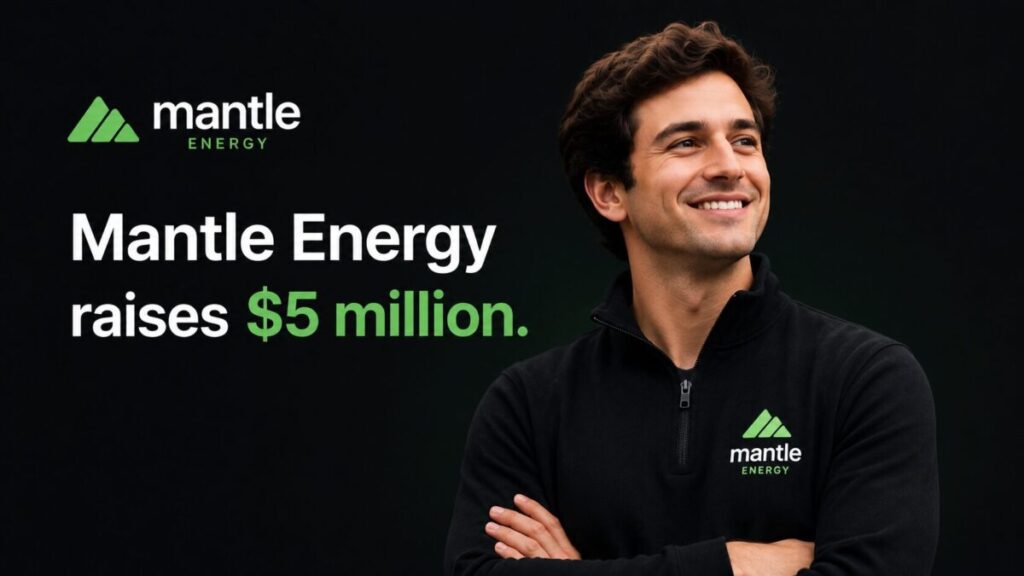
Mantle Energy just closed a $5 million seed round. Small check by some standards. Big deal for what it signals.
The announcement landed on June 16, 2026, and it’s worth pausing on. A Dallas-based startup is betting that the oil and gas industry has been sitting on a goldmine it never knew how to spend. Backed by Hunt Energy Company, Mantle Energy is now stepping out on its own, carrying a technology that could change how we think about a “depleted” well.
Here’s the kicker. Most people assume a dead well is just that, dead. Mantle Energy doesn’t buy it. And honestly, neither should you once you hear the pitch.
What Is Mantle Energy?
The idea is almost stubbornly simple. Most wells get shut in long before the oil and gas underground is actually gone. About 90% of the hydrocarbons in a typical shale formation are still down there even after a well stops producing. That’s the number Mantle Energy keeps coming back to.
So instead of chasing more oil out of the ground, Mantle Energy flips the question. What if you didn’t extract it at all? What if you turned it into heat instead?
The company grew out of Hunt Innovative Technologies, the innovation arm inside Hunt Energy Company, before spinning out as its own entity, Mantle Energy, Inc. It blends two worlds that rarely talk to each other: enhanced oil recovery, the old playbook for squeezing more out of tired wells, and geothermal energy, usually reserved for places with volcanoes in the backyard. Mantle Energy doesn’t need a volcano. That’s the whole point.
How Much Did Mantle Energy Raise?
Five million dollars. That’s the headline number, and it’s a seed round, not a victory lap.
For a deep-tech energy company still proving out pilots, five million is real validation. Energy infrastructure is not cheap, and it’s not fast. Anyone who’s raised capital for hardware knows that.
The reality is, this money isn’t meant to last forever, and Mantle Energy isn’t pretending otherwise. The plan is to scale pilot deployments, lock in partnerships, and build the kind of track record that makes a Series A conversation easy instead of a fight. This is a bridge round. It’s there to prove the thing works before anyone writes a much bigger check.
Who Led Mantle Energy’s Seed Round?
17Shoals Inc. led the round. Hunt Energy Company is still close, still involved, still the parent that incubated the whole idea. But an outside lead investor matters here.
It tells you something. When a corporate spinout pulls in outside capital, it means the technology isn’t just convenient for the parent company. It means someone with no obligation to Hunt Energy looked at the math and decided to bet on it anyway.
This is becoming a familiar pattern in energy. A big incumbent builds something interesting inside its own walls, then lets it walk out the door with fresh investors attached. It gives the new company room to chase partnerships and customers across the whole industry, not just inside the family.
How Does Mantle Energy’s Technology Work?
Here’s where it gets interesting. Mantle Energy uses controlled combustion underground to heat existing oil and gas formations up to geothermal-grade temperatures. That heat gets captured and converted into electricity, the same basic principle as a conventional geothermal plant, except the heat isn’t a gift from nature. It’s engineered.
And that distinction changes everything. Traditional geothermal only makes sense in a handful of places, the American West, Iceland, anywhere sitting near the Ring of Fire. Geography decides who gets to play. Mantle Energy’s approach removes that constraint entirely. If you’ve got an old oil and gas formation, you might have a power plant. Doesn’t matter if you’re nowhere near a fault line.
Let’s be honest, that’s a big claim. But it’s also why this round has people paying attention. The company is positioning itself as a “transitional energy” business, repurposing oil and gas infrastructure for a lower-carbon outcome instead of walking away from it. Most of the carbon stays exactly where it is, underground, while the heat does the work.
Think about what that actually means for an old oilfield. Right now it’s a stranded asset, sitting there, costing money to maintain and producing nothing worth the trouble. Under Mantle Energy’s model, that same patch of ground becomes a power source. No new drilling. No new land grab. Just a different use for something that already exists. It’s the kind of idea that sounds obvious once you hear it, and that’s usually a good sign.
Who Is Mantle Energy’s CEO?
James Franks runs the show. He came up through Hunt Innovative Technologies, where he served as Director of Innovation and Entrepreneur-in-Residence, the same incubator that built Mantle Energy in the first place. His background is upstream oil and gas, energy markets, and scaling new products. Not a stretch hire. He helped build the thing he’s now running.
Franks has framed the opportunity plainly. There’s plenty of oil and gas still in the ground. The problem is, a lot of it isn’t economical to pull out with today’s methods. So rather than fighting that math, Mantle Energy sidesteps it. Convert the resource into thermal energy instead. Add baseload power to the grid. Leave the carbon alone.
It’s a founder-led story in the truest sense. He didn’t parachute in from outside. He built it from the inside out, and that usually shows up in how a company moves. Less time explaining the technology to leadership, more time actually building it.
Why Did Hunt Energy Spin Off Mantle Energy?
This is where it gets interesting from a strategy angle. Mantle Energy is the latest technology to graduate out of Hunt Innovative Technologies, and Todd Benson, Hunt Energy’s Chief Innovation Officer, has talked about this as the incubator doing exactly what it was built to do. Develop something disruptive inside the walls. Let it leave once outside investors believe in it too.
Hunter Hunt, CEO of Hunt Energy, called Mantle Energy a genuinely transitional energy company, one repurposing existing oil and gas resources rather than just pulling more fossil fuels out of the ground. That framing matters. Mantle Energy isn’t a climate-tech company pretending it has nothing to do with oil and gas. And it isn’t a traditional operator either. It sits in between, on purpose.
For Hunt Energy, the spinout is smart in another way too. It lets a legacy oil and gas company participate in the energy transition without throwing away decades of expertise and existing infrastructure. The new venture might even be able to lean on assets the parent company already understands.
And there’s a talent angle here too, one that doesn’t get talked about enough. Big companies are often bad at moving fast on new ideas, not because the ideas are bad, but because the structure around them is built for something else entirely. An incubator like Hunt Innovative Technologies exists to solve exactly that problem. Build it inside, where there’s patience and resources. Let it leave once it needs speed and outside accountability instead.
What’s Next for Mantle Energy?
Pilots. Partnerships. Proof. That’s the next chapter for Mantle Energy, and none of it is glamorous.
Scaling those pilot projects is the real test. If the controlled-combustion-to-electricity process holds up across different formations and different conditions, that’s what unlocks a Series A. If it doesn’t, none of the rest matters. The reality is, every energy startup lives or dies on whether the pilot actually works at scale, not on the pitch deck.
There’s also a practical angle worth thinking about. Mantle Energy doesn’t need to drill new wells. It needs to work with operators who already control aging formations. That’s a different kind of partnership conversation than most startups have to have, and it could move faster than building new infrastructure from scratch. Operators have the wells. Mantle Energy has the use case. Put those two together and you skip a lot of the early friction that usually slows down energy hardware companies.
For now, Mantle Energy is one to watch, not because it’s flashy, but because it’s quietly rewriting what counts as geothermal. The leadership knows oil and gas from the inside. The backing combines a strategic parent with an outside investor who didn’t have to say yes. And the bet is simple: there’s energy already underground, just waiting for someone to ask the right question about it.
So the next few months will tell the real story. Pilot data doesn’t lie. Either the heat shows up where Mantle Energy says it will, or it doesn’t. That’s the whole game now.
Read about – Startup business models
Read in – Startup Directory
Read about Solo businesses

Hi Friends, This is Swapnil; I love reading and sharing knowledge. Currently working as a content writer at startupsunion.com. You all can hang out with me here.