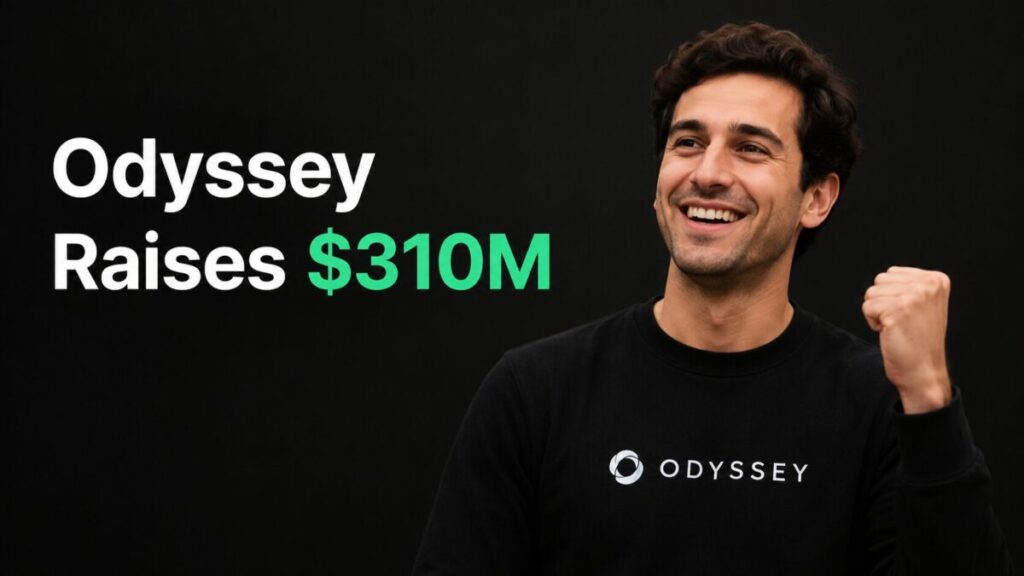
Nobody saw this coming. Not at this scale. Not this fast.
Odyssey, an AI lab pioneering world models founded by self-driving car veterans, announced a $310 million Series B at a $1.45 billion valuation on June 17, 2026. And the story behind that number is far more interesting than the number itself.
What Is Odyssey and What Does It Build?
Let’s be honest. Most people hear “AI startup” and picture another chatbot. Another writing tool. Another thing that summarizes your emails.
Odyssey is not that.
A world model works differently from the AI most people already know. Instead of predicting the next word in a sentence, it learns to predict how the physical world behaves, including how objects move, how light falls, and what happens after something is touched or pushed.
So instead of generating text, it generates reality. Or at least, a very accurate simulation of it.
Odyssey is an AI lab pioneering general world models: causal, multimodal systems that learn to predict and interact with the world over long horizons. This foundational technology promises to revolutionize robotics, science, healthcare, education, gaming, defense, and beyond.
The founders know physical AI from the inside. Odyssey was started in late 2023 by Oliver Cameron, a former Cruise and Voyage executive, and Jeff Hawke, a founding engineer at self-driving firm Wayve. Their pitch grew out of the core driverless-car problem: predicting what happens next so a machine can act on it.
That is a very specific problem. And it turns out, solving it for cars means you are most of the way to solving it for everything else.
Odyssey Raises $310M Series B at $1.45 Billion Valuation
Here is the kicker. This is not a team of thousands burning through a war chest.
With 55 employees and $27M raised before this round, Odyssey is now one of the most capital-intensive AI bets per head in the market.
Fifty-five people. $310 million. Do that math and sit with it for a second.
Investors are not funding a sales team or a marketing department. They are funding a research thesis. And they believe in it enough to write one of the largest early-stage checks in the world model category.
Natural Capital led the round, with participation from Amazon, AMD Ventures, GV, EQT, IQT, and others.
Jay Zaveri, General Partner at Natural Capital, said: “We developed deep conviction in Odyssey’s research direction, technical leadership, and execution, which made this our largest investment to date. We believe they have the potential to help define AI beyond language models.“
Largest investment to date. From a firm that has seen a lot of deals. That line matters more than people are giving it credit for.
Who Invested in Odyssey’s Series B Round?
The investor list here is worth reading slowly. Because every name on it is a strategic signal, not just a check.
Amazon, AMD Ventures, GV, EQT, IQT, and others joined the Series B round. GV is Google’s venture arm. EQT is one of Europe’s largest and most active investment firms. And In-Q-Tel is the CIA-affiliated fund that has been quietly showing up in more and more AI deals.
IQT has supported more AI companies in recent years, and Odyssey’s mission statement specifically mentions defense as a target use.
That is not a footnote. That is a feature.
Then there are the angels. Individual investors include Jeff Dean, Google’s chief scientist; Elad Gil; Qasar Younis of Applied Intuition; Garry Tan of Y Combinator; Guillermo Rauch of Vercel; and Kyle Vogt, founder of Cruise.
The reality is, this group does not bet on companies that are riding trends. They bet on companies that create them. And they all said yes to Odyssey.
Odyssey’s founders have brought together a world-class research team from DeepMind, Tesla, Waymo, Meta, Apple, and Wayve. So the talent story matches the investor story. That alignment is rare. And it tells you something.
Why Odyssey Chose Amazon Over Nvidia
This is the part of the story that the AI industry cannot stop talking about. And rightly so.
Four months ago, Nvidia’s venture arm, NVentures, backed Odyssey’s Series A in February 2026, as part of Nvidia’s broader strategy to fund world model startups such as Wayve and Runway. Nvidia is not part of the Series B group.
Read that again. Nvidia backed them. Then Odyssey raised $310M without them.
Odyssey has announced a new deal with Amazon Web Services, which will become the company’s preferred cloud provider. Odyssey will use AWS Trainium chips, which are purpose-built to deliver performance advantages for speed and quality.
And AMD Ventures joined as a shareholder. Nvidia’s biggest chip rival. Pairing Trainium with money from AMD Ventures makes the round read like a vote against the market leader.
But was it? Here is where it gets honest. It is unclear whether the switch reflects real conviction in Amazon’s chips or simply better terms in a fierce market, and “preferred cloud” is not “exclusive.”
So maybe it is conviction. Maybe it is leverage. Maybe it is both. Either way, Odyssey now sits at the center of the most important infrastructure battle in AI right now.
Ron Diamant, Vice President and Distinguished Engineer at Amazon, noted that world models represent one of the most demanding workloads in AI, requiring massive compute throughput with tight latency constraints, and that Trainium is purpose-built for exactly this kind of scale.
How Odyssey Plans to Use the $310M Funding
Two things. Simple. But not easy.
The new money is going toward two related goals. The first is scaling up computing power. The second is pushing Odyssey’s research closer to real-world use.
The AWS deal is the engine for the first goal. Trainium chips give Odyssey the raw compute to run real-time, physics-accurate simulations at a scale that was not affordable before. And the relationship goes beyond just renting servers.
Both Odyssey and AWS will collaborate on future research and go-to-market efforts to make these use cases more accessible to customers.
And then there is the bigger ambition behind all of it. Oliver Cameron, the co-founder and CEO, put it plainly:
“The last few years have seen major breakthroughs in scaling, interactivity, multimodality, and physics accuracy, and the field is now advancing extremely quickly. This round provides the compute, infrastructure, and partners to push the frontier of general world models, and to achieve a GPT-3 moment for the field.“
A GPT-3 moment. That is the reference point. That is when language models stopped being a research curiosity and became something the world actually used. Odyssey wants to do that for world models. With $310M in the bank, they at least have a shot.
What Are World Models and Why Do They Matter?
So what actually is a world model? No jargon. No hype. Just the real thing.
World models are AI systems designed to learn and simulate how the physical and digital world works. Instead of simply recognizing patterns or predicting the next word like a large language model, they build an internal representation of reality, including physics, causality, and time, so they are capable of simulating or predicting outcomes of actions before taking them.
Think of it this way. A language model tells you what a car crash sounds like. A world model simulates the physics of the crash, predicts the damage, and tells you what went wrong before it happened.
That difference is everything.
A robotics company could run thousands of training scenarios inside Odyssey’s simulation instead of on a real factory floor. Cheaper. Faster. Safer. The use case practically sells itself.
Odyssey’s own research already shows what this looks like in practice. Odyssey-2 Max advanced the state-of-the-art in physics accuracy for general world simulation. Starchild-1 introduced the first real-time multimodal world model. Agora-1 launched multi-agent interaction within a shared world simulation. With PROWL, Odyssey demonstrated how world models can improve through active exploration.
That is not a roadmap. That is a track record. And it is why investors wrote a $310M check.
Which Industries Will Odyssey’s Technology Impact?
Short answer? Most of them.
Odyssey’s foundational technology promises to revolutionize robotics, science, healthcare, education, gaming, defense, and beyond.
Robotics is the most obvious near-term play. Physical AI agents need to be trained in simulation before they ever touch the real world. World models make that simulation accurate enough to actually matter. Autonomous vehicles are right behind, which tracks given where the founders came from.
Defense is not a maybe. It is a stated priority. And with In-Q-Tel at the table, the government interest is already real.
But zoom out and the picture gets even bigger. Whoever can convincingly simulate the world will have customers well beyond gaming.
And the race is on. Decart.ai raised $300 million at nearly a $4 billion valuation to develop world models named Lucy and Oasis. AI pioneer Yann LeCun’s startup AMI Labs raised $1.03 billion in March to train world models, and Runway AI raised $315 million in February.
Big numbers. Big names. Big ambitions. But Odyssey’s $310M raise puts it squarely in the middle of that competition, backed by some of the smartest capital in the industry, running on chips built for exactly this kind of work, with a founding team that has already done the hardest version of this problem once before.
The GPT-3 moment for world models is coming. The only question left is who gets there first.
Odyssey AI for Robotics, Gaming, and Entertainment: Key Use Cases
Read about – Startup business models
Read in – Startup Directory
Read about Solo businesses

Hi Friends, This is Swapnil; I love reading and sharing knowledge. Currently working as a content writer at startupsunion.com. You all can hang out with me here.