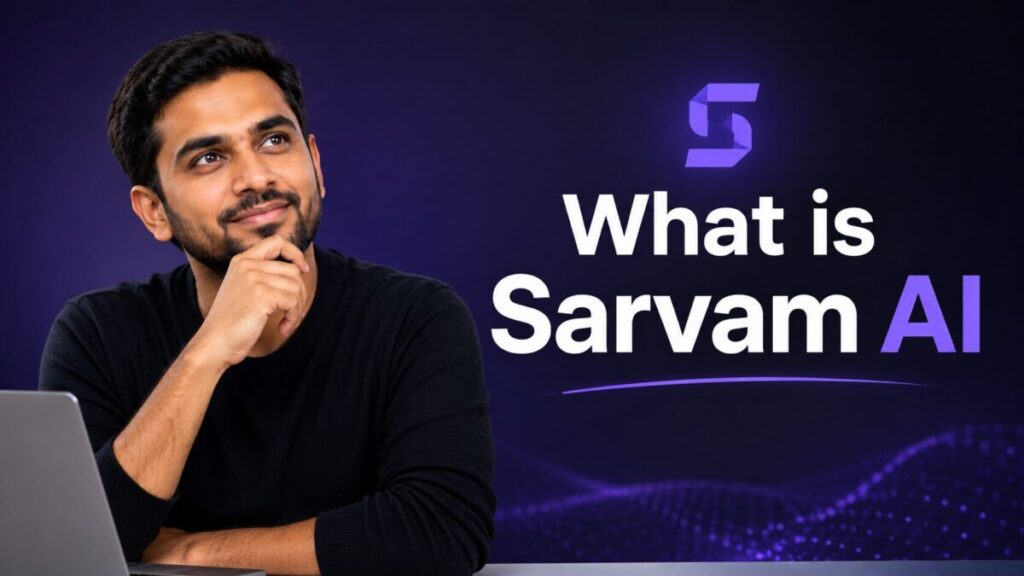
What Is Sarvam AI and Who Founded It?
Most AI companies build for the world and then try to squeeze India in as an afterthought. Sarvam AI did the exact opposite.
The reality is, building AI “for India” is not the same as building AI “in India.” Sarvam AI understood that difference from day one. The company built a full-stack AI platform with everything developed, deployed, and governed entirely within India, designed to support public service delivery and reflect the country’s actual linguistic reality, not a translated version of it.
Sarvam AI is an Indian artificial intelligence company headquartered in Bengaluru, Karnataka. Founded in August 2023, it develops large language models and multimodal AI systems with a sharp focus on Indian languages and region-specific use cases.
But here is the part that matters most: the founders.
CEO Pratyush Kumar holds a BTech in electrical and electronics engineering and a PhD in computer engineering from IIT Bombay. He spent years doing deep research at IBM and Microsoft, served as faculty at IIT Madras, and, before Sarvam, co-founded AI4Bharat, an open-source initiative laser-focused on Indian language AI. This is not someone who woke up one morning and decided to “do AI.”
Co-founder Vivek Raghavan is cut from the same cloth. An IIT Delhi graduate with a PhD from Carnegie Mellon University, he spent nearly 12 years volunteering with UIDAI on Aadhaar’s biometric systems. He also served as chief mentor at the Nilekani Center at AI4Bharat, IIT Madras, and advised Digital India Bhashini under the National Language Translation Mission.
So when these two sat down to build Sarvam AI, they were not experimenting. They were executing on a thesis they had spent decades earning the right to pursue.
How Sarvam AI Works with Indian Languages
Let’s be honest about the problem. India has 1.45 billion people. The vast majority do not read, write, or type in English. And almost every major AI tool built in the last decade, from ChatGPT to Gemini, sits on a foundation of English-first data.
That is not a small gap. That is a billion people left out.
Sarvam AI’s models are built to be used through voice commands and are accessible across 22 Indian languages. The company argues, correctly, that this is a structural competitive advantage in a country where the inability to use English is not a limitation; it is simply the lived reality of most people.
But here is the kicker. Supporting a language and actually understanding it are two very different things. A Hindi speaker from a village in Rajasthan does not speak the same Hindi as a Delhi professional. The vocabulary is different. The phrasing is different. The accent is completely different. Global models choke on this. Sarvam AI is trained specifically to handle it.
The models are trained and evaluated on Indian languages and culturally grounded data, enabling higher accuracy in real production scenarios. The stack spans speech-to-text, speech translation, text translation, and high-quality text-to-speech, each one designed for India’s actual linguistic diversity, not a sanitized textbook version of it.
And it goes further. The platform handles code-switching like Hinglish and Tanglish and accented speech that global models routinely struggle with. Think voice-based KYC, where users narrate their details in Hindi; automated transcription of customer support calls in regional languages; and voice search for users who have never typed a search query in their life.
That is the real market Sarvam AI is going after.
Sarvam AI Models: Features and Capabilities
Sarvam AI is not a single tool. It is a full stack, and that distinction matters enormously.
The platform includes Samvaad for conversational AI, Studio for content transformation, Akshar for document digitization, and Arya as an AI for the work layer. On the model side, you have Bulbul for text-to-speech, Saaras for speech-to-text, Mayura for translation, and a vision model purpose-built for document intelligence.
The flagship models that launched in February 2026 are a serious statement. The 30 billion parameter model carries a 32,000 token context window built for real-time conversations. The 105 billion parameter model runs a 128,000 token context window for complex reasoning tasks. Both models support all 22 Indian scheduled languages and are optimized for voice-first interaction.
And here is what makes the 105B model genuinely significant: it was trained from scratch using domestic compute infrastructure under the government’s IndiaAI Mission. This is not a fine-tuned foreign model with an Indian accent slapped on top. This is a foundational model built independently. That matters for sovereignty, and it matters for accuracy on Indian-language tasks.
Performance-wise, the models benchmark competitively against Gemma 27B, Mistral-32-24B, Nemotron-30B, Qwen-30B, and GPT-OSS-20B across mathematical reasoning, coding, and general problem-solving tasks.
But benchmarks are one thing. Usage is another.
Sarvam AI’s conversational platform now handles more than 2 million interactions a day. Its inference platform processes roughly 10 million API calls daily. Its speech models transcribe more than 500,000 hours of audio each month. Those numbers are not projections. They are current.
Sarvam AI Funding and Valuation (2026 Update)
This is where things move fast.
On June 15, 2026, Sarvam announced it raised $234 million in the first close of its $300 million Series B, at a post-money valuation of $1.5 billion. That makes it India’s newest AI unicorn. HCLTech led with $150 million as a strategic investment, picking up a 10.46 percent equity stake. Bessemer Venture Partners also came in, alongside existing backers Khosla Ventures and Peak XV Partners.
To understand how far this company has come, go back to December 2023. That is when Sarvam raised $41 million across its seed and Series A rounds, led by Lightspeed Venture Partners, with Peak XV and Khosla participating. Less than three years later: unicorn status, $275 million raised in total, and a partnership with one of India’s largest IT companies.
The HCLTech angle is not just a capital story. The plan is to combine Sarvam’s AI models with HCLTech’s enterprise relationships, engineering workforce, and software assets to build AI products for businesses and governments at scale. That is a distribution engine that most startups spend a decade trying to build.
And there is another layer. In April 2025, India’s Ministry of Electronics and Information Technology selected Sarvam AI as one of the companies to develop an indigenous foundational model under the IndiaAI Mission, providing access to government-supported GPU computing infrastructure for model training.
At this point, Sarvam AI is not just a well-funded startup. It is a core piece of India’s national AI infrastructure strategy.
Sarvam AI Use Cases: Banking, Government, and More
Benchmarks impress engineers. Deployments impress everyone else.
The reality is, Sarvam AI has already moved well past proof-of-concept. Its products are being used in banking, insurance, government services, and defense. And the scale of those deployments is not small.
Take agriculture. Sarvam’s multilingual voice agents executed a data collection campaign for the Ministry of Agriculture and Farmers Welfare, processing high-quality interactions across 17 million individual farmers. Seventeen million. That is not a pilot. That is a production deployment at a national scale.
On the insurance side, a nationwide voice campaign for a leading Indian insurance provider automated low-cost policy renewals for over 45 million policyholders. Sarvam also partnered with SBI Life Insurance to deploy generative AI applications for customer engagement and sales support.
Government integration runs deep too. A custom AI stack operates within UIDAI’s secure on-premise infrastructure, supporting 10 Indian languages with real-time enrollment feedback and fraud alerts. Sarvam’s technology has also been deployed within Aadhaar’s biometric identification system and in the Indian central bank’s life insurance products.
So yes, there is a line of thinking that Sarvam AI resembles an arm of India’s AI strategy more than a conventional venture-backed startup. That is not a criticism. It might actually be the company’s single biggest competitive moat.
For developers and early-stage companies, Sarvam launched its Startup Program in March 2026. Selected companies get 6 to 12 months of API credits, priority engineering support, and access to production infrastructure for building multilingual AI applications across speech, translation, and large language models.
Is Sarvam AI Free to Use? Pricing Explained
Short answer: yes, you can start for free.
Sarvam AI offers transparent pay-per-use pricing across its full platform. Every plan starts with free credits, and those credits work universally across all APIs. They do not expire. Once you use them up, you top up from the Sarvam Dashboard or upgrade your plan.
Here is what the numbers look like on specific APIs. Speech-to-text starts at $0.35 per hour of audio. Add speaker identification, and that goes to $0.53 per hour. Text translation and transliteration come in at $0.23 per 10,000 characters. Text-to-speech sits at $0.18 per 10,000 characters.
On the document intelligence side, pricing has been actively dropping. Sarvam slashed its Vision API cost by 67 percent, bringing the per-page processing cost from Rs. 1.5 down to Rs. 0.5. This came after the platform crossed 35 million pages digitized since launching in February 2026. The company attributed the cut to infrastructure efficiency gains at scale, not competitive pressure. That is a meaningful distinction.
For enterprise customers, custom rate limits, volume discounts, and dedicated support are available on request.
But here is what I would tell any developer evaluating this: the free credits are more than enough to build a working prototype. Test it with real users in Tier 2 cities before you commit. Not with your English-speaking colleagues in Bengaluru or Mumbai. With actual target users. The gap between those two feedback pools will tell you everything you need to know about whether this is the right infrastructure for your product.
That is the kind of honest feedback Sarvam AI itself would give you. And it is also exactly why this company has reached the scale it has.
Read about – Startup business models
Read in – Startup Directory
Read about Solo businesses

Hi Friends, This is Swapnil; I love reading and sharing knowledge. Currently working as a content writer at startupsunion.com. You all can hang out with me here.