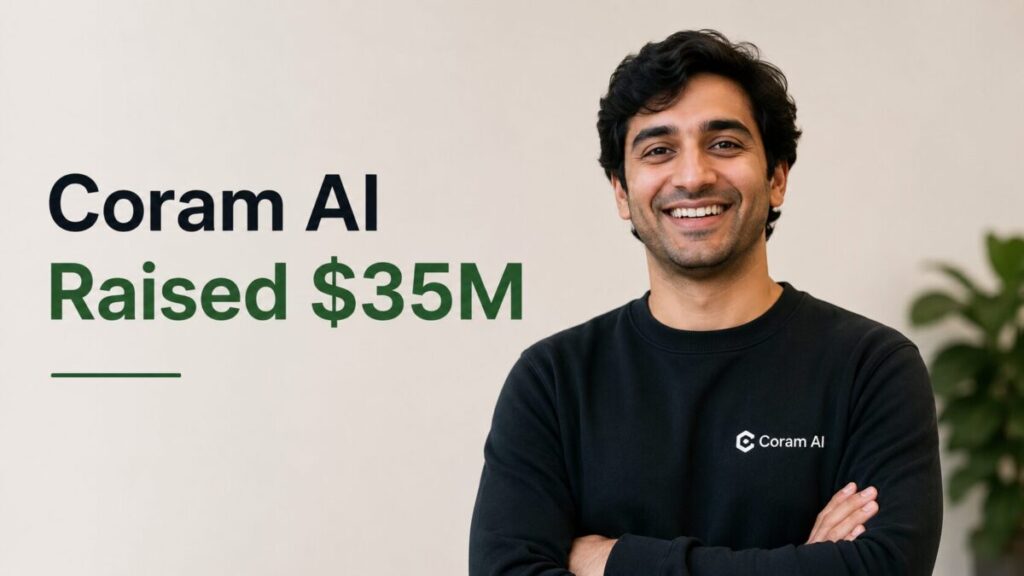
Physical security has a dirty secret. Most organizations spend thousands of dollars installing cameras, access control systems, and visitor management tools. And then? They rely on a handful of overworked staff members to manually scrub through footage whenever something goes wrong. The process is slow. It is expensive. And frankly, it has not changed much in decades. Coram AI is building the fix, and investors just put $35 million behind that bet.
What Is Coram AI and What Does It Do?
Coram AI is an AI-native physical security platform that helps organizations monitor their sites for safety and quickly investigate potential security incidents. But calling it a camera software company undersells what is actually happening here.
What started as a video-security solution has evolved into a broader physical security ecosystem that combines video surveillance, access control, emergency management, visitor management, and AI-powered investigations within a single platform. The goal is simple, even if the engineering behind it is not. Stop making security teams piece things together by hand.
Most software in this space is siloed and requires on-site monitoring to be effective. Video, access control, visitor logs, and emergency response sit in separate tools, so investigating one incident means stitching them together by hand. Coram centralizes those workflows in a single AI platform, without requiring teams to replace existing infrastructure.
The customer base reflects just how universal that problem is. The platform serves schools, hospitals, factories, churches, and large enterprises. Security headaches do not pick favorites. And neither does Coram.
Why Did Coram AI Raise $35 Million in Series B?
Here is the honest answer: demand got ahead of capacity. That is a good problem, but it is still a problem.
Modern physical security teams face increased threats, fewer staff, and more systems to keep track of. Organizations are sitting on mountains of security data, and nobody has the bandwidth to make sense of it in real time. That gap is exactly where Coram lives.
The fresh capital will be used to accelerate product development, expand the company’s AI capabilities, strengthen its edge infrastructure, and scale go-to-market efforts as demand for intelligent security systems continues to rise.
With demand outpacing the team, Coram will use the new round to significantly grow its sales capacity, alongside continued investment in AI product development and customer success.
And the growth is not just happening in North America. The company also plans to expand its engineering team in its Bengaluru office, hiring across AI, software engineering, and product development functions. Coram views India as a key hub for building next-generation AI technologies that power its global platform.
So the $35 million Series B is not defensive spending. It is offensive. Coram is running at the market while the window is open.
Who Are the Investors Behind Coram’s $35M Round?
The round was co-led by Ansa Capital and Battery Ventures, with UP.Partners, 8VC, and Mosaic Ventures also participating. The round brings total funding to $66 million, following a $13.8 million Series A.
Battery Ventures and 8VC are not new to this story. They backed the Series A too. That kind of repeat conviction from existing investors means something. It is one thing to write a first check. It is another to double down after seeing how a team operates under pressure.
Allan Jean-Baptiste, co-founder and managing partner at Ansa Capital and a Coram board member, framed the investment clearly: “Physical security is one of the largest industries yet to be transformed by modern AI. Coram’s founders bring a rare combination of frontier AI expertise and deep conviction” about where the industry needs to go.
The latest investment brings Coram’s total funding to $66 million and signals growing investor confidence in the role artificial intelligence can play in modern security operations. For a company that is only four years old, $66 million in total capital is not a small number.
Who Founded Coram AI and What Is Their Background?
This is where the story gets interesting. Most security software companies are built by enterprise software veterans. Coram was not.
Coram was founded by Ashesh Jain and Peter Ondruska, both of whom spent years building AI systems for autonomous vehicles before shifting to physical security. Jain previously led autonomy engineering at Lyft’s self-driving division and held engineering roles at Zoox, the autonomous vehicle company.
Ondruska led AI research at Lyft and later joined Toyota’s Woven division after Toyota acquired Lyft’s self-driving technology in 2021. Their work on autonomous vehicles centered on training systems to interpret physical environments in real time, and Coram’s approach draws on that background.
Let’s be honest about what that means in practice. Teaching a car to understand the world at 60 miles per hour, in real time, with zero margin for error, is one of the hardest problems in AI. Jain and Ondruska spent years doing exactly that. Applying those same instincts to a school hallway or a factory floor is not a stretch. It is a direct transfer of hard-won skill. And that edge is visible in the product.
What Is Coram’s Deep Investigation Feature?
This is the part that makes security teams sit up straight.
Alongside the funding, Coram announced a new feature called Deep Investigation. Rather than requiring security staff to search through footage manually, the tool analyzes video feeds, access-control logs and visitor activity across locations and time periods, then surfaces findings with supporting evidence. The feature is designed to let a smaller security team cover more ground without adding headcount.
The capability moves beyond text-based video search to autonomous security agents that can analyze video, access events, and visitor activity across cameras, locations, and time, answering complex security and operational questions with evidence attached. Investigations that took hours or weeks now take minutes, so one security professional can investigate more, respond faster, and protect more people without adding staff.
Here is the kicker. This is not a minor update buried in a changelog. Deep Investigation changes the fundamental math of what a security team can accomplish. One person. Multiple sites. Months of footage. Answers in minutes. That is a different world from what existed before.
How Fast Is Coram AI Growing After Series A?
The numbers are hard to argue with.
Since raising its $13.8 million Series A last year, Coram says revenue has grown fourfold, and its customer base has tripled. More than 1,500 sites across the United States and Canada now use the platform, including Fortune 500 companies, school districts, healthcare providers, manufacturers, municipalities, and nonprofit organizations. Customers include 1-800-GOT-JUNK?, Hershey’s Ice Cream, World YMCA, and Lakepointe Church.
The reality is, revenue growing 4x in a single year is not something you paper over with clever marketing. That kind of growth comes from a product that actually works in the field.
Hershey’s Ice Cream uses Coram across its facilities, which produce millions of gallons annually for nationwide distribution. “Coram’s AI capabilities mean there is no live person required to watch footage all day. The system works in the background, so our staff can focus on their actual jobs,” said IT director Stephen Hoffer.
Lakepointe Church, a multilingual church with 8 campuses in Dallas, Texas, uses Coram to create a safe and welcoming environment for its over 30,000 congregants. A church. A frozen dessert company. A national junk removal brand. When your customer list looks that varied, you are solving a real problem, not chasing a niche.
What Will Coram AI Do With the New Funding?
Short version: grow fast, build deep, and do not slow down.
The funding will drive AI product development, sales, and customer success as more organizations trust AI to scale their security systems. Sales headcount goes up. Engineering in Bengaluru expands. Product development accelerates. These are not abstract goals. They are the operational building blocks of a company trying to own a category.
“Coram AI protects the places people live and work: catch risks earlier, and keep schools, hospitals, and workplaces safer instead of just documenting what went wrong,” said Ashesh Jain, co-founder and CEO.
Coram is part of a wave of startups trying to become the operating system for physical security by wrapping AI agents around it. Its bet is that every building will eventually run hundreds of agents in the background.
That bet might sound ambitious. But with $66 million raised, 1,500 active sites, and a customer base that keeps tripling, Coram AI is not talking about the future of physical security. It is already building it.
How Coram AI Is Quietly Rewriting the Rules of Physical Security
Read about – Startup business models
Read in – Startup Directory
Read about Solo businesses

Hi Friends, This is Swapnil; I love reading and sharing knowledge. Currently working as a content writer at startupsunion.com. You all can hang out with me here.