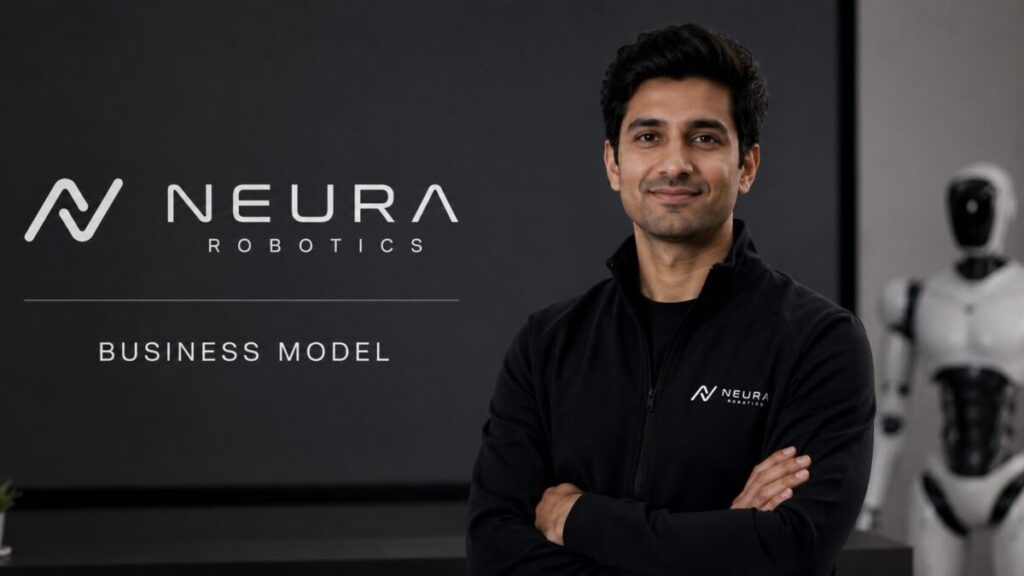
There is a shift happening on factory floors across Europe. Quiet, but seismic. Machines are no longer just executing commands. They are watching, listening, learning, and adapting in real time. NEURA Robotics, a German startup founded in 2019, is the company betting its entire existence on that shift. And right now, the smartest money in tech agrees with them.
How NEURA Robotics Started
The problem David Reger set out to solve was not a narrow engineering challenge. It was a civilizational one.
Let’s be honest: traditional industrial robots are rigid, pre-programmed, and dangerously limited. They cannot adapt to a new task, respond to a human gesture, or make a contextual decision. They do exactly what they are told and nothing more. For decades, that was fine. Then the skilled labor shortage became impossible to ignore across manufacturing, logistics, and healthcare, and “fine” stopped being good enough.
Reger founded NEURA in Metzingen, near Stuttgart, with a mission to expand the capabilities of collaborative robots with cognitive skills, enabling an entirely new level of interaction between humans and machines. The guiding principle he put at the centre of the company was simple: “We serve humanity.”
NEURA integrated sensor technology, robotics, and artificial intelligence from day one, and claims to have built the world’s first cognitive cobot, a machine able to learn from its environment, make decisions autonomously, and adapt to dynamic production scenarios.
The target audience spans automotive plants, hospital corridors, and warehouse operations. Buyers who need reliability, adaptability, and safety. In a single machine.
Competitive Advantage
NEURA competes against the likes of Boston Dynamics, Figure AI, and Agility Robotics. So what actually separates them?
The biggest one is this: everything is built in-house. NEURA is the only company worldwide that designs and manufactures intelligent cognitive robots entirely under one roof, following a consistent one-device approach inspired by the concept of a smartphone with arms and legs, combining all central components and sensors for physical AI into a single device. Competitors are still stitching together third-party parts. NEURA owns the full stack.
Then there is the Neuraverse. It is a cloud-based software platform where partners and customers, including tech companies, system integrators, and consultants, can develop their own robotic applications. It also serves as the shared knowledge base that trains NEURA’s robots. The more robots deployed, the more data flows back, the smarter every future unit becomes. That is a compounding advantage, not a one-time feature.
And geographically, NEURA holds an unchallenged position. It remains the only humanoid robotics company in Germany, and the first to ship a commercially viable cognitive robot anywhere in Europe.
Finally, native sensor technology. Most global competitors still source sensors externally. NEURA does not. That keeps IP fully owned and production timelines tighter.
Marketing Technique
Here is the thing about NEURA’s marketing: there is almost no conventional advertising. None. The company has built its brand almost entirely through proof points and industrial credibility. And it is working.
Enterprise Partnership Announcements. Strategic partners including Bosch, Schaeffler, Kawasaki, Qualcomm, Amazon, and NVIDIA position NEURA at the intersection of industrial automation and AI. Every new partnership announcement reaches NEURA’s ideal buyers directly. No ad spend required.
Industrial Demonstrations. The 4NE1 model has been used to set records, including the first sandwich ever crafted by a humanoid robot. That sounds trivial. But it circulated globally and communicated real-world capability in a way a product brochure never could.
Founder-Led Positioning. Reger is genuinely present in the places that matter. He has been appointed to the German Economic Senate, the Economic Council, and the European Senate for Economy and Technology. These are not vanity titles. They are rooms where industrial procurement decisions are shaped.
NEURA Gyms. These are specialised large-scale training environments combining real-world sensor interaction, simulation, and multimodal learning pipelines. They function as live demonstrations of what cognitive robots can actually do, at scale, in realistic conditions.
How NEURA Robotics Makes Money
The revenue model runs on three layers.
First, hardware sales. Industrial models including MAiRA and LARA are priced between €15,000 and €45,000. Direct B2B. No middlemen.
Second, platform licensing. The Neuraverse functions as a recurring software layer. Partners pay to build robotic applications on top of the shared intelligence ecosystem. So as more robots deploy, software revenue compounds alongside hardware revenue.
Third, and this is where it gets interesting, long-term enterprise supply agreements. Schaeffler has committed to integrating a mid-four-digit number of humanoid robots from NEURA into its global production network by 2035. That is not a one-off sale. That is a decade-long revenue relationship. The framework agreement with Schaeffler alone was reportedly valued at €300 million.
Around the time of its Series B in early 2025, NEURA reported 10x revenue growth and a €1 billion order book. The model is beginning to compound.
Market Share of NEURA Robotics
The reality is that the humanoid robotics market is still early. Really early. The global market for installed industrial robots is estimated at around $16.7 billion in 2026, with NEURA currently serving less than two percent of this market, assuming all orders are fulfilled.
But context matters. Within Europe, NEURA holds a position no competitor can currently challenge. The company has raised $2.11 billion in total, counts Amazon, Qualcomm Ventures, Robert Bosch, and NVIDIA among its 23 investors, and now employs around 1,200 people.
A recent funding round valued the company at roughly €4 billion. Given the $1.4 billion Series C announced in June 2026, the real figure is almost certainly higher now. And with a confirmed order book already exceeding one billion dollars from clients like Kawasaki and Schaeffler, NEURA is not chasing market share on paper. It is earning it in practice.
Business Model Canvas of NEURA Robotics
Key Partners: Bosch, Schaeffler, Kawasaki, Delta Electronics, Qualcomm Technologies, Amazon, and NVIDIA. In January 2026, NEURA partnered with Robert Bosch to develop humanoid robot software, and in April partnered with Dassault Systemes to close the simulation-to-real gap in robotics.
Key Activities: Cognitive robot R&D, hardware manufacturing in Metzingen, Neuraverse platform development, NEURA Gym operations, and real-world data collection for AI model training.
Value Proposition: Robots that see, hear, touch, and remember. A shared intelligence platform that improves every unit over time. One device, fully integrated, designed to work beside humans without a safety cage.
Customer Segments: Automotive manufacturers, logistics operators, healthcare institutions, and third-party developers building applications on the Neuraverse.
Revenue Streams: Hardware unit sales priced at €15k to €45k, long-term enterprise supply agreements, and Neuraverse platform licensing.
Key Resources: Proprietary sensor technology, Neuraverse data platform, Germany-based manufacturing, and a growing global patent portfolio.
Channels: Direct enterprise sales teams, strategic technology partnerships, industrial trade events, and NEURA Gym demonstration facilities.
Cost Structure: Heavy R&D investment, hardware manufacturing, international facility expansion, and talent acquisition across robotics and AI engineering.
Conclusion: Is NEURA Robotics a Viable Business?
Let’s call it what it is. NEURA is not just viable. It is building one of the more defensible positions in frontier technology today.
A €1 billion order book. 10x revenue growth. Backing from NVIDIA, Amazon, Qualcomm, and Bosch. The only humanoid production facility operating at commercial scale in Europe. That is not hype held together with press releases. That is early proof of product-market fit at industrial scale.
But here is the kicker. The Neuraverse creates a compounding data advantage that most competitors simply cannot replicate yet. Every robot deployed feeds intelligence back into the platform. The next generation learns faster, adapts better, and costs less to train. So the moat grows with every sale. Not in spite of growth, but because of it.
NEURA’s stated goal is to build systems that continuously learn, collaborate, and operate across real-world environments, reaching multi-million robot production by 2030. The risks are real. Manufacturing at scale is brutal. Competition from US and Chinese players is fierce. And deep-tech timelines have a habit of stretching past the original plan.
But NEURA has done what most startups at this stage fail to do. It moved from lab to commercial deployment. Locked in enterprise customers. And built an ecosystem, not just a product. David Reger believes cognitive robotics will become bigger than the smartphone. A year ago that sounded like founder ambition. Today it sounds like a credible roadmap.
Read about – Startup business models
Read in – Startup Directory
Read about Solo businesses

Hi Friends, This is Swapnil; I love reading and sharing knowledge. Currently working as a content writer at startupsunion.com. You all can hang out with me here.