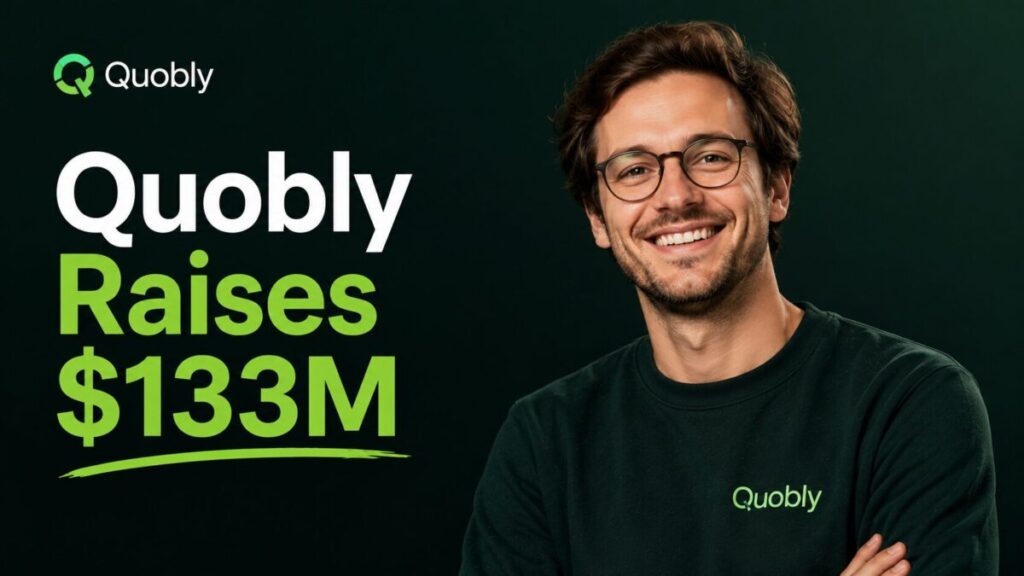
A French startup just closed one of Europe’s largest quantum rounds ever. And their bet is refreshingly simple: use the chip industry that already exists.
Let’s be honest. Most quantum computing news sounds like it was written for people with physics PhDs. Dense, abstract, full of words that mean nothing to anyone actually running a business. So when a French startup called Quobly raised $133 million (EUR 115 million) on June 3, 2026, most people scrolled past it.
That would be a mistake. This story is worth paying attention to. Not just because of the money. But because of what Quobly is actually doing and why the approach is genuinely different from everything else in this space.
What Is Quobly and What Does It Do?
Quobly is a quantum computing company based in Grenoble, France. For context, Grenoble has been a hub for chip and semiconductor research in Europe for decades. The company was co-founded by Maud Vinet, who serves as CEO, and came out of research work at CEA and CNRS, two of France’s most respected scientific institutions.
The goal? Build quantum computers that businesses can actually use. Not theoretical machines. Not lab prototypes that will be “production-ready in ten years.” Real systems, deployed in real environments, within the next twelve months.
The company focuses on silicon-based quantum computers. It has over 100 people on the team and operates not just out of France but also has offices in Singapore and Canada. So this is not a small academic spinout quietly working in a basement. It is a company that is growing fast and already thinking internationally.
Who Funded Quobly’s $133M Round?
Here is the kicker. The investor list for this Quobly $133M raise is not your typical Silicon Valley roster. It is a mix of state capital, industrial giants, and deep-tech specialists. And that combination tells you something important about the seriousness of what is being built.
Investors in Quobly’s $133M Series A
- Bpifrance – France’s state-backed investment bank, participating through the Deep Tech 2030 fund under the France 2030 government initiative
- STMicroelectronics – One of Europe’s largest chip companies and a core manufacturing partner for Quobly
- SEALSQ – A cybersecurity and semiconductor company co-leading the round
- European Innovation Council (EIC Fund) – The EU’s flagship body for backing breakthrough technologies
- ALIAD – Air Liquide’s corporate venture arm
- Blast and Innovacom – French deep-tech investors who backed Quobly at earlier stages
- Existing shareholders – CEA, CNRS, Quantonation, and Supernova Invest
This is not speculative venture money chasing a trend. Bpifrance is managing this investment on behalf of the French government. STMicroelectronics is not just writing a check. They are a manufacturing partner. The reality is, when governments and industrial companies put money in together, it usually means they believe the technology is close to working in the real world. That matters.
How Quobly Builds Quantum Computers Using Silicon Chips
Most quantum computing companies are doing something genuinely hard. They are trying to build entirely new types of hardware. New materials, new supply chains, new fabrication methods. Exotic stuff. Expensive stuff. Stuff that does not exist at scale yet.
Quobly is doing something different. Smarter, arguably. Instead of inventing a new industry from scratch, they are using the one that already exists.
The company builds its quantum chips using modified silicon transistors, the same basic components that power the laptop you are reading this on. These chips are manufactured on 300mm silicon wafers, which is the exact same standard used across the global semiconductor industry right now.
“For quantum computing to deliver value, we are going to need millions of qubits. This will require yield and industrial capabilities. The strategic choice we have made is to leverage the semiconductor industry for its high performance, lower costs, and existing infrastructure.” – Maud Vinet, CEO and Co-founder, Quobly
To make this happen at scale, Quobly embedded a specialized team of engineers directly inside STMicroelectronics’ commercial fabrication facilities. Before that, it developed its quantum chips on a pilot manufacturing line in partnership with French research institute CEA-Leti, successfully meeting the semiconductor industry’s constraints on dimensions and materials.
So the path is: prove it in the lab with CEA-Leti, then move it to full industrial production with STMicroelectronics. That is a real roadmap. Not a vague promise.
Why Quobly’s Quantum Computers Are 100x Cheaper Than Rivals
Cost is the wall that quantum computing keeps running into. A single superconducting quantum computer can cost tens of millions of dollars. It needs cooling systems that operate near absolute zero. Special facilities. Proprietary components that barely exist as supply chains yet.
That price tag is why almost no company outside of government labs and the biggest tech firms can afford to actually use one.
Quobly’s approach changes that math. Because the company builds on existing semiconductor manufacturing infrastructure, it borrows decades of cost optimization from an industry that has spent sixty years driving the price of chips toward near-zero. You do not reinvent the factory. You use the one that is already running.
The result, according to Quobly CEO Maud Vinet, is quantum computers that are 100 times cheaper to produce than competing technologies. And beyond the hardware itself, Quobly’s systems are designed to integrate into existing data centers and High Performance Computing (HPC) environments. Compatible power requirements. Compatible footprint. No need to build a specialized facility around the machine.
Developers can build and test applications on Quobly’s quantum platform through a tool called Alloy Forge, working under realistic hardware conditions rather than theoretical simulations.
When Will Quobly Launch Its First Commercial Quantum Computer?
This is the part most outlets breeze past. But it is the most important question. Because a company that raises $133M with no product launch date is just a fundraise story. Quobly has actual dates.
Quobly’s Product Roadmap
- End of 2026 – Launch of Alloy Pioneer, Quobly’s first commercial quantum computer, accessible via the cloud for early adopters in research and HPC environments
- 2027 – Physical deployment of Alloy systems inside customers’ own HPC infrastructure
- Beyond 2027 – Scaling silicon quantum processors toward millions of qubits, expanding commercial operations internationally
The $133M is going toward three things: improving the performance and scalability of the quantum platform, scaling up manufacturing of silicon quantum processors, and getting those first Alloy systems deployed in real customer environments. It also funds continued R&D and international expansion.
Worth knowing: Quobly is largely pre-revenue today. The company made approximately EUR 10 million in revenues across 2025 and 2026, mostly from the French government’s Proqcima programme, a 2024 competition to build a large-scale quantum computer by 2032. The Alloy Pioneer launch is the moment Quobly transitions from a funded research project to an actual commercial business. That transition is the whole game.
How France and the US Are Investing Billions in Quantum Computing
The timing of Quobly’s $133M raise is not random. It dropped right in the middle of a full-scale government spending war over quantum technology.
In May 2026, French President Emmanuel Macron pledged EUR 1 billion in state investment into quantum computing. The announcement came almost the same day the Trump administration unveiled $2 billion in federal funding for quantum firms in the United States, channeled through the CHIPS and Science Act.
Two billion here. One billion there. Governments are not funding this because it is interesting. They are funding it because they believe quantum computing is a strategic technology in the same category as semiconductors, AI, and nuclear energy. Nations that lead in quantum will have massive advantages in cybersecurity, drug discovery, materials science, and financial modeling.
And there is a historical lesson sitting behind all of this. Europe watched the AI infrastructure wave. Data centers, GPUs, cloud capacity. It landed almost entirely in American hands. European policymakers are not willing to repeat that. Quobly’s round, backed by French sovereign capital and the European Innovation Council, is a direct statement: the manufacturing and the technology should stay in Europe this time.
But here is what makes this more than just a policy story. Five quantum computing rounds of $100M or more have been raised in Europe since the start of 2026 alone. The capital is real. The momentum is real.
Who Are Quobly’s Biggest Competitors in Quantum Computing?
Quobly raising $133M puts it in serious company. But competition in this space is real, and the field is moving fast in multiple directions at once.
| Company | Country | Technology | Recent Funding | Approach |
|---|---|---|---|---|
| Quobly | France | Silicon Qubits | $133M Series A | Industrial fab |
| Pasqal | France | Neutral Atoms | EUR 100M | Neutral atom |
| IQM | Finland | Superconducting | EUR 128M | Superconducting |
| Quantum Motion | UK | Silicon Qubits | $160M Series C | Silicon (GlobalFoundries) |
| Oxford Quantum Circuits | UK | Superconducting | GBP 260M ($350M) Series C | Cloud QC |
The closest rival to Quobly on a technical level is Quantum Motion. It is an Oxford University spinout that also bets on silicon qubits and is working with US chipmaker GlobalFoundries on manufacturing. Same general thesis, different industrial partner, different geography.
Against superconducting players like IQM and Oxford Quantum Circuits, Quobly is making a longer play. The argument is not “we have better qubits today.” The argument is “our approach can actually scale to the millions of qubits that quantum computing ultimately needs, without inventing a new industry to do it.”
That is a bold bet. It is not proven yet. A 100-qubit chip is a milestone, not a fault-tolerant machine. But it is a bet that now has $133 million, France’s government, and STMicroelectronics behind it. So it is not just bold. It is funded.
So, What Does This All Actually Mean?
Here is the straightforward version. Quobly raising $133M is a real signal in a field full of noise.
The approach is grounded. Using existing silicon manufacturing instead of building exotic new hardware from scratch is the kind of thinking that actually survives contact with reality. The team is serious. The investors are serious. The government money behind this is serious. And for the first time, there is a commercial product with an actual date attached to it.
Will Alloy Pioneer change everything by the end of 2026? Probably not overnight. But it will be a working quantum computer that researchers and HPC teams can access via the cloud. That is not nothing. That is, in fact, exactly how most technology transitions start. Quiet. Then fast. Then everywhere.
Read about – Startup business models
Read in – Startup Directory
Read about Solo businesses

Hi Friends, This is Swapnil; I love reading and sharing knowledge. Currently working as a content writer at startupsunion.com. You all can hang out with me here.