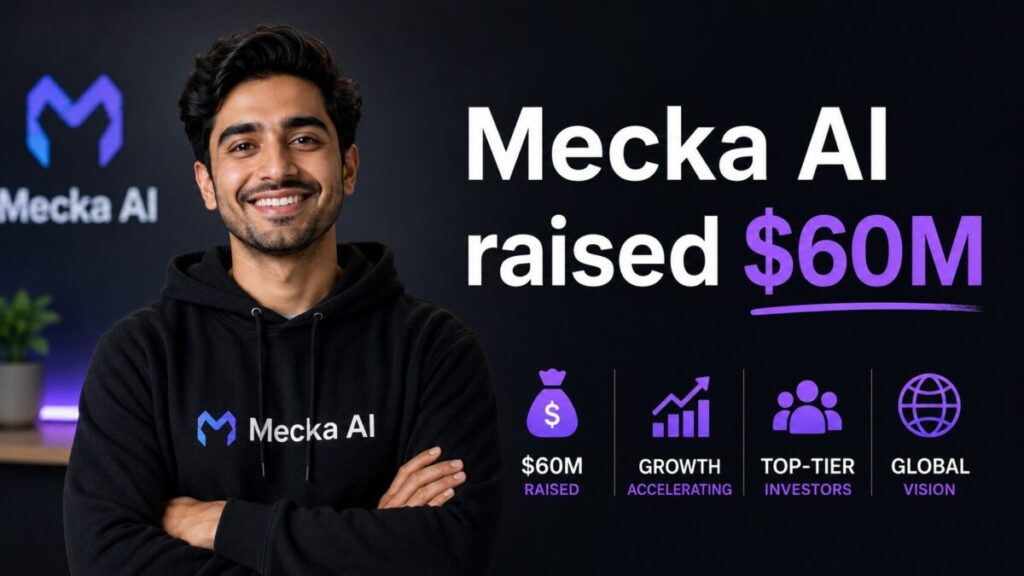
Most robotics startups talk a big game. They raise money, put out a press release, and then spend three years trying to figure out what they actually are. Mecka AI is doing something different. This New York City startup just raised $60 million to solve one of the quietest but most stubborn problems in the robotics world: where does the training data come from?
The answer they came up with? Humans. Real ones. Walking, reaching, picking things up, going about their day. And the fact that serious investors are backing this idea with serious money means the skeptics are getting quieter.
What Is Mecka AI and What Does It Do?
Mecka AI collects human movement data and uses it to train robots. That is the short version. The longer version is more interesting.
Most people assume robots learn by being operated by humans directly, a method called teleoperation. Someone controls the robot, the robot does the task, and the system learns from that. It works. But it is slow, expensive, and hard to scale. Mecka AI looked at that problem and asked a different question. What if you just… watched humans instead?
So that is what they built. A system that captures how people move through the world, and feeds that data into AI models that teach robots to do the same. Hand gestures. Walking patterns. The way someone reaches across a table. All of it becomes training material.
The company calls itself the data layer for robotics. Think of it like the pipes under a city. You do not see them. But nothing works without them. That is the role Mecka AI is going after.
How Mecka AI Raised $60 Million in Funding
Here is the kicker. This $60 million did not arrive in one clean round with a press event and a celebratory tweet. Mecka AI raised a total of $60 million across two previously unannounced fundraises: a $25 million Series A round that closed in November, and a $35 million follow-on investment.
Two rounds. Both quiet. Both now public for the first time. Before that, the company raised an $8 million seed round led by NEO, with participation from SV Angel, A-Star Capital, Cade, Timeless, and Offline VC.
So in a relatively short stretch of time, Mecka AI went from an $8 million seed to a $60 million raise. That is not a slow climb. That is a company that figured something out and had the numbers to prove it. CEO Josh Gao did not disclose the valuation. Smart move. When the revenue story is that strong, you do not need to lead with a number.
Who Are the Investors Behind Mecka AI?
The reality is, the investor list here tells you a lot about where smart money thinks the world is going.
Framework Ventures, a VC firm best known for its crypto investments, led both the Series A and the follow-on round. Other investors included Menlo Ventures, SV Angel, Kindred Ventures, and angel investor Ted Xiao, a former researcher at Google DeepMind and a founding member at Jeff Bezos’s AI startup Project Prometheus.
Sit with that for a second. A crypto-native venture firm is leading a robotics data company’s two biggest rounds. That is not a mismatch. That is a firm with pattern recognition in fast-moving, data-driven markets making a calculated bet on physical AI. They have seen what happens when you get the data layer right. They are not going to miss it twice.
And Ted Xiao as an angel? That is legitimacy you cannot buy from a marketing budget. Someone who has done deep AI research at Google DeepMind and worked inside Jeff Bezos’s secretive AI venture does not write a check without believing in the science.
Vance Spencer, co-founder of Framework Ventures, put it plainly: “This is the fastest-growing revenue company that we’ve ever invested in, so the proof is in the business itself.” That quote. From that firm. Says everything.
How Mecka AI Collects Human Data to Train Robots
This is the part that surprised me most when I dug into it. Mecka AI uses multiple methods of collecting data from humans, including custom hardware like body sensors, as well as iPhones.
iPhones. The thing sitting in your pocket right now. That is a data collection device for robot training. It sounds almost too simple. But that is exactly the point. The best data collection tools are the ones people already use and are comfortable with.
The team spent months going through research papers, visiting robotics labs, and reaching out to roboticists on social media. They eventually landed on an unconventional hypothesis: train robots on data collected from humans, not through teleoperation. Gao says that “nobody really popularly believed this would be possible.” But it is. And they proved it.
Josh Gao was recently on a video call from Shenzhen, China, where he was at a factory producing custom equipment his startup designed specifically to capture human movement data. That is not a CEO doing press rounds. That is a founder in the field, building the actual machine.
By 2025, after collecting thousands of gigabytes of this data, the team had enough proof to formally launch and start signing real customers.
Who Founded Mecka AI and What’s Their Background?
No one from Stanford. No ex-OpenAI researcher. No robotics PhD. And honestly? That might be exactly why this works.
In 2023, Josh Gao and co-founder Mogen Cheng sold their previous startup, which focused on payments technology for restaurants. Co-founder Jason Chong sold his own startup to crypto exchange Coinbase. And co-founder Duy Nguyen was, in Gao’s words, an “OG sneakerhead” who made millions flipping shoes.
These are four people who know how to build businesses, find demand, and move fast. They are not academics debating theory. They are operators.
The four founders knew each other through mutual friends. At some point they sat down and asked a big question: where is the puck actually going? They looked past payments and crypto and landed on physical AI. The central question Gao kept coming back to was simple but profound: “Can you have general intelligence in the physical world?”
So they got to work. Reading papers. Visiting labs. Cold messaging researchers. Learning from zero. And rather than that being a weakness, it turned out to be a strength. They were not anchored to old assumptions about how robots should be trained.
Today, Mecka AI has 40 employees and is headquartered in New York City. Small team. Big contracts. Serious momentum.
How Big Is Mecka AI’s Revenue and How Fast Is It Growing?
Short answer: very fast.
Based on already signed contracts, Mecka AI is projecting an annual run rate of $100 million. One hundred million. In annual run rate. From a company that launched properly in 2025. Gao did not name the customers publicly. But signed contracts are not projections or hopes. They are commitments. Real companies writing real checks.
And remember what Vance Spencer said. Fastest-growing revenue company Framework Ventures has ever backed. Framework has been in crypto, DeFi, and Web3. Sectors where numbers can go vertical overnight. For a robotics data infrastructure company to earn that title from that firm is a genuinely remarkable signal.
The comparison that keeps coming up is Scale AI, which built a data labeling business for large language models so valuable that Meta paid over $14 billion to acquire roughly half of the company. If a similar market develops around robotics data, Mecka AI’s position at the center of it would be worth an enormous amount. That is the bet. And the revenue numbers suggest it is already paying off.
What’s Next for Mecka AI in the Robotics Industry?
Here is where it gets bigger. Mecka AI does not want to just sell data. The vision is much more hands-on than that.
Gao does not see Mecka AI as merely a data aggregator. He wants the company to be directly involved in helping firms integrate and train robotics models. “Useful robots can be deployed today,” Gao said, “and immediately.“
That is a strong claim. But the infrastructure, the funding, and the revenue trajectory all point to a company that is ready to back it up. Gao also said: “Many folks are now looking and realizing that robotics is going to be one of the most important waves that’s happening.”
And he is right. The robotics industry is at the point where data quality and data scale are the actual bottlenecks. Hardware is getting better fast. Software is maturing. But without the right training data, the robots stay dumb. That gap is exactly where Mecka AI sits.
So the question is not really whether the robotics market will grow. It will. The question is who controls the data that makes those robots actually useful. Right now, with $60 million raised, a $100 million ARR projection, and a team of operators who have no interest in moving slowly, Mecka AI is making a very clear argument that the answer is them. The robots are coming. Mecka AI is teaching them how to move.
Read about – Startup business models
Read in – Startup Directory
Read about Solo businesses

Hi Friends, This is Swapnil; I love reading and sharing knowledge. Currently working as a content writer at startupsunion.com. You all can hang out with me here.