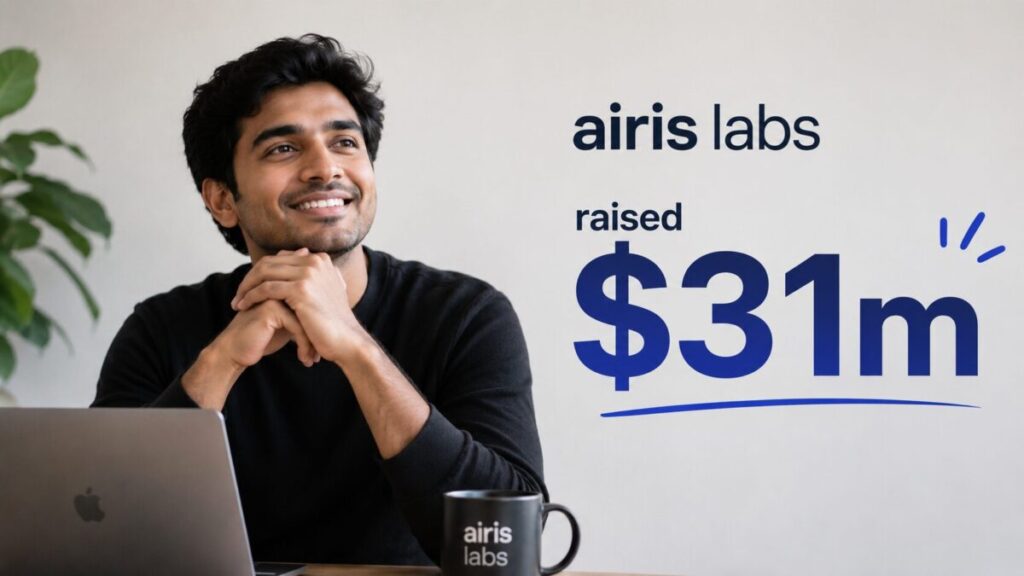
Let me tell you something about the defense tech world that most people outside it do not fully appreciate. The problem was never a shortage of cameras. It was never a shortage of drones or body cams or satellite feeds. Governments have had eyes everywhere for years. The real problem, the one that costs lives and missions, is that nobody could make sense of all that footage fast enough to do anything about it. That is the problem Airis Labs decided to solve. Quietly. For three years. And now, with the news that Airis Labs raised $31M in a Series B round, the company has finally stepped into the open. Here is everything worth knowing.
What Is Airis Labs and What Does It Do?
Airis Labs is a defense technology and AI company focused on intelligence and video-first analytics. Founded in the spring of 2023, the company operated with a “build first, talk later” philosophy, quietly completing its pre-seed, seed, and Series Financing while concentrating on product development and execution rather than public announcements. Three years of silence. No press releases. No flashy conference appearances. Just building.
Founded by Noam Friedman, Rotem Abeles, and Amos Lahav, Airis Labs specializes in what it calls User-Generated Field Intelligence, transforming unstructured visual data from sources such as smartphones, social media, body cameras, and drones into machine-readable insights for government organizations.
The reality is, most defense software companies spend more time talking about what they will build than actually building it. Airis Labs flipped that entirely. And when Airis Labs raised $31M, it was not to fund promises. It was to scale something that was already working in the field.
Among other deployments, Airis participates in a US Army program focused on accelerating the integration of new technologies while also working with law enforcement and customs agencies.
Think about that for a second. US Army. Law enforcement. Customs. All of this before the company ever made a public announcement. That is not luck. That is what happens when a founding team focuses entirely on making the product earn its keep before asking for attention.
Why Airis Labs Raised $31M in Series B Funding
So why now? Why raise and go public at this particular moment?
The Airis Labs funding round comes amid growing investor interest in defense-focused AI infrastructure and intelligence technologies. Governments worldwide are rapidly expanding their use of AI systems across surveillance analysis, situational awareness, cyber operations, autonomous systems, and intelligence workflows. In many cases, the challenge is no longer access to information but the ability to process and interpret it quickly enough to support operational decision-making.
That last line is the whole story. Access to information is not the bottleneck anymore. Speed of understanding is. And that gap, between raw footage and actionable intelligence, is exactly where Airis Labs sits. Here is the kicker. With 45 employees across the US and Israel, Airis Labs plans to double headcount by the end of the year. Going from 45 to roughly 90 people in under twelve months is not a company that is testing the waters. That is a company that already knows what it needs to build and just needs the bodies and resources to build it faster.
Rather than focusing exclusively on traditional video analytics tasks such as motion detection or object classification, Airis Labs is attempting to build systems capable of semantic understanding across visual environments.
Let’s be honest about what that distinction means. Old-school surveillance software tells you something moved. Airis Labs tells you what it is, what it is doing, and why your team should care. That is a completely different category of tool.
Who Invested in Airis Labs’ $31M Round?
When Airis Labs raised $31M, it did not scrape together a random collection of small checks. The investor lineup is worth paying attention to. The round was led by PSG Equity, with participation from TLV Partners, StepStone Group, and Redseed Ventures.
PSG Equity leading the round matters. They back B2B software companies that have real enterprise traction. They are not in the business of funding visions. They fund companies with actual revenue and a clear path to scaling it.
Additional investors include angel investors Eyal Waldman, Jeff Horing, Yasmin Lukatz, and David Chinn. And then there is Eyal Waldman. The former Mellanox co-founder and chief executive whose company was sold to Nvidia for roughly $7 billion in 2020.
When someone who built and sold a company to Nvidia for $7 billion writes a personal check into your startup, people notice. That is not a passive vote of confidence. That is a technically sophisticated investor who has looked at the product and decided it is the real thing. So you have institutional growth equity. You have top-tier venture funds. And you have a billionaire ex-founder with deep roots in the infrastructure and defense tech world. That combination tells you quite a bit about how seriously this company is being taken.
How Airis Labs Turns Drone and CCTV Footage Into Intelligence
This is the part that people tend to gloss over. But honestly, if you do not understand what the product actually does, the funding news is just a number. Airis Labs is advancing a computerized vision platform designed to ingest and process unstructured video streams from aerial drones, tactical body cameras, closed-circuit security systems, and social media platforms. The software applies machine learning algorithms to automate objects, anomalies, and threat tracking, providing operational commanders with immediate, high-fidelity situational awareness.
Picture a real operational scenario. A military unit is operating in an urban area. There are drones overhead. Personnel on the ground are wearing body cameras. There are fixed CCTV systems on buildings nearby. There is social media video being posted by civilians in real time. Each of those is a separate, unstructured stream of visual data. Without Airis Labs, a human analyst has to watch all of it manually. Nobody can watch all of it manually. Things get missed. That costs missions. Sometimes it costs lives.
The platform transforms unstructured visual data from smartphones, drones, social media, CCTV, and body cameras into structured intelligence that analysts and AI agents can search, investigate, and analyze in real time.
And here is something the CEO said that stuck with me. “The company’s biggest competition is rarely another vendor.” Rather it is the fragmented, in-house data science projects government teams build themselves, which rarely scale to meet real operational demands.
That is a brutally accurate observation about how government technology actually works. Agencies build their own tools out of necessity, those tools barely function at scale, and then they keep patching them because switching costs feel too high. Airis Labs is making the case that a purpose-built, production-ready platform beats the duct-tape approach every single time.
Airis Labs was also recently selected to join Oracle’s Defense Ecosystem initiative, which supports companies developing AI and cloud technologies for government and defense deployments. Being picked for Oracle’s defense ecosystem is not a minor footnote. It means the company’s infrastructure and security standards have been vetted at a level that most startups never reach.
Why Defense AI Startups Are Attracting Big Money in 2026
Let’s zoom out for a second. Defense tech funding is booming.
That is the short version. But there is a longer version that explains why Airis Labs raised $31M at this particular moment and why it will not be the last big defense AI raise you read about this year.
The nature of modern conflict and modern security threats has changed faster than most people realize. Drone warfare has become common. Urban surveillance requirements have grown enormously. Border security operations are generating more visual data than ever before. And governments, for the first time, are genuinely willing to pay for software solutions rather than only hardware.
Airis Labs targets government and public safety organizations, offering subscription-based enterprise software designed to streamline video analysis and improve operational efficiency.
The subscription model piece matters more than it might seem on the surface. Legacy defense contractors typically sell big, expensive, one-time hardware systems. A subscription software model means the revenue is predictable, renewable, and tied directly to whether the product keeps delivering value. For a company like Airis Labs, that structure is a competitive advantage. It forces the team to keep improving the product because every renewal cycle is a performance review.
And for investors, especially growth equity investors like PSG Equity, predictable recurring revenue from government agencies is about as attractive as it gets. Government contracts do not churn the way commercial SaaS customers do. When an agency integrates your platform into their operations, they are in it for the long run.
How Airis Labs Plans to Use the $31M
Now that Airis Labs raised $31M, the question worth asking is where exactly that money is going. The company intends to use the funds to scale its infrastructure deployment, accelerate software feature engineering, and expand its technical teams across its Middle Eastern and American hubs.
The company plans to use the capital to expand its US operations, hire new personnel, and accelerate the development of its video-first AI platform.
The US expansion is not just a growth move. It is a strategic necessity. Washington D.C. is where federal procurement decisions get made. Being physically present, having a team embedded in that ecosystem, building relationships with the people who sign contracts, that is how defense technology companies graduate from promising startups to serious government vendors. With 45 employees across the US and Israel, Airis Labs plans to double headcount by the end of the year.
Doubling from 45 to roughly 90 people in under twelve months is aggressive. But it makes sense. The company has already proven the product works. It has signed real government contracts. The bottleneck now is not whether the technology is ready. The bottleneck is having enough engineers to build new features and enough people on the ground to land and expand existing relationships.
The dual-hub structure, with engineering depth in Israel and go-to-market muscle in the US, is a proven model for Israeli defense-tech companies entering the American government market. The new funding gives Airis Labs the runway to execute that playbook properly.
What’s Next for Airis Labs After Emerging From Stealth
Here is where things get genuinely interesting. Emerging from stealth is not a finish line. It is the start of a completely different kind of race.
The company has raised a total of $60 million since its launch three years ago, actively deploying its analytical software to secure multi-agency contracts across international military and public safety organizations.
That sentence matters a lot. Multi-agency. International. That is not a company with one pilot customer and a hope. That is a company with a distributed, proven deployment history across different governments and different operational contexts. And that is the foundation on which everything going forward gets built.
But emerging from stealth also means something changes. Now the company is visible. Competitors will study the product more carefully. Larger defense contractors will take notice. Government agencies that did not know Airis Labs existed last month will start asking questions.
The reality is, that visibility is both an asset and a challenge. It will open doors that were previously closed. And it will invite scrutiny that quiet startups never face. Airis Labs exits stealth with $60 million to transform fragmented drone, CCTV, and social media footage into structured intelligence for government analysts and AI agents.
The category they are defining, User-Generated Field Intelligence, is not just a product. It is a bet that governments around the world will eventually need a standardized infrastructure for processing visual data from the field. If that bet is right, and the existing contract base suggests it very well might be, Airis Labs is not just a promising startup. It is potentially the foundation of a new category of defense technology.
Three years of silence. Sixty million dollars raised. Forty-five employees about to become ninety. Real contracts with real governments. Not bad for a company most people had never heard of until last week.
Read about – Startup business models
Read in – Startup Directory
Read about Solo businesses

Hi Friends, This is Swapnil; I love reading and sharing knowledge. Currently working as a content writer at startupsunion.com. You all can hang out with me here.