Making the Tech Obvious
Let’s be honest, staring at raw database code is a headache. ChartDB fixes that. It is an open-source tool that turns your messy database into a clean, easy-to-read visual chart. You don’t need to install clunky software on your machine. You don’t have to hand over secret database credentials either. You just run a smart query, copy the JSON text it spits out, and paste it right into ChartDB. Boom.
It instantly visualizes all your tables and shows exactly how they connect to one another. You can even add fields and see the differences live between your development and your database. It is simple. It does one highly specific thing really well.
The 0 to 1,000 User Framework
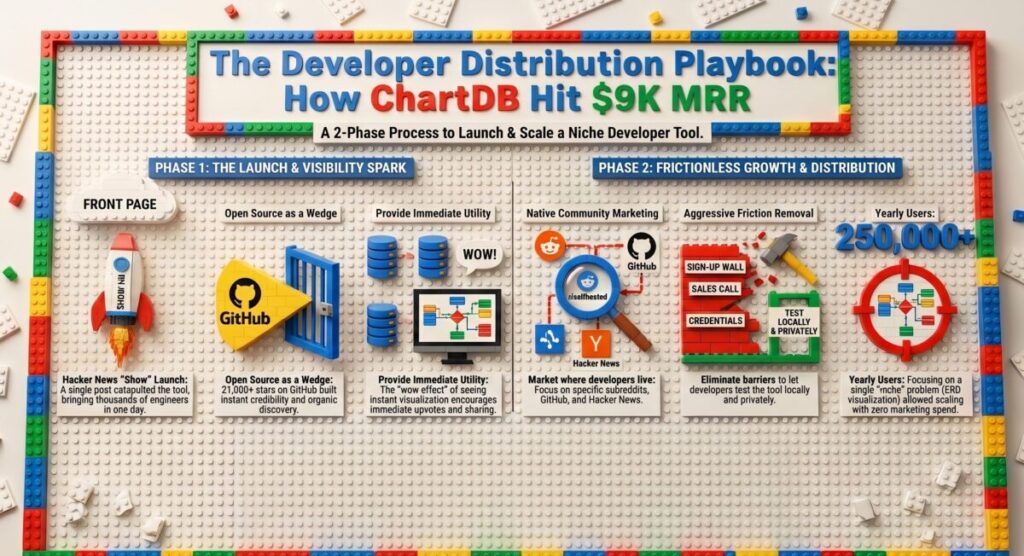
Getting those first users is brutal. It’s lonely. It’s hard. But it works if you strip out the garbage. The reality is, they ignored the masses and built this entirely for one type of person: developers. Their core framework was aggressively focused on removing friction. No sign-up walls. No sales calls. You just open it and try it.
So how did they get it out there? They distributed it by hanging out exactly where their target users already live. They launched on Hacker News. They put themselves out there just three weeks into development, and that single post hit the front page. It dragged in thousands of engineers in a single day. They also grew through GitHub and specific self-hosted subreddits on Reddit.
Here is the kicker. They gave it away for free at first. They just watched the usage. When users started asking to work together with their teams, they realized they needed to build real-time collaboration. And that was exactly what they built into their paid cloud version to finally start monetizing.
The Tech Stack Under the Hood
You don’t need magic to build this. They wired the core application together using React, Vite, Node.js, and Tailwind. To make the visual canvas actually work, they used React Flow. But running a SaaS costs money. AWS handles the cloud hosting for $600 a month. For writing code, Cursor maxes out at $200 a month. Landing big clients requires SOC 2 compliance, which runs through a “tricom” account at $500 a month.
They spend $20 on a ChatGPT subscription plus around $50 for the AI assistant’s API. Their marketing website sits on Framer for $30 a month. For tracking numbers, “pomon analytics” costs $25 a month, while “chart mobile” is used for free. They also plug in Stripe for subscription payments, a tool called “recent” for transactional emails, “chris” for live user chat, and Ahrefs to capture organic search traffic.
Read more about Solo businesses.
Solo businesses – Ivonne ,Super Demo, Journalable, Locked

Hi Friends, This is Swapnil; I love reading and sharing knowledge. Currently working as a content writer at startupsunion.com. You all can hang out with me here.