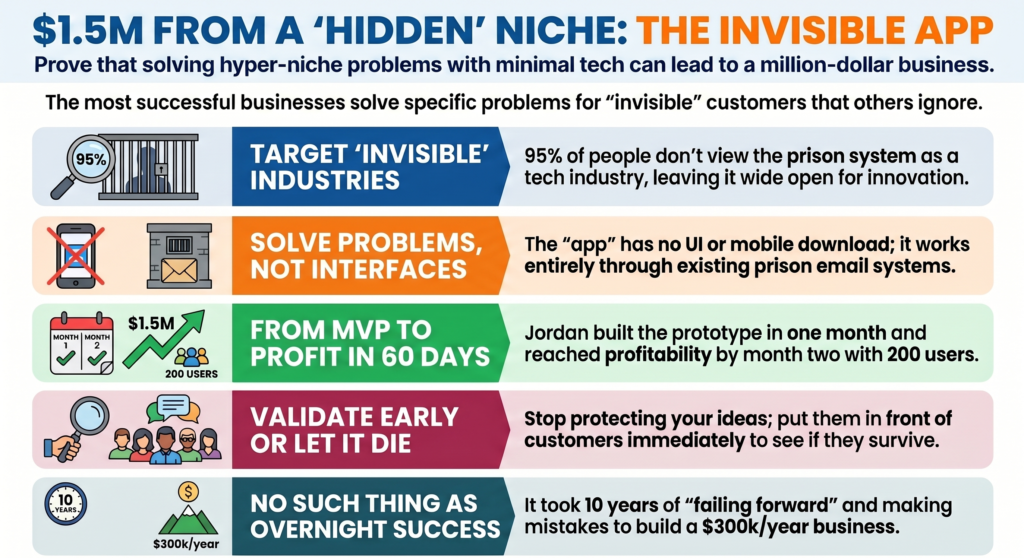
The marketing and sales strategy for Parakeet Chat is unique because it operates within the “closed ecosystem” of the prison system, where traditional digital marketing tactics like landing pages and email lists are ineffective.
The company’s strategy focuses on the following key areas:
Sales and Pricing Model
- SaaS Model: The business operates as a monthly Software as a Service (SaaS).
- User vs. Customer: There is a distinction between the two; while the users are the incarcerated individuals, the customers who actually pay for the service are their families on the outside.
- Pricing Structure: The service costs $15 or $20 per month depending on the selected plan, with a discount offered for yearly subscriptions.
Marketing and Growth Tactics
- Word of Mouth: Jordan, the founder, states that growth is almost entirely driven by word of mouth. Incarcerated users who find the product valuable act as “zealots” and show it to others within the facility.
- Referral System: To incentivize growth, the app includes an internal recruitment system. If a current customer recruits a new user who signs up and pays, the original customer receives approximately one month of free credits.
- Targeted Validation: Because he could not use standard marketing to validate the idea, Jordan built a Minimum Viable Product (MVP) and got it directly in front of contacts he had in prison to gather immediate feedback and iterate quickly.
Market Positioning
- Solving a “Scam” Problem: The strategy relies on offering a higher-quality, fairly priced alternative to existing prison services, which the founder’s contacts described as low-quality “scams” offered at very high prices.
- Focus on High-Value Use Cases: The product markets itself through its utility, specifically helping users research legal rights and case law, as well as facilitating communication with family members.
more about the families paying for the service.
In the business model for Parakeet Chat, a clear distinction is made between the users (incarcerated individuals) and the customers (their families on the outside), as the families are the ones who actually pay for the service.
Here are the key details regarding these families and their role in the business:
- Financial Responsibility: Because paying for services from within prison is complicated, the families act as the financial supporters. They pay for the service as a monthly subscription, typically costing $15 or $20 per month depending on the plan, with discounts available for yearly commitments.
- Emotional and Practical Value: For many families, the service is a vital link to their loved ones. The app has facilitated nearly 100,000 family connections that might not have otherwise existed. One user shared that the service allowed him to receive a “hello” message from his daughter, whom he had not been able to speak to in years.
- Support for Legal and Educational Goals: Beyond simple communication, families pay for the service to provide their incarcerated relatives with access to AI tools for legal research, studying case law, and general education. This is particularly valuable because resources within the prison system are often limited or high-priced “scams”.
- Referral Incentives: Families are also involved in the growth of the platform. Through an internal recruitment system, if a paying customer recruits another family to sign up and pay for the service, the original customer receives approximately one month of free credits.
How do families use the app for legal research support?
Based on the sources, families do not typically perform the legal research themselves through the app; rather, they provide the financial support that enables incarcerated individuals to conduct their own research.
The families’ role in legal research support involves the following:
- Financial Enablement: Families act as the paying customers, covering the monthly subscription fee of $15 or $20. This payment provides their incarcerated loved ones with access to AI tools that would otherwise be unavailable or prohibitively expensive within the prison system.
- Providing Access to Critical Resources: Because resources within the prison system are often limited or described by the founder’s contacts as “massively overpriced scams,” family-funded subscriptions allow users to access modern AI like ChatGPT.
- Empowering the Incarcerated User: Once the family pays for the service, the incarcerated user interacts with the AI via the internal prison email system. The primary use case for these users is studying case law, understanding their legal rights, and finding information to help fight their legal cases.
In summary, while the families are the ones paying for the service, the actual legal research is performed by the incarcerated individuals using the AI chatbot to better their legal situations.

Hi Friends, This is Swapnil; I love reading and sharing knowledge. Currently working as a content writer at startupsunion.com. You all can hang out with me here.