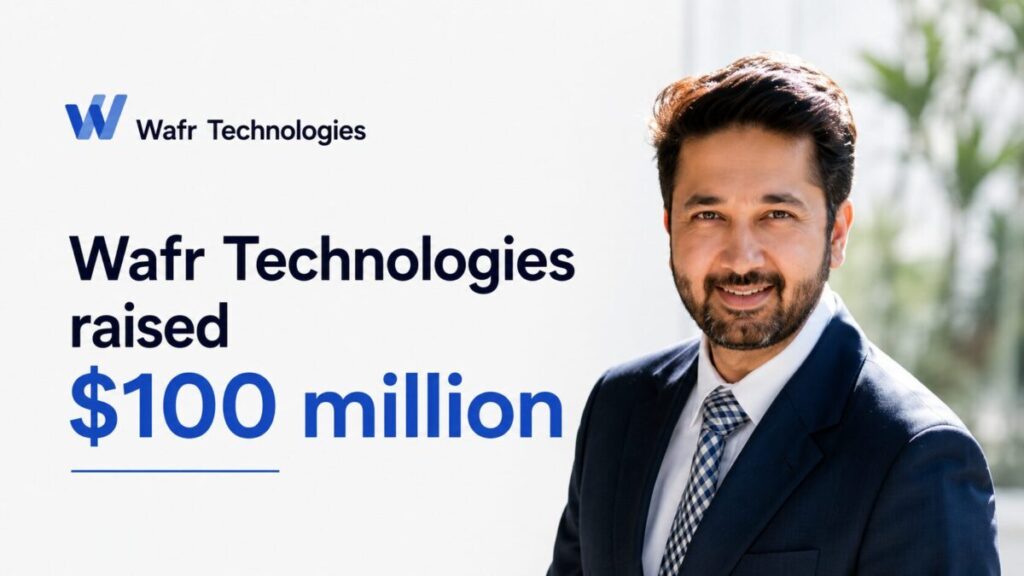
AI is thirsty. Every chatbot reply, every training run, and every inference call runs through a data center that needs cooling. And cooling means water. Lots of it. That’s the problem Wafr Technologies is trying to solve, and it just got a serious vote of confidence to go do it. Wafr Technologies raised $100 million toward a larger $300 million goal. The announcement landed on July 2, 2026. Here’s what’s actually going on and why it matters more than another funding headline might suggest.
What Is Wafr Technologies?
Wafr Technologies is a Vancouver-based startup building cooling systems for AI data centers. Not the flashy part of AI. The unglamorous, expensive, water-guzzling part that shows up after the model is already trained and someone has to keep thousands of servers from cooking themselves.
The pitch is simple. AI data centers burn through absurd amounts of water and electricity just staying cool. Wafr says it has a way to cut both dramatically without slowing anything down.
The company was co-founded in March 2025. That makes a $100 million raise a fast climb for a startup that’s barely over a year old. Fast, but not random. It tells you how urgent the water problem has become across the AI industry right now.
Wafr sits in that weird, growing overlap between cleantech and AI infrastructure, a space that barely existed three years ago and is now pulling in serious institutional money. The company was also recognized on Foresight Canada’s Foresight 50 Showcase in 2025, a list built around the country’s most investible cleantech companies. That recognition came before this raise. It’s part of why investors were already circling.
Wafr Raises $100 Million in New Funding
Let’s talk numbers, because that’s why you clicked. Wafr Technologies raised $100 million from a group of private investors. That figure is roughly a third of the company’s stated $300 million target.
Here’s the thing though. This isn’t a neat, labeled Series A or Series B; Wafr is calling it progress toward a bigger campaign, one built around a specific and ambitious project: a Canadian AI research lab focused on sustainable computing.
The money breaks down into three buckets. Establishing the research lab. Expanding research and development on the cooling tech itself. And scaling Canadian-made technology to meet what the company calls growing global demand for AI computing, all while trying to shrink the environmental bill that usually comes attached to it.
CEO Bikram Singh put it plainly. Artificial intelligence, he said, is one of the biggest advancements of this generation. But it shouldn’t cost future generations their environment to get there. That tension is exactly what Wafr is betting real money on solving.
Foresight Canada is a major backer of the broader lab initiative. Director of Earth Tech and Investor Relations Brittany Goldhawke called Wafr’s technology a game changer for an industry facing genuine resistance over water and grid limits. And that resistance isn’t theoretical. It’s already showing up as permitting delays and community pushback against new data center projects across North America.
Who Are Wafr’s Founders?
Two names sit behind this raise: Bikram Singh, the CEO, and Darrell Kopke.
Singh isn’t new to cooling. He spent nearly two decades in the cooling industry across the Middle East and India before starting Wafr. That matters more than it sounds. Building cooling systems for hot, water-scarce regions like Dubai takes a completely different playbook than building for a temperate climate. Singh’s background gives Wafr a technical foundation most first-time founders just don’t have.
Here’s the kicker. Singh got his MBA at the University of British Columbia. Kopke was his professor there. A classroom relationship turns into a cofounded company. It happens more than people think, but it rarely happens this fast or this well-funded.
Kopke brings the sustainability and strategy side. He’s been vocal about Canada’s shot at leading sustainable AI, arguing that economic growth and environmental responsibility aren’t actually competing goals. That framing shows up constantly in how Wafr talks about itself. And it’s clearly landing with investors who want AI exposure without the environmental baggage attached.
How Wafr’s Cooling Technology Works
So what’s actually different here? Wafr built what it calls a thermal battery. It’s a proprietary system that captures cooling capacity when grid electricity is cheap, then releases that stored capacity during peak demand, when power costs more and grids are already stretched thin.
Think of it like a battery, but for cold air instead of electricity. Instead of running cooling systems flat out around the clock, Wafr banks cooling capacity during off-peak hours and deploys it exactly when the data center needs it most.
The numbers Wafr is reporting are big. Up to a 95% cut in water use. Up to an 80% cut in cooling power. Those aren’t rounding-error improvements. If those figures hold up at scale, they change the actual math on what it costs, financially and environmentally, to run a large AI data center.
The technology has already been demonstrated in India and Dubai. Two markets where water scarcity and brutal heat make cooling efficiency a necessity, not a nice-to-have. What Wafr hasn’t done yet is prove itself at a Canadian scale. That’s exactly why this round matters so much.
Why AI Data Centers Need This Technology
The context here explains why investors moved fast. A typical data center burns through up to 10 million liters of water per megawatt annually. Cooling alone eats 30 to 45% of a facility’s total electricity load. And that’s before you even count the computer itself.
Now scale that up. A 100-megawatt AI data center in the U.S., roughly the size hyperscalers like Amazon, Google, and Microsoft build routinely, uses around 2 million litres of water per day. According to a 2025 International Energy Agency analysis, that’s on par with the water use of 6,500 households. One data center. Every single day. The water footprint of a small town.
And the buildout is not slowing down. Big Tech, including Amazon, Microsoft, Alphabet, and Meta, is expected to spend over $700 billion this year alone on AI infrastructure, according to a June 2026 Goldman Sachs report. That number is projected to blow past $5 trillion by 2030. Every dollar of that comes with a water and energy bill attached. Most of the industry still doesn’t have a good answer for how to pay it.
Canada has its own version of this problem. Ottawa has committed to 850 megawatts of domestic AI compute by 2030. No real plan yet to measure the water that’s going to take. That gap is precisely the opening Wafr is trying to fill.
Cooling has also gotten genuinely lucrative, not just necessary. In March 2026, U.S. company Ecolab announced it was buying Calgary-based CoolIT Systems, a liquid cooling company, for US$4.75 billion. One of the largest Canadian tech acquisitions on record. That alone tells you how much capital is chasing solutions to this exact problem.
Wafr’s Plans for a Canadian AI Research Lab
This $100 million raise isn’t just fuel for growing the company. It’s earmarked specifically to help build a world-class AI Research Lab in Canada, bringing together researchers, engineers, and industry partners to develop the next generation of AI infrastructure technology.
The ambition goes beyond one lab, though. Wafr wants Canada to be seen as a global leader in sustainable AI infrastructure, leaning on the country’s engineering talent and clean energy grid as a real competitive edge against markets that haven’t prioritized environmental cost at all. Kopke has been direct about this. Canada has an opportunity to lead, not follow, on sustainable AI.
The lab is still just a plan. Nothing built yet. This raise represents roughly a third of what Wafr says it needs to actually get there.
What’s Next for Wafr Technologies?
Wafr isn’t staying home. The company says it’s prioritizing the United States as its main market, alongside Germany. The logic is straightforward. The U.S. has roughly 5,300 data centers, more than any other country by a wide margin. Germany is a distant second, at around 400.
Singh has pointed out something blunt. The U.S. is also the market with the least sustainable AI infrastructure right now. He sees that as both the problem and the opportunity. Wafr’s bet is that as water and energy questions become unavoidable on every AI compute contract, its cooling tech stops being a nice-to-have and starts being a requirement.
So what to watch next? Whether Wafr closes the remaining $200 million toward its $300 million goal. Whether the Canadian research lab moves from paper to poured concrete. Whether the cooling tech gets proven at scale outside India or Dubai. For now, Wafr Technologies raised $100 million on the strength of a real problem and a founding team that’s spent two decades thinking about exactly this. Whether that’s enough to actually change how AI data centers get cooled is the question the next year will answer.
Sources used for this article:
Read about – Startup business models
Read in – Startup Directory
Read about Solo businesses

Hi Friends, This is Swapnil; I love reading and sharing knowledge. Currently working as a content writer at startupsunion.com. You all can hang out with me here.
Hilfreich! Spiele wie Blob Opera und Labubu Piano: The Choicer Voicer unter . The Choicer Voicer
This answered my questions. Also recommend Gem Transcribe: for browser audio upload or record transcription.. Gem Transcribe