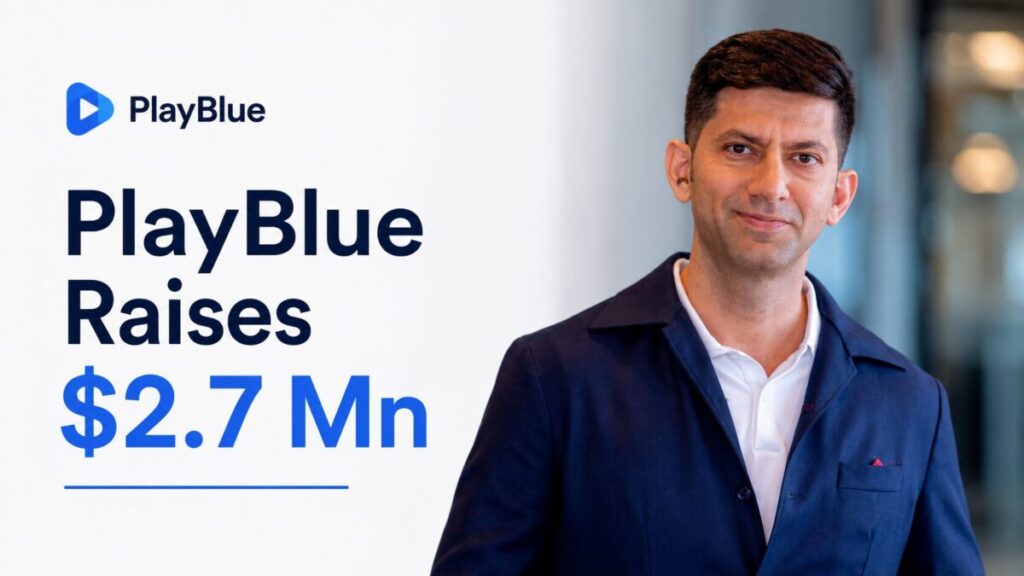
Here’s a funding story worth paying attention to. PlayBlue, an omnichannel multi-brand sports retail platform, just closed $2.7 Mn (₹25.7 Cr) in a seed round. Centre Court Capital and MIXI Global co-led it. WEH Ventures came in too.
Let’s be honest, seed rounds happen every week in India. Most don’t matter much. This one does, and here’s why: it’s a real bet on organized sports retail in a country where that category has always been messy and fragmented. Investors don’t write checks like this unless they see something bigger coming.
The reality is, PlayBlue is trying to do two hard things at once. Build offline stores. Grow an e-commerce business. At the same time. That’s not easy. But if it works, it changes how Indians shop for sports and fitness products.
What Is PlayBlue and What Does It Sell?
PlayBlue is an omnichannel multi-brand sports retail platform. Simple as that. It brings athleisure, footwear, equipment, and nutrition products together under one roof, both online and in physical stores.
Here’s the kicker though. This isn’t just another marketplace slapping brands onto a website. PlayBlue has pulled together more than 100 global and homegrown brands into curated, experiential stores, all connected by a single digital platform. So a customer isn’t just buying shoes. They’re walking into (or logging onto) a space built around sport and fitness as a lifestyle, not a transaction.
And that experiential piece matters more than people give it credit for. Sports retail in India has been split for years. You’ve got single-brand stores. You’ve got big-box sporting goods chains. You’ve got e-commerce players competing purely on price. Nobody’s really stitched it all together into one coherent experience. PlayBlue is betting that’s the gap worth filling.
How Much Funding Did PlayBlue Raise?
$2.7 Mn. Around ₹25.7 Cr. That’s the number.
On paper, it’s a fairly standard seed round for an Indian startup. But the ambition behind it is not standard at all. Most seed-stage founders use this kind of capital to test one channel, prove it works, then raise again. PlayBlue is skipping that caution and building retail infrastructure and e-commerce at the same time.
That’s a bold call. It’s also risky. Building two channels simultaneously eats capital fast, and there’s no guarantee both scale at the same pace. But it fits a pattern we’ve seen across India’s D2C and retail space lately: investors backing teams who combine strong brand curation with tech-driven operations, especially in fitness and athleisure, where consumer spending keeps climbing.
Who Invested in PlayBlue’s Seed Round?
Two lead investors, not one. Centre Court Capital and MIXI Global co-led the round. WEH Ventures joined as a participant.
When two funds co-lead instead of one taking the whole round, that usually means more than one team did the homework and both came away convinced. It’s a small signal, but an important one. It tells you the diligence wasn’t rushed.
WEH Ventures being in the mix adds something too. The fund has a track record with consumer and lifestyle brands in India, so its presence brings retail and growth-stage know-how to the table, not just capital. For a company trying to build stores and scale e-commerce at once, that operational experience on the cap table is worth more than the check size suggests.
Who Are the Founders of PlayBlue?
Satyam Trivedi and Jayam Vora started PlayBlue in 2025. Neither of them is new to this world.
Trivedi ran GMR Sports as CEO before this. That means years of exposure to sports business operations, brand deals, event management, the whole ecosystem. Vora spent time in a senior role at Cult.fit, one of India’s biggest fitness and wellness platforms. So he’s built consumer fitness products at real scale before.
And that combination is the whole story here. Trivedi knows how to get brands to the table. Vora knows how to keep consumers coming back. It’s a rare pairing, sports industry relationships on one side and fitness-consumer product instincts on the other. Founders with operating scars from real companies tend to build differently than first-timers, and investors clearly noticed that.
How Will PlayBlue Use the Funding?
The plan is straightforward on paper, harder in practice: launch flagship stores and keep growing the pan-India e-commerce platform. Not one or the other. Both.
Offline, the money goes toward building out experiential stores where people can actually touch and try products across athleisure, footwear, equipment, and nutrition. Online, it goes toward deepening the e-commerce side, which likely means investment in technology, logistics, and customer acquisition.
So why bother with both? Because sports and fitness products are hard to sell purely online. People want to try shoes on. They want to feel equipment in their hands before buying. But they also want the convenience of ordering online when they already know what they want. PlayBlue is betting it needs both channels working together, not competing with each other, to win this category.
Where Will PlayBlue Open Its First Stores?
Bengaluru gets the first store. Mumbai and Delhi-NCR come next.
Starting in Bengaluru isn’t random. The city has a strong fitness culture, a tech-heavy population, and enough disposable income to support premium sports retail. It’s a logical proving ground before expanding further.
Mumbai and Delhi-NCR are obvious next steps too. Both are massive metro markets with dense concentrations of exactly the kind of urban, fitness-focused customer PlayBlue is chasing. This city-by-city rollout isn’t flashy, but it’s smart. Nail the format in one city. Fix what’s broken. Then take it to the next one. Trying to launch everywhere at once is how retail startups burn cash and lose focus.
What Are PlayBlue’s Growth Plans for the Next 5 Years?
Big numbers here. Over the next five years, PlayBlue wants a network of more than 150 stores. It wants a community of over 1 Cr (10 million) users. And on revenue, the target is ₹100 Cr, with a goal of hitting operational profitability before its next fundraise.
That’s an aggressive roadmap for a company that just closed its seed round. Going from a single store in Bengaluru to 150 stores nationwide takes serious execution on site selection, brand relationships, supply chain, and customer experience, all at once. Building a 10 million-user community is its own separate mountain to climb.
But here’s what stands out. The founders aren’t just chasing growth for growth’s sake. They’re targeting profitability before raising again. In a funding environment where investors care more about unit economics than blitzscaling, that’s the right instinct. It suggests PlayBlue is building with discipline, not just burning capital to hit vanity numbers.
The Bigger Picture for India’s Sports Retail Market
This funding round tells you something about where investors think Indian retail is headed. Fitness isn’t a trend anymore. It’s a lifestyle for a growing chunk of urban India, and that means demand for organized, trustworthy sports retail is only going up.
PlayBlue has the backing. Centre Court Capital, MIXI Global, WEH Ventures are all in. It has founders with real scars from building sports and fitness businesses before. What it doesn’t have yet is proof that the model works at scale.
So the real test starts now, in Bengaluru, with one store and a lot riding on it. If PlayBlue can pull off its dual online-offline strategy, 150 stores and 10 million users in five years starts to look less like a pitch deck slide and more like a real trajectory. For now, this $2.7 Mn seed round is just the first step. The hard part comes next.
Sources actually used for the facts in this article:
- Startup news and updates: daily roundup (July 2, 2026) – Dailyhunt/YourStory
- Sports Retail Brand PlayBlue Bags $2.7 Mn To Expand Into Offline Retail – Inc42
Read about – Startup business models
Read in – Startup Directory
Read about Solo businesses
Hi Friends, This is Swapnil; I love reading and sharing knowledge. Currently working as a content writer at startupsunion.com. You all can hang out with me here.
Buena lectura. Van Gogh Free AI Video Generator (/) para text-to-video. Van Gogh Free AI Video Generator
Aprendí mucho. Dúo para TikTok y Reels: AI Hotel Lobby — /. AI Hotel Lobby