What Is QOSMIC and What Does It Do?
Here’s the short version. QOSMIC is a Bengaluru-based deep-tech company building optical communication infrastructure for space. Not satellites. Not rockets. The wiring in between.
The company is going after what it calls the data layer of the space economy. That’s the network that carries information between satellites, orbital data centers, and the ground network. And instead of doing it the old way, with radio signals, QOSMIC is betting everything on lasers.
The company builds laser-based communication infrastructure for satellites, aiming to replace slower radio-frequency systems with high-speed optical links. Two products sit at the center of this: optical ground stations and satellite communication terminals, stitched together into one optical communications stack. Most satellites today still talk to ground stations using radio-frequency links, things like S-band, X-band and Ka-band systems. QOSMIC thinks that era is ending.
QOSMIC Raises $3.3 Million in Seed Funding
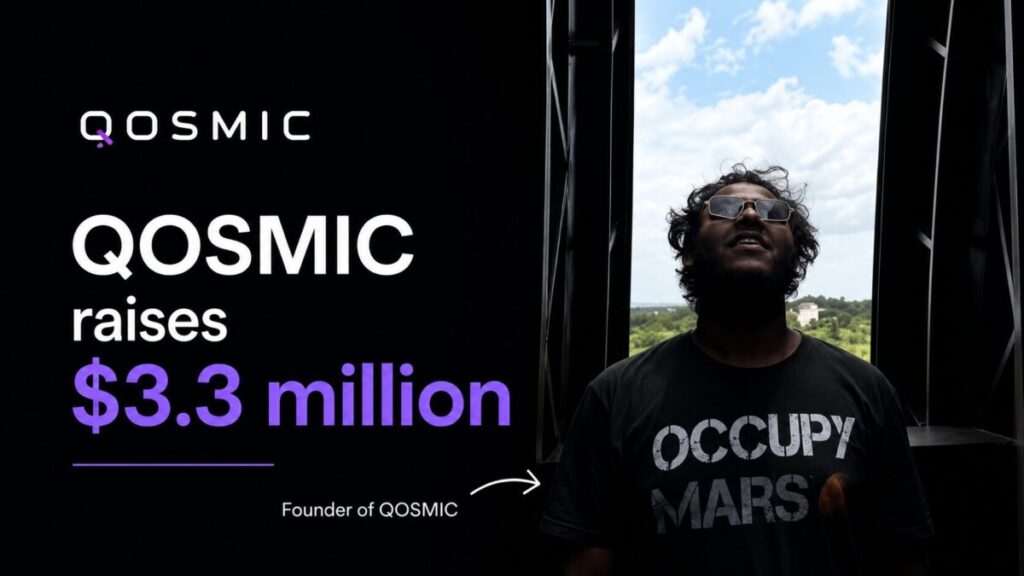
So here’s the news. QOSMIC raised $3.33 million in a seed funding round, announced in late June 2026. Not a massive round by Silicon Valley standards. But for a year-old deep-tech company building hardware for space, it’s real money with real intent behind it.
The funding will accelerate the company’s work to build the data layer of the space economy, and that’s not a throwaway line. This is capital meant to move QOSMIC out of the lab and into the field.
The reality is, most seed rounds buy a company time to figure things out. This one is different. It will support product deployment, manufacturing, testing and team expansion as QOSMIC prepares for in-orbit trials and commercial rollouts. Every dollar here has a job already assigned to it.
Who Are QOSMIC’s Investors?
The round was led by Accel and Prosus, with participation from South Park Commons, ARTPARK, and angel investor Manish Jain. Two heavyweight leads on a deep-tech seed round. That’s not nothing. It tells you institutional investors looked under the hood and liked what they saw.
But let’s get to the actual thesis, because it’s worth hearing in the investors’ own words. Mahendran Balachandran and Pratik Agarwal, partners at Accel, put it this way: satellites are collecting more than they can ever send back to Earth, and as computing moves into orbit, that gap only widens. That’s the whole bet, really. Data is piling up faster than it can come down.
And the kicker is what they think solves it. According to the Accel partners, QOSMIC is solving the problem with laser ground stations that are faster, more secure and far cheaper than today’s systems. Faster. More secure. Cheaper. That’s the trifecta every infrastructure investor wants to hear, and it’s rare to get all three in one pitch.
QOSMIC’s Founders and Company Background
QOSMIC was founded in 2025 by Shreyaans Jain, Rohit Ramakrishnan, and Aloke Kumar. Jain runs point as co-founder and CEO, and he’s been the one out front explaining the company’s vision since the round closed.
Let’s be honest, a company that’s barely a year old rarely has much to show beyond a deck and a dream. QOSMIC isn’t most companies. It moved fast, and that speed is probably a big part of why investors leaned in early.
Jain has a way of framing this that sticks. He’s said the next decade of the space economy will be defined by data, full stop. Satellites keep getting smarter and more capable, he argues, but the pipes connecting them to Earth haven’t kept pace. He’s drawn the comparison directly to the internet’s own infrastructure story: fibre optics became the backbone of the internet, and he believes optical communications will do the same for space. It’s a big claim. But it’s the kind of claim that gets a $3.3 million check written.
How QOSMIC’s Laser Technology Works
Here’s where it gets technical, but stay with me, because the numbers are wild. A single Earth observation satellite can generate terabytes of data daily, Jain has said. Terabytes. Daily. From one satellite.
And the infrastructure built to carry that data home? It’s straining. Conventional radio links are constrained by limited spectrum, congestion, and short transmission windows, and the result is brutal. Around 50 to 60 percent of satellite data never reaches end users because there isn’t enough bandwidth to send it back. Half the data. Gone. Never seen.
Jain summed up the stakes plainly when he told the Economic Times that if data can’t come back to Earth, it has no value at all. That’s the whole problem in one sentence.
QOSMIC’s fix is to swap radio for light. Its laser-based optical communication systems can move data between orbit and Earth at significantly higher speeds and capacities than radio-frequency systems allow. And this isn’t theory dressed up as a pitch deck. In less than a year since starting, QOSMIC field-validated its complete optical communication stack over a 10-kilometre terrestrial link at Technology Readiness Level 6 (TRL6), demonstrating the full chain of pointing, acquisition, tracking, and high-speed data transfer outside a laboratory environment. TRL6 isn’t a buzzword. It means the tech got tested in the real world, not just on a whiteboard. That’s a big deal for a company this young.
Why Satellites Need Better Data Transmission
The timing here isn’t an accident. Something much bigger is happening above our heads. As the number of low-Earth orbit (LEO) satellites increases, the volume of data generated in space is rising rapidly, creating bottlenecks in data transfer.
So the question isn’t really about getting satellites up there anymore. One of the most pressing challenges in the space economy is no longer just launching satellites into orbit, it’s efficiently transmitting the enormous amount of data they generate back to Earth. Launch used to be the hard part. Now it’s the easy part.
And the scale coming down the pipeline is almost hard to picture. According to Goldman Sachs Research, approximately 70,000 low-Earth orbit satellites are expected to be launched over the next five years. Seventy thousand. Each one generating more data than the last generation ever did, thanks to sharper sensors and more onboard compute. As computing increasingly moves into orbit itself, through orbital data centres, that gap between what’s collected and what actually makes it home only gets wider.
That’s the gap QOSMIC is chasing. And it’s a big one to chase.
What’s Next for QOSMIC?
With the money in the bank, the work shifts from proving the tech to building it at scale. QOSMIC plans to use the funds to deliver optical ground stations and satellite terminals to international customers; strengthen integration, testing, and manufacturing capabilities; and expand its engineering team across optical, mechanical, and electronics domains. That last part matters more than it sounds. Deep-tech hardware companies don’t scale on vision alone. They scale on engineers who can actually build the thing twice, then a hundred times.
But here’s the hard truth nobody glosses over in press releases. The TRL6 validation was a real milestone, but the next phase, in-orbit testing, is significantly more complex and expensive. Space doesn’t forgive mistakes the way a terrestrial test link does. QOSMIC faces the standard risks every deep-tech startup faces, proving its technology can survive and perform in the harsh environment of space.
So what should you actually watch for? Three things. Flight testing progress. The first operational ground stations are going live. And contracts with commercial satellite operators are actually signed, not just discussed. Those milestones will determine whether QOSMIC can compete with established radio-frequency solutions and offer a real, cost-effective alternative for high-volume satellite data transmission.
The reality is, $3.3 million doesn’t guarantee anything in this business. It buys a shot. What QOSMIC does with that shot, whether laser-based communication actually becomes the fibre optics of space, that part’s still being written.
Sources used in this article:
MAKO Raised $28 Million to Bring Shark-Skin Technology to Aircraft
Read about – Startup business models
Read in – Startup Directory
Read about Solo businesses

Hi Friends, This is Swapnil; I love reading and sharing knowledge. Currently working as a content writer at startupsunion.com. You all can hang out with me here.