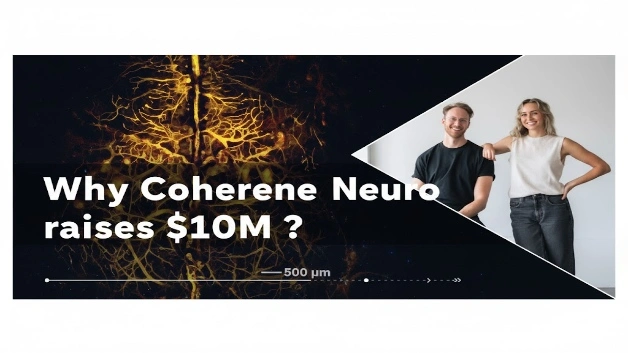
The global neurotech sector witnessed a transformative moment as Coherence Neuro, the San Francisco-based therapeutic brain-computer interface startup, secured $10 million in seed funding to advance its SOMA-1 system targeting glioblastoma—one of the most aggressive brain cancers.
Coherence Neuro is Led by Topology Ventures and Artesian with participation from Blackbird, Possible Ventures, XEIA Venture Partners, Jumpspace Ventures, Divergent Capital, SmartGateVC, Spacewalk VC, and prominent angels including Matt Krisiloff, Linhao Zhang, and Tim Shi, this capital enables first human trials scheduled for 2027—raising a crucial question: why is venture capital flowing into bioelectric cancer treatment when glioblastoma kills 90% of patients within 24 months despite surgery, radiation, and chemotherapy costing billions annually, yet Coherence Neuro’s closed-loop neurostimulation aims to transform cancer from destructive fight into manageable condition through data-driven electrical interventions?
The $12.87 Billion Market Nobody Expected Neurotechnology Could Disrupt
The answer for Coherence Neuro lies in understanding what’s happening beneath the surface of brain-computer interface evolution. Despite the global BCI market valued at $3.21 billion in 2025 projecting explosive growth to $12.87 billion by 2034—representing 16.7% compound annual growth—the sector faces a critical therapeutic paradox. Traditional BCIs restore communication and motor function for paralysis patients through neural signal interpretation, yet cancer applications remain virtually unexplored despite 300,000 annual glioblastoma diagnoses worldwide with median survival of just 12-15 months and five-year survival rates below 5%—outcomes unchanged in decades despite tremendous oncology advances.
Coherence Neuro operates a technology platform unique in bioelectronics: the SOMA-1 therapeutic BCI featuring wireless coin-sized implants that continuously monitor cancer bioelectric signaling and deliver targeted stimulation to disrupt tumor growth in real time. Founded by Ben Woodington (medical device engineer and neurotech researcher) and Elise Jenkins (electrical engineer turned neuro-oncology researcher) who completed PhDs at University of Cambridge’s Bioelectronics Laboratory, the team envisions futures where aggressive cancers are managed continuously rather than treated reactively.
Coherence Neuro’s mission reflects fundamental reconceptualization: cancer represents system-state error requiring biological harmony restoration rather than external invader demanding destruction. As co-founder Jenkins emphasized: “We aim to bridge the gap between neuro and AI with a closed-loop, bi-directional cancer-treating system that listens to electrical cues evolving as diseases progress and nudges them back towards healthier states using electrical stimulation.”
Why Glioblastoma’s Treatment Failure Required Bioelectric Solutions
Coherence Neuro’s funding trajectory provides context for why neurostimulation platforms outweigh incremental chemotherapy improvements. When glioblastoma patients face 15-month median survival despite $3.72 billion global treatment market projected to reach $7.87 billion by 2033 at 8.68% compound annual growth rate, existential treatment failures become undeniable. Traditional approaches—surgical resection followed by radiation therapy and temozolomide chemotherapy—offer limited benefit, with 90% of patients experiencing recurrence within two years and outcomes essentially unchanged since temozolomide’s 1999 FDA approval. The blood-brain barrier severely limits drug penetration, tumor heterogeneity creates treatment resistance, and monitoring occurs only through periodic MRIs spaced months apart—by which time regrowth often becomes irreversible.
The funding structure of Coherence Neuro reflects institutional recognition that bioelectric modulation superiority determines next-generation cancer care. XEIA Venture Partners articulated treatment urgency: glioblastoma represents “death sentence” with median survival about 12 months even with state-of-the-art treatment, and only 5% of patients reach the five-year mark. Blackbird General Partner Michael Tolo emphasized technical ambition: “This is one of the most ambitious technical efforts we have seen at Blackbird, turning decades of neuroscience into a new way to fight cancer.” Unlike traditional therapies impacting entire bodies through systemic toxicity, SOMA-1 embeds in relevant brain areas administering therapies directly—enabling precision impossible through conventional approaches while capturing biological data previously inaccessible.
The Closed-Loop Architecture Behind Clinical Validation
The funding round accelerates first human trials planned for 2027, with SOMA-1 implanted during tumor removal surgery most glioblastoma patients already undergo—adding minimal additional risk or burden. The timing coincides with neurotech reaching inflection points where brain-computer interfaces mature sufficiently for therapeutic applications beyond communication restoration. Industry data confirms $2.3 billion raised across 129 neurotech deals in 2024—up from $1.4 billion across 115 deals in 2023—representing 88% compound annual growth rate suggesting $4 billion funding trajectory for 2025. Seven companies topped $100 million rounds in 2024, indicating healthy investor patience and willingness betting on long-term market strategies despite extended development timelines.
Coherence Neuro differentiates through full-stack platform creating disease-focused data ecosystem that continuously refines itself—the more devices are used, the smarter and more responsive systems become. Unlike existing electrical therapies like Novocure’s tumor-treating fields requiring external headcaps and backpacks creating lifestyle disruptions, SOMA-1 features fully implantable, MRI-safe design delivering targeted stimulation exactly where needed with zero patient burden.
The over-ear wearable provides all-day power and memory, while the SOMA app offers real-time insights, session history, and symptom tracking—comprehensive solution impossible through traditional oncology. Market validation exists: desperate patients already pay for electrical cancer treatment despite current cumbersome forms, demonstrating willingness to adopt bioelectric approaches when accessibility improves.
Why This Matters For Global Healthcare Innovation
Coherence Neuro’s $10 million raise positions the platform within broader 2025 neurotech dynamics where therapeutic BCIs demonstrate strategic advantages justifying investments despite oncology sector challenges:
Treatment Paradigm Transformation: Glioblastoma represents 47.7% of all malignant brain and CNS tumors, affecting 3.21 per 100,000 people with incidence rising due to aging populations, improved diagnostics, and environmental factors. Despite comprehensive treatment protocols, outcomes remain dismal—90% of adult patients die within 24 months, and blood-brain barrier limitations prevent effective drug delivery. SOMA-1’s continuous monitoring addresses critical gap: current care relies on periodic MRIs detecting regrowth months after occurrence, yet real-time bioelectric feedback enables immediate treatment adjustments. Studies confirm tumor-treating field therapy improves progression-free survival and overall survival rates, validating electrical modulation’s cancer-fighting potential—yet Coherence Neuro’s implantable approach eliminates external device burdens hindering adoption.
Market Maturation Accelerating: The brain-computer interface market exhibits unprecedented trajectories—$3.21 billion in 2025 reaching $12.87 billion by 2034 at 16.7% CAGR, with invasive BCI segment growing fastest at 11.6% annually. Healthcare applications dominate with over 45% market share in 2024, driven by increasing neurological disorder prevalence and demand for advanced treatment options enhancing patient quality of life. Medical end-users represent over 50% of market share and project 16.9% growth rates through rising epilepsy, stroke, and Parkinson’s disease prevalence driving innovative treatment demand. North America holds 40% global market share supported by advanced oncology infrastructure and strong clinical adoption of novel therapies, creating optimal commercialization environment for breakthrough technologies like SOMA-1.
The Answer: Bioelectric Precision Meets AI-Driven Adaptation
So why $10 million for Coherence Neuro preparing first human trials in 2027? Because the platform combines elements investors value: world-class founding team with Cambridge PhD credentials in bioelectronics and neuro-oncology, unmet medical need serving 300,000 annual glioblastoma patients facing death sentences despite $3.72 billion treatment market, and strategic timing where BCI technology matures while cancer outcomes stagnate. The neurotech market reaching $12.87 billion by 2034 with healthcare applications dominating demonstrates addressable scale, while glioblastoma treatment market hitting $7.87 billion validates commercial opportunity—yet outcomes unchanged in decades create urgency demanding radical innovation.
The investment validates that cancer treatment winners emerge through bioelectric modulation platforms enabling continuous monitoring and real-time intervention rather than incrementally improving chemotherapy drugs facing blood-brain barrier limitations. With glioblastoma median survival stuck at 15 months despite comprehensive treatments, 90% recurrence rates within two years, and blood-brain barrier preventing effective drug delivery, traditional oncology approaches exhaust improvement pathways.
As seven neurotech companies raised $100 million+ rounds in 2024 and industry funding grew 88% annually reaching projected $4 billion in 2025, investor conviction supports long-term development cycles therapeutic BCIs require—recognizing that solving glioblastoma through bioelectric approaches opens cancer treatment paradigms applicable across oncology.

I’m Araib Khan, an author at Startups Union, where I share insights on entrepreneurship, innovation, and business growth. This role helps me enhance my credibility, connect with professionals, and contribute to impactful ideas within the global startup ecosystem.